
The Hidden Battle Your Skin Fights After Outdoor Adventures
Your Skin Is Still Responding After You Come Inside
You finish a long day outdoors. Another best day in the bag. You put down your pack. Put away the skis or hang up the bike. You wash off the mud, sweat and dust.
Your muscles are sore. The good sore. The soreness that tells you, “Job well done!”
Your brain says the exposure is over. No more damaging UV rays. Therefore, no more damage to my skin. No more damage to my DNA.
But your skin is telling you something different.
It stings. It feels tight, dry, maybe a little burned. Most people fail to recognize those signals for what they are: your skin is not necessarily finished responding to the elements.
Sun, wind, cold, heat, dry air, altitude, sweat, saltwater and chlorine can trigger biological responses in the skin that don’t necessarily stop when environmental exposure ends.
Think about what happens to your muscles after a hard day outdoors. They may feel tired or sore. Inflammatory and metabolic responses continue. Your body begins restoring, rebuilding and adapting. That’s why athletes think about recovery after exercise, not just what happens during exercise.
Your skin deserves similar consideration.
Skin is living tissue with its own complex protective, repair and recovery machinery. Yet our understanding of what happens inside the skin during—and especially after—environmental exposure continues to evolve.
Recent research has revealed something important: when skin is exposed to UV radiation and other environmental stressors, some of its biological responses don’t necessarily end when the exposure does.
Oxidative stress can persist after exposure. Inflammatory signaling can continue. The skin barrier may remain disrupted, increasing moisture loss while the skin works to restore itself. Research into ultraviolet exposure has even revealed that some forms of UV-related DNA damage can continue to form for hours after exposure to sunlight has ended.
Think about that for a moment.
We already understand the importance of muscle recovery after exercise. It’s high time we start giving skin recovery after exposure the same consideration.
For decades, most outdoor skincare has focused on what we do before we go outside: sunscreen, protective clothing, hats and sunglasses. Those remain our best line of defense. Prevention should always come first.
But once you recognize that skin can still be responding after you come inside, another set of questions becomes difficult to ignore:
What can we do to support our skin after the exposure has already happened?
What can we do to mitigate damage?
What can we do to support the skin’s own recovery processes?
Those questions are at the heart of post-exposure skincare.
Traditionally, our response after too much exposure has been to reach for cooling gels, aloe or topical anesthetics. These can help soothe the symptoms we associate with overexposure. But soothing a symptom is not necessarily the same thing as supporting the skin through the biological processes occurring beneath it.
Feeling better and recovery are not necessarily the same thing.
There’s a broader idea here.
We teach athletes a three-part cycle:
PREPARE → PERFORM → RECOVER
At SUI WASSER, we believe outdoor skincare deserves its own recovery cycle:
PROTECT → EXPOSURE → RECOVERWhat do we mean by RECOVER?
Recovery doesn’t mean that skincare somehow “repairs” damaged skin or takes over the body’s own biological machinery. Skin already has sophisticated systems for maintaining its barrier, regulating inflammation, managing oxidative stress, renewing cells and repairing damage.
Recovery means supporting the environment in which those systems do their work.
After outdoor exposure, that can mean replenishing lipids and moisture lost from the barrier, providing antioxidant support, soothing stressed skin and supplying ingredients that help support normal skin function while the skin’s own recovery processes continue.
Think of it the same way you think about athletic recovery. Food doesn’t rebuild a muscle for you. Sleep doesn’t perform cellular repair for you. Hydration doesn’t make adaptation happen. They provide resources and conditions that support the body’s own recovery machinery.
That’s what we mean by RECOVER at SUI WASSER.
Protect before exposure. Support your skin after it. Then get back outside and do it again.
Exposure Isn’t an On/Off Switch
It’s tempting to think of environmental exposure as an event with a clear beginning and end.
You go skiing for six hours. You’re exposed. You come inside. You’re no longer exposed. Damage done. But biology doesn’t necessarily work that way.
Environmental stressors can initiate a cascade of responses within the skin. Depending upon the exposure, these may include:
generation of reactive oxygen species (ROS)
depletion or alteration of antioxidant defenses
inflammatory signaling
changes in skin-barrier function
increased transepidermal water loss
lipid disruption
cellular stress responses
UV-induced DNA damage
Some of these happen rapidly. Others continue evolving in the hours after the environmental stressor itself has disappeared.
Think about exercise. Your body doesn’t immediately return to its pre-exercise state the moment you stop running. Heart rate remains elevated. Body temperature takes time to fall. Metabolism changes. Muscles begin repairing and adapting to the stress you just placed upon them.
Skin also has a recovery period.
And that period deserves more attention—especially if you’re an athlete or anyone who must perform outdoors day after day.
The Hours After Sun Exposure Are Particularly Interesting
One of the most important discoveries in modern photobiology came from researchers investigating what happens to skin cells after UV exposure ends.
Ultraviolet radiation can cause characteristic DNA lesions known as cyclobutane pyrimidine dimers, or CPDs.
For years, these were generally understood as damage produced during UV exposure.
Then researchers discovered something unexpected.
In melanocytes—the cells responsible for producing melanin—some CPDs continued to form after the UV source had been removed.
Researchers called these “dark CPDs.”
In a landmark 2015 Science paper, Premi and colleagues demonstrated a biochemical pathway through which UV exposure could initiate reactions involving melanin that continued after irradiation had ended, producing enough energy to cause additional CPD formation in darkness.
In other words:
The sunlight was gone.
The biological chemistry it initiated wasn’t necessarily finished.
This does not mean that everyone continues accumulating UV damage indefinitely after going indoors. Nor does it mean that applying a cosmetic product afterward can reverse DNA damage.
But it does challenge an overly simple assumption:
Exposure ends when the sun exposure ends.
At least some biological consequences of exposure can continue afterward.
Oxidative Stress Doesn’t Necessarily Stop at the Door Either
UV radiation and other environmental stressors can increase production of reactive oxygen species, commonly abbreviated ROS.
ROS aren’t inherently bad.
Your cells naturally produce them, and they play important roles in normal biological signaling.
The problem arises when ROS production overwhelms the skin’s ability to maintain its normal redox balance.
That condition is known as oxidative stress.
Oxidative stress can affect proteins, lipids and cellular structures and can contribute to inflammatory signaling and processes associated with photoaging.
Skin has sophisticated antioxidant systems to help manage this.
But those systems aren’t infinite.
Repeated environmental exposure—particularly over years and decades—is one reason we’re interested not simply in individual sunburns, but in the cumulative biological burden of outdoor life.
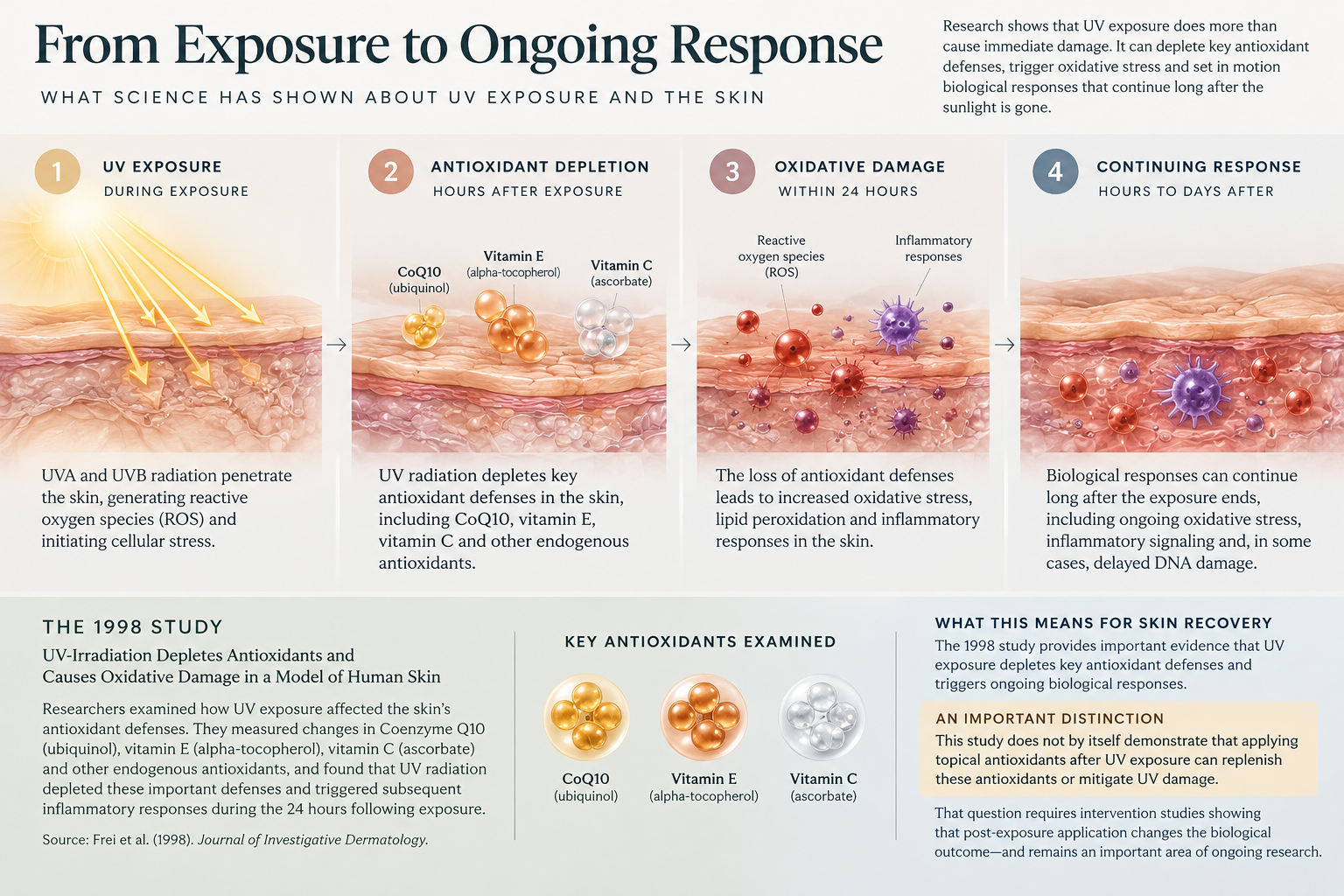
From Exposure to Ongoing Response: This infographic illustrates what research has revealed about the skin’s response to ultraviolet exposure. UV radiation can deplete important antioxidant defenses—including CoQ10, vitamin E and vitamin C—contributing to oxidative stress and inflammatory responses that may continue after exposure ends. The research helps explain why the post-exposure period deserves greater scientific attention, while importantly not establishing that topical application of these antioxidants after exposure can reverse or mitigate UV-induced damage.
Then There’s the Skin Barrier
Not every consequence of outdoor exposure happens at the cellular level.
Some are much easier to see and feel.
After a long winter day outside, your skin might feel:
tight. Dry. Rough. Chapped. Irritated.
That’s your skin telling you something.
The outermost portion of the epidermis—the stratum corneum—forms a remarkably effective barrier between your body and the environment.
That barrier depends partly upon an organized matrix of lipids surrounding skin cells.
Cold temperatures, low humidity, wind, repeated washing, sweat and other environmental conditions can challenge that barrier.
When barrier function is compromised, water can escape from the skin more readily through a process called transepidermal water loss, or TEWL.
And once again, walking indoors doesn’t instantly restore everything to baseline.
Your skin now has work to do.
Your Skin Is Built to Recover
This is an important point.
Skin isn’t passive. It is a living organ with extraordinarily sophisticated protective, repair and homeostatic systems.
Skin continuously renews itself. It regulates inflammation. It maintains antioxidant defenses. It repairs its barrier. Cells respond to stress. Damaged components are repaired, recycled or removed.
But those systems don’t necessarily operate with the same efficiency throughout our lives.
As skin ages, some of its natural protective and recovery capabilities change. Epidermal turnover slows. Barrier recovery can take longer. Sebum and lipid production decline. Antioxidant defenses and aspects of DNA repair can become less efficient. Collagen synthesis declines while cumulative environmental damage continues to accumulate.
That creates an important intersection between aging and exposure.
A 25-year-old and a 65-year-old can spend the same six hours outdoors, but they aren’t necessarily bringing the same biological resources to the recovery process afterward. And for someone who has spent decades skiing, cycling, farming, coaching, hiking, sailing, or simply living life outdoors, today’s exposure is occurring on top of a lifetime of previous exposure.
This is one reason we use the term Skin Longevity.
The goal of skincare shouldn’t be to pretend that a balm or serum somehow replaces the skin’s own protective and recovery systems.
It can’t.
A more useful question is:
As those systems change with age, how can we better support the environment in which the skin’s own protective and recovery processes operate?
That’s where post-exposure skincare becomes particularly interesting and important.
Protect → Replenish → Recover
At SUI WASSER, we’ve started thinking about outdoor skincare as a continuous cycle rather than a single defensive step.
PROTECT
Before and during exposure.
Broad-spectrum sunscreen. Protective clothing. Hats. Shade. Appropriate equipment. Limiting unnecessary exposure.
These remain the foundation.
REPLENISH
After exposure.
Restore lipids and emollients to skin that has spent hours exposed to wind, cold, dry air, sun, sweat or water.
Support the physical barrier and reduce unnecessary moisture loss.
RECOVER
Give the skin an environment supportive of its normal recovery processes.
This is where ingredients such as antioxidants, barrier-supporting lipids and soothing compounds become particularly interesting—and where emerging research into biological photoprotection may eventually expand our understanding considerably.
Then we do it again.
Protect → Replenish → Recover → Repeat.
Because for people who live life outdoors, exposure isn’t something that happens once.
It’s cumulative. It’s weekly. It’s monthly. It’s season after season.
One Day Isn’t the Real Story
A six-hour bike ride matters.
So does a full day skiing.
But when we think about Skin Longevity, we’re interested in something larger.
What happens after:
5 years outdoors?
10 years?
20 years?
40 years?
Outdoor professionals, athletes, coaches, instructors, farmers, construction workers, guides, sailors and people who simply love being outside may accumulate thousands upon thousands of hours of environmental exposure during their lives.
And there is a hard truth behind that conversation.
In Colorado, recent National Cancer Institute data show melanoma incidence in several mountain counties substantially above the statewide rate. From 2018–2022, the age-adjusted incidence of melanoma was 42.6 cases per 100,000 people in Chaffee County, 40.1 in Pitkin County and 35.0 in Routt County—compared with 22.1 statewide.
Those statistics do not tell us that altitude or outdoor exposure alone caused those cancers. Skin cancer risk is influenced by many factors, including genetics, skin type, age, behavior and cumulative ultraviolet exposure. But the numbers are difficult to ignore—particularly for communities where outdoor recreation, outdoor occupations and high-altitude UV exposure are woven into everyday life.
And Colorado isn’t the only place researchers have noticed the relationship. Studies of alpine populations have investigated associations between altitude, ultraviolet exposure and melanoma incidence, adding another dimension to the question of what a lifetime outdoors means for our skin.
That cumulative exposure is part of what researchers increasingly describe as the skin exposome—the total collection of environmental and lifestyle exposures that influence how skin changes throughout life.
And that leads us to a broader idea.
Perhaps outdoor skincare shouldn’t only be about preventing tomorrow’s sunburn. Perhaps it should also be about supporting the skin between exposures—for decades.
The Recovery Window
This is where SUI WASSER’s research interest is increasingly focused. We’re interested in what happens during the minutes and hours after environmental exposure.
What biological processes remain active?
How long do they remain active?
Which processes can meaningfully be influenced?
Which ingredients have credible evidence behind them?
And where does cosmetic skincare stop and biology take over?
We don’t have all of those answers.
Science doesn’t have all of them either.
But research into oxidative stress, inflammatory signaling, barrier biology, DNA photodamage and biological photoprotection is beginning to give us a much more sophisticated picture of what happens after exposure.
And that picture suggests something remarkably simple:
Coming inside doesn’t necessarily mean the exposure story is over.
Your skin may still be responding.
So protect it before you head outside.
Take care of it while you’re there.
And when you finally come back inside—
don’t forget about what happens next.
FROM EXPOSURE TO RECOVERY
The outdoor day may be over. Your skin’s recovery isn’t.
That’s why we built Après Sport Balm and Recovery+ Balm as two distinct steps in a post-exposure routine.
APRÈS SPORT — REPLENISH
After exposure, Après Sport is designed to flood your skin with antioxidants, replenish barrier-supporting botanical oils and help counter the oxidative stress associated with long days in the sun and elements.
Think of Après Sport as the first response after exposure—replenish what the outdoors took and support your skin as its natural recovery processes begin.
RECOVERY+ — RECOVER
Then, before bed, Recovery+ provides your skin with an overnight, nutrition-rich bath of Squalane, THDA Vitamin C, CoQ10, Vitamin E, Meadowfoam Seed Oil and Bisabolol—deeply conditioning and replenishing your skin while its natural repair and renewal processes are underway.
MADE FOR THE SKIN THAT TAKES THE EXPOSURE
Both balms are designed for use wherever outdoor life takes a toll—face, cheeks, nose, lips, neck, hands, arms, elbows and other exposed areas. Use them where your skin feels dry, depleted, weathered or simply in need of replenishment after a day outdoors.
The routine is simple:
EXPOSURE → REPLENISH → RECOVER → REPEAT
Après Sport after exposure. Recovery+ overnight.
Because Skin Longevity isn’t only about protecting your skin before you head outside. It’s also about how you care for it after you come back in.
That’s Post-Exposure Skincare.
A note from SUI WASSER
SUI WASSER develops skincare for people who live life outdoors. Our interest in post-exposure skincare and Skin Longevity is rooted in emerging and established research into environmental skin exposure, barrier function, oxidative stress, inflammation and photobiology.
At SUI WASSER, we think of our balms as a nutrient-rich bath for your skin. Our formulas combine carefully selected botanical oils, lipids, antioxidants and barrier-supporting ingredients designed to replenish and condition skin after life outdoors. We don’t add perfumes, artificial fragrances or ingredients simply to make a formula smell or look a certain way. Every ingredient needs a reason to be there. The result is deliberately rich, concentrated skincare built around what your skin needs—not the extras it doesn’t.
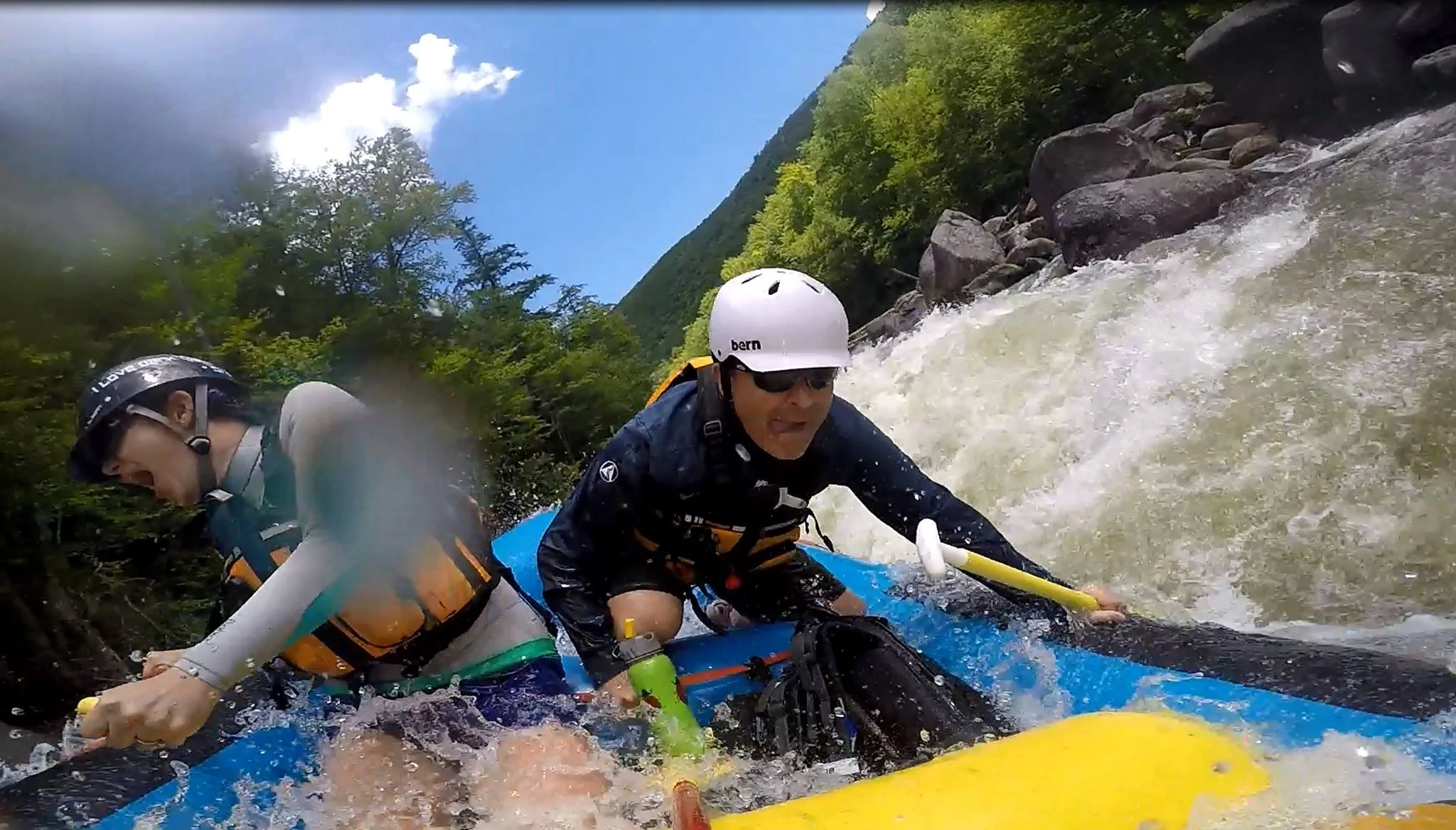
Whitewater Rafting on the Upper Section Deerfield River, Western Massachusetts.
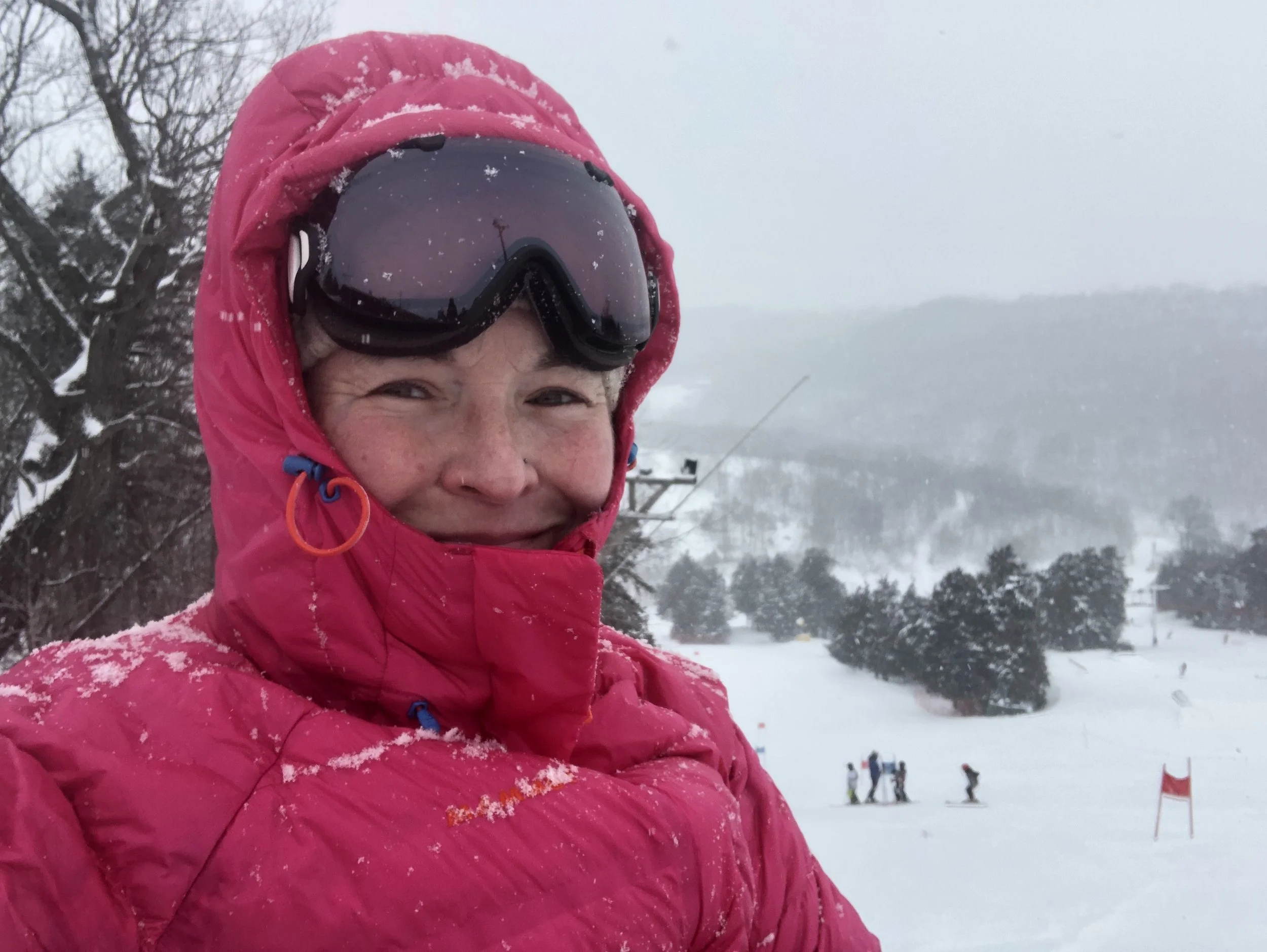
ABOUT THE FOUNDER & AUTHOR
Founder Mya Schaefer came to skincare through a lifetime spent outdoors.
A former competitive ski racer, U.S. Ski Team D-Team member and NCAA All-American, Mya later worked as a ski-area manager and has spent decades coaching alpine ski racing. Her life has been shaped by environments where sun, wind, cold, altitude and dry air aren’t occasional exposures—they’re simply part of the day.
That experience also meant decades of accumulated exposure.
Over time, Mya became increasingly interested in what happens to skin after we come back inside. Sunscreen, protective clothing and other preventative measures are essential, but exposure doesn’t necessarily end the moment we step out of the sun, off the mountain or away from the wind.
That question became deeply personal after losing two close friends and her mother to skin cancer within four years.
Those experiences changed the direction of SUI WASSER.
Rather than approaching skincare primarily as beauty or cosmetics, Mya began looking at it through the lens of long-term skin health and outdoor exposure: How does skin respond after environmental stress? How do those responses change as we age? And what can topical skincare realistically do to support the skin’s own barrier, antioxidant, inflammatory and recovery systems?
Those questions became the foundation of SUI WASSER’s work in Outdoor Skincare, Post-Exposure Skincare and Skin Longevity.
SUI WASSER isn’t built around the idea that one miracle ingredient can undo a lifetime outdoors. It’s built around a more practical idea:
Protect before exposure. Replenish after exposure. Support recovery. Repeat—for a lifetime outdoors.
Further Reading
Premi, S., et al. (2015). Chemiexcitation of Melanin Derivatives Induces DNA Photoproducts Long After UV Exposure. Science, 347(6224), 842–847.
This landmark study demonstrated that certain forms of UV-induced DNA damage can continue developing for more than three hours after ultraviolet exposure ends. The findings reveal an important dimension of skin biology: some damaging processes can continue even after the environmental exposure has stopped.
Premi S, et al. — Chemiexcitation of Melanin Derivatives Induces DNA Photoproducts Long After UV Exposure
The landmark 2015 Science paper demonstrating that cyclobutane pyrimidine dimers (CPDs) can continue to form in melanocytes after UV exposure has ended.
Read the study →
National Cancer Institute — Ultraviolet Radiation and Skin Cancer
Background on ultraviolet radiation, DNA damage, and the relationship between cumulative UV exposure and skin cancer.
Learn more →
Lin TK, Zhong L, Santiago JL — Anti-Inflammatory and Skin Barrier Repair Effects of Topical Application of Some Plant Oils
A review examining skin-barrier function, inflammation, oxidative stress, and the effects of several topical plant oils.
Read the review →
SUI WASSER — What Is Post-Exposure Skincare?
Why outdoor skincare shouldn't necessarily end when environmental exposure ends—and how replenishment and recovery fit alongside protection.
Read the article →
SUI WASSER — Aging Skin, Outdoor Exposure, and Skin Longevity
A closer look at cumulative environmental exposure, how skin changes with age, and why supporting skin over decades matters for people who live life outdoors.
Read the article →
SUI WASSER — Why Does SUI WASSER Exist?
The story behind our focus on outdoor skincare, post-exposure recovery, and Skin Longevity.
Read the story →
Explore SUI WASSER Outdoor Skincare
Discover our balms and recovery-focused skincare formulated for people who live life outdoors.
Explore the products →
