Arnica on the Skin: What Actually Happens After You Apply It?
Introduction: My relationship with Arnica goes back 4-decades.
For years, I’ve used various forms of ‘Arnica’ to soothe leg pain—the legacy of a lifetime of ski racing, hard crashes, and injuries. Sometimes it seemed to help considerably. Other times, the results were underwhelming. The variability fascinated me. So I began to look into and question the “Arnica” I was purchasing and applying. I wanted to understood why the results were not consistant. Was Arnica itself inconsistent, or did the way it was prepared and delivered to the skin make a difference? Those were the questions I began to research.
The findings eventually became part of the thinking behind our formulation of Trail Recovery+ balm. Rather than simply accepting that “Arnica works,” I wanted to understand what compounds in Arnica may be responsible for its effects, whether those compounds actually penetrate the skin, and whether the formulation carrying them influences what happens after application.
As it turns out, scientists have been asking many of the same questions. And the research suggests something important: when it comes to Arnica, the formulation and preparation may matter almost as much as the ingredient itself.
In this article, we’ll follow Arnica from the flower, through extraction and formulation, onto—and potentially into—the skin. Along the way, we’ll explore why some Arnica products may behave differently from others, what researchers believe compounds such as helenalin may do once they enter the skin, and why that science influenced the way we formulated Trail Recovery+.
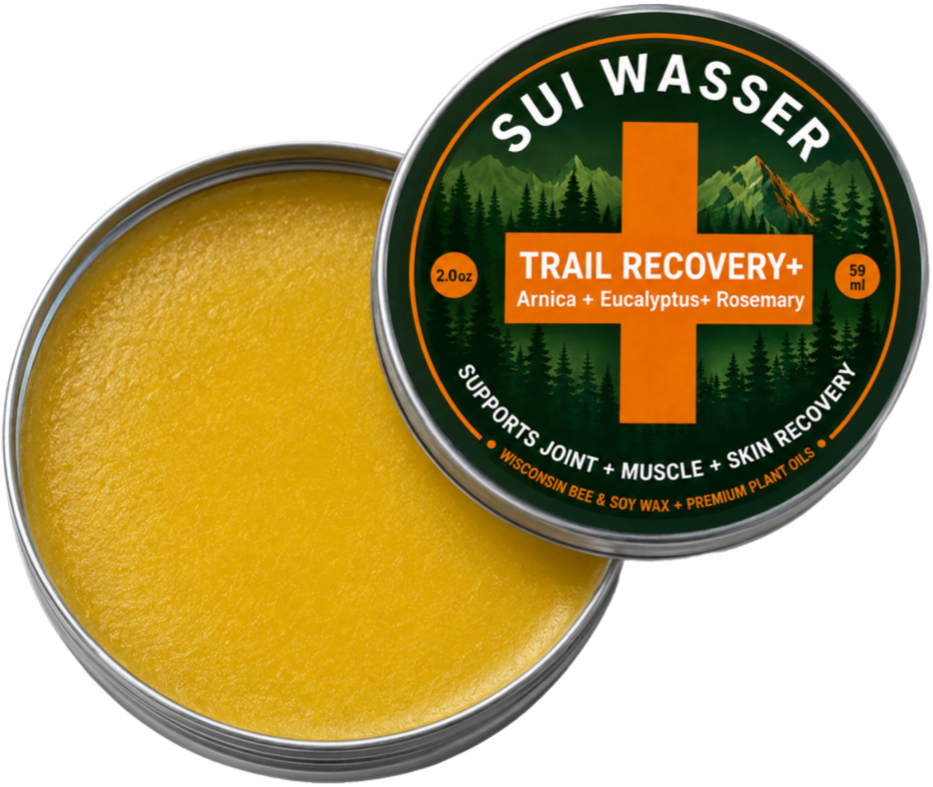

TIP: How to Best Use & Apply Trail Recovery+ Balm
Before we dive into the science, if you’re new to Trail Recovery+, it can be applied to sun- or element-stressed skin. As with any new skincare product, we recommend testing a small area first.
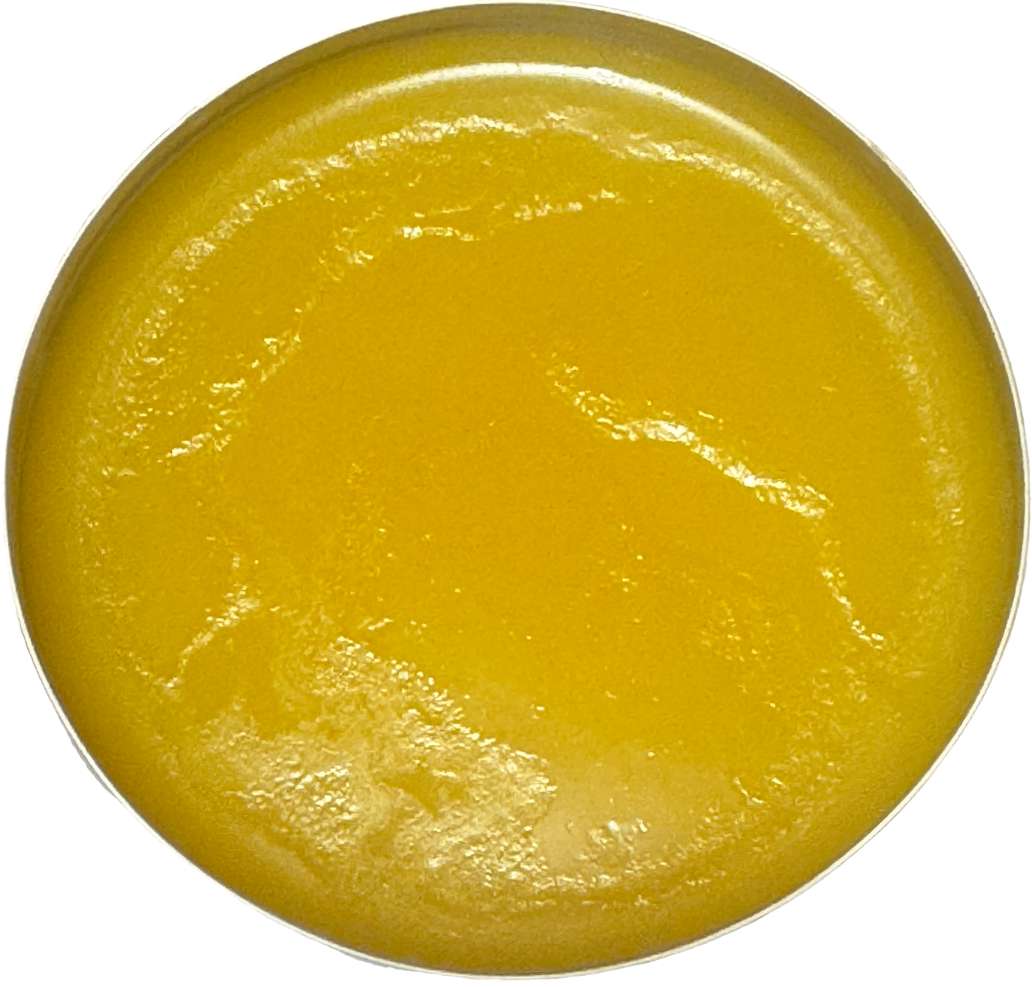
When applying Trail Recovery+, use a generous amount and gently massage a layer over the intended area until the balm is evenly distributed and begins to settle into the skin. Don’t be in a hurry to rub it away—the balm is designed to leave a light, persistent layer on the skin.
Trail Recovery+ can be applied at any time of day, but we especially recommend applying it before bed, giving the balm prolonged, undisturbed contact with the skin overnight.
For external use only. Do not apply to broken skin.
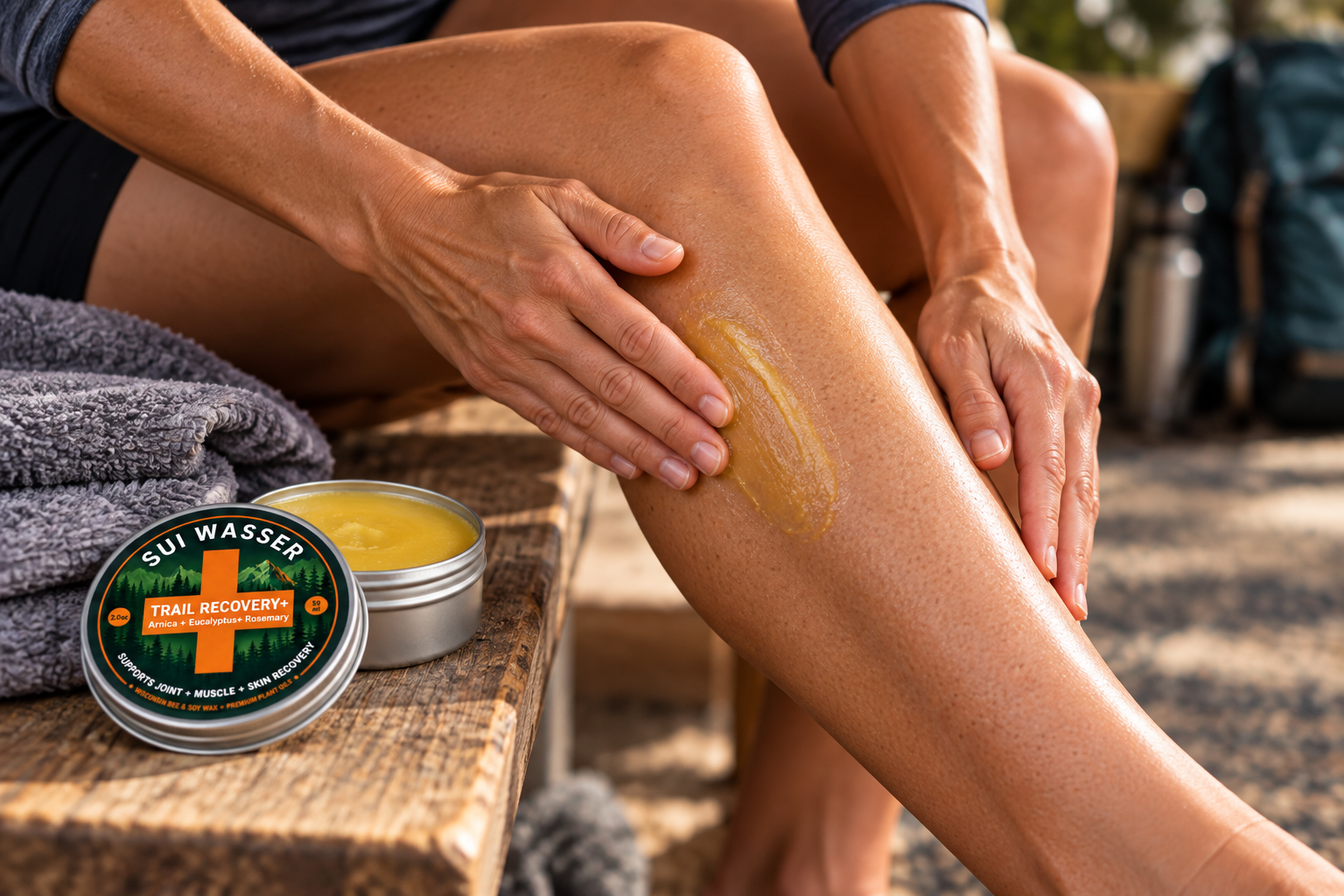
Apply Trail Recovery+ Balm anytime, but we highly recommend applying it before bed.
Arnica on the Skin: What Actually Happens After You Apply It?
Arnica has been used topically for generations. But can its active compounds actually penetrate the skin? What happens when they get there? And does the formulation carrying Arnica change the answer?
For generations, people have reached for Arnica after bruises, bumps, strenuous activity, and long days spent working their bodies hard.
Its reputation is hardly new. Arnica montana, a yellow flowering plant native to mountainous regions of Europe, has a long history of topical use. Today you’ll find it in everything from gels and creams to ointments, oils, and balms.
But tradition isn’t the question we’re interested in.
What does the science actually tell us happens after Arnica is applied to the skin?
Do Arnica’s biologically active compounds simply sit on the surface?
Can they penetrate the skin?
If they do, where do they go?
What might they do once they get there?
And perhaps most interestingly for us at SUI WASSER:
Does the formulation carrying Arnica change what happens next?
Let’s follow the evidence.
First: What’s Actually in Arnica?
Arnica isn’t a single chemical compound.
The flower contains a complex mixture of naturally occurring substances, including flavonoids, phenolic compounds, essential-oil constituents, and a particularly interesting family of compounds known as sesquiterpene lactones.
Among the most studied are derivatives of helenalin and dihydrohelenalin.
These compounds are considered important contributors to Arnica’s biological activity, and researchers have spent decades investigating how they interact with biological systems.
There’s an important detail here, however.
Not all Arnica is chemically identical.
Studies examining Arnica montana have found that the concentration and relative proportions of its sesquiterpene lactones can vary according to factors including plant source and chemotype.
That’s our first lesson:
An ingredient name doesn’t tell us everything about an ingredient.
Where it came from, how it was grown, which portion of the plant was used, how it was extracted, how much is present, and how it was formulated can all matter.
That’s a theme we’ll return to.
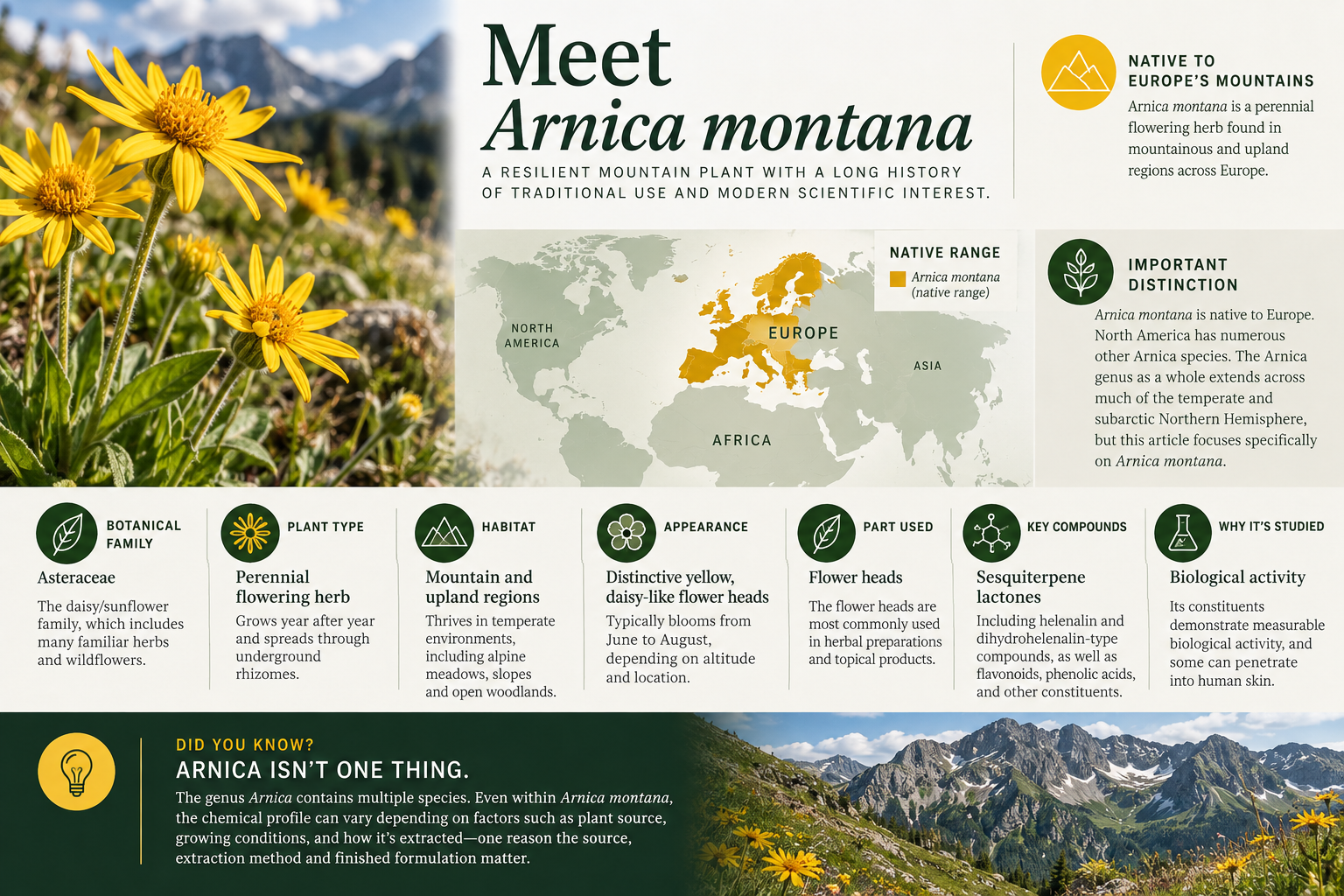
Introducing Arnica montana. It’s important to note that ARNICA ISN’T ONE THING. The genus Arnica contains multiple species. Even within Arnica montana, the chemical profile can vary—one reason the source, extraction method and finished formulation matter.
Can Arnica’s Compounds Actually Penetrate the Skin?
This is where things become particularly interesting. Researchers have directly investigated whether Arnica’s sesquiterpene lactones can penetrate human skin. They can.
In a 2004 laboratory study examining topical Arnica preparations, researchers found that sesquiterpene lactones penetrated into and permeated through the stratum corneum—the outermost portion of our skin barrier.
But the researchers discovered something else: The preparation mattered. The behavior of the complete Arnica preparation differed from that of isolated sesquiterpene lactones.
That raises an important formulation question. An ingredient doesn’t interact with our skin in isolation. It arrives within a vehicle—perhaps water, alcohol, oil, gel, cream, ointment, or balm—and that surrounding formulation can influence what happens after application.
More recent research took the question further.
In a study examining both porcine and human skin, researchers found that Arnica sesquiterpene lactones accumulated within the skin, particularly within the epidermis, while comparatively smaller quantities completely permeated through it.
Think about what that means.
The compounds weren’t necessarily just sitting on top of the skin.
Nor were they simply passing straight through it.
Significant amounts were being retained within the skin itself.
That leads naturally to another question.
What Might Arnica Do Once It’s There?
One of the most investigated Arnica constituents is helenalin.
And to understand why scientists find helenalin interesting, we need to briefly step inside the cell.
Our bodies contain extraordinarily complex signaling networks that allow cells to respond to injury, pathogens, environmental stress, and other challenges.
One important signaling system involves a protein complex called:
NF-κB — nuclear factor kappa B.
NF-κB plays an important role in regulating immune and inflammatory responses.
When certain cellular stress signals occur, NF-κB can become activated and influence the expression of numerous genes involved in the body’s inflammatory response.
Very broadly, we can visualize part of that process like this:
Tissue stress or injury
↓
Cellular signaling
↓
NF-κB activation
↓
Expression of inflammatory mediators
Laboratory research has shown that helenalin can interfere with this pathway.
Early research demonstrated inhibition of NF-κB activation by helenalin, while subsequent mechanistic work identified interactions involving the p65 component of NF-κB and its ability to bind DNA.
That gives scientists a plausible biochemical mechanism through which some Arnica constituents may influence inflammatory signaling.
But there is an important distinction.
A demonstrated cellular mechanism is not the same thing as demonstrating that a finished topical product will treat an injury or medical condition.
Concentration matters.
Delivery matters.
Formulation matters.
The condition of the skin matters.
And biological systems are considerably more complicated than any single pathway.
That’s why mechanistic research is fascinating—but it shouldn’t be turned into a medical promise.
Arnica Isn’t Simply an “Anti-Inflammatory Plant”
This is another place where the science becomes more nuanced than typical ingredient marketing.
Sesquiterpene lactones are biologically active molecules.
That’s precisely what makes them interesting.
But biological activity isn’t automatically synonymous with benefit.
Research suggests that the effects of Arnica’s sesquiterpene lactones can depend upon concentration and biological context. Arnica can also cause skin sensitization and allergic contact dermatitis in susceptible individuals.
A systematic review of the available evidence found evidence for anti-inflammatory activity in a number of experimental systems while also identifying inflammatory and sensitization responses under other circumstances.
Clinical research is similarly mixed.
Some controlled studies have reported benefits from topical Arnica preparations. For example, one randomized study examining experimentally induced bruising found that a topical 20% Arnica preparation performed better than petrolatum for reducing bruising in that particular model.
Other studies and applications have produced less compelling results.
So the scientifically responsible conclusion isn’t:
“Arnica works.”
Nor is it:
“Arnica doesn’t work.”
The more interesting conclusion is that Arnica contains biologically active compounds with identifiable cellular mechanisms, some of those compounds can penetrate human skin, and clinical outcomes appear to depend upon the preparation, concentration, application, and condition being studied.
And that brings us to the question that originally led us down this rabbit hole.
Does the Formulation Matter?
At SUI WASSER, we spend considerable time thinking about ingredients.
But increasingly, we’re asking another question:
What carries those ingredients to the skin?
Because an impressive ingredient list isn’t necessarily an impressive formulation.
Researchers studying Arnica have actually investigated this question.
In one experiment comparing Arnica preparations, researchers examined the penetration behavior of sesquiterpene lactones delivered through different topical formulations.
They found that penetration from an Arnica gel decreased over a four-hour period.
From the ointment preparations, however, penetration remained comparatively constant during that period.
Their conclusion was particularly relevant to formulation science:
Skin penetration depended not only upon concentration, but also upon the type of formulation used.
That’s an important finding.
It means asking “Does Arnica penetrate the skin?” may be an incomplete question.
We may also need to ask:
What is carrying the Arnica?
Why Trail Recovery+ Is a Balm
And this brings us to Trail Recovery+.
When we formulated Trail Recovery+, we didn’t put Arnica into a rapidly evaporating spray.
We begin with Arnica infused into sunflower oil.
That Arnica-infused oil is then incorporated into an anhydrous balm alongside Meadowfoam Seed Oil, Sea Buckthorn Berry Oil, Eucalyptus, Rosemary, waxes, and other components of the formulation.
There’s a practical reason for that architecture.
We wanted the formulation to stay on the skin.
A balm creates a persistent lipid layer rather than disappearing shortly after application. That layer conditions the skin, can help reduce moisture loss, and maintains contact between the formulation and the skin over time.
And published Arnica research raises an intriguing question about that decision:
Could prolonged contact between an Arnica-containing lipid formulation and the skin influence the delivery and retention of Arnica’s constituents?
The existing research gives us reason to ask the question.
It does not, however, allow us to claim that Trail Recovery+ delivers more Arnica compounds into the skin than another formulation.
We haven’t performed that experiment.
And there’s another important limitation.
Our Arnica Isn’t the Same Arnica Used in These Studies
Much of the published Arnica penetration research has examined standardized extracts, tinctures, gels, creams, or ointments.
Trail Recovery+ uses Arnica-infused sunflower oil.
Oil maceration is an established method of preparing Arnica extracts, and published safety literature describes Arnica preparations produced through extraction into vegetable oils.
But extraction method matters.
An oil infusion should not automatically be assumed to contain the same concentrations or proportions of helenalin, dihydrohelenalin derivatives, or other compounds as an ethanolic extract or standardized pharmaceutical preparation.
And without analytical testing of our particular Arnica infusion, we don’t know its precise sesquiterpene-lactone profile.
We think that’s worth saying.
Science isn’t strengthened by pretending to know something we haven’t measured.
The Bigger Lesson: There Are No “Hero Ingredients”
This investigation also illustrates something we’ve discussed elsewhere in the Skin Longevity Library.
Skincare marketing loves hero ingredients.
Arnica. Retinol. Vitamin C. Niacinamide. Sea Buckthorn.
Pick an ingredient, place it prominently on the label, and build a story around it.
But biology doesn’t read labels.
The presence of an ingredient tells us surprisingly little without knowing more.
Which chemical constituents are present?
At what concentrations?
How were they extracted?
Are they stable?
What is carrying them?
How long does the formulation remain on the skin?
Can those compounds penetrate the skin?
Where do they accumulate?
And what happens biologically when they get there?
Those questions are much harder than simply asking whether a product “contains Arnica.”
They’re also considerably more interesting.
From Flower to Skin
So what happens when you rub Arnica onto your skin?
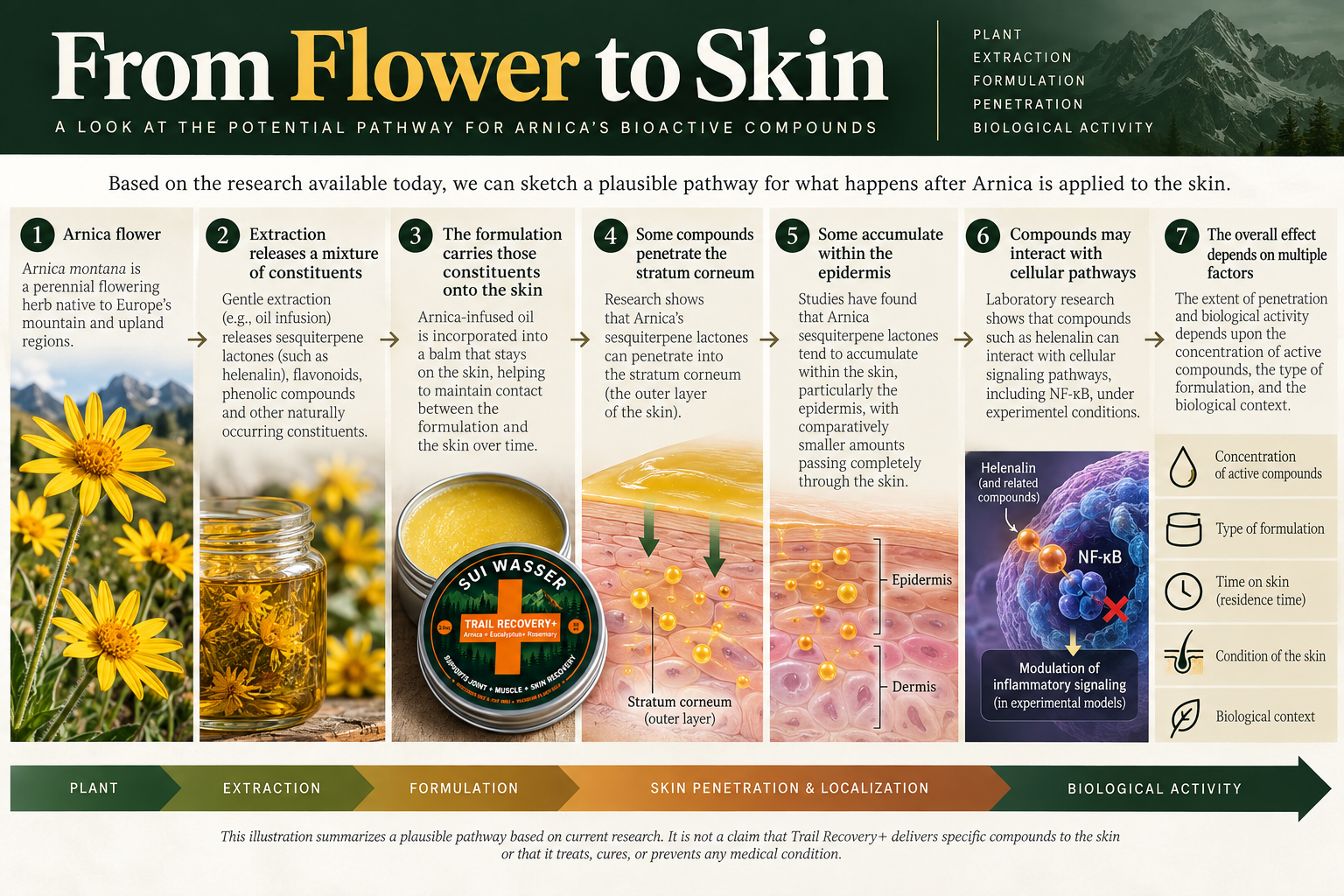
Based on the research available today, we can sketch a plausible pathway:
Arnica flower
↓
Extraction releases a mixture of botanical constituents
↓
The formulation carries those constituents onto the skin
↓
Some sesquiterpene lactones penetrate the stratum corneum
↓
Some accumulate within the epidermis
↓
Compounds such as helenalin can interact with cellular signaling pathways, including NF-κB, under experimental conditions
↓
The extent of penetration and biological activity depends upon concentration, formulation, and biological context
That’s much more interesting than saying:
“Arnica is good for sore muscles.”
It’s also much more accurate.
And it leaves us with another question we’re interested in answering.
What exactly is in our own Arnica infusion?
One logical next step for SUI WASSER would be analytical characterization of the Arnica-infused sunflower oil used in Trail Recovery+—potentially using techniques such as HPLC or LC-MS to identify and quantify its sesquiterpene-lactone profile.
Then we could stop asking what might be in our particular infusion.
We could measure it.
That’s how better questions eventually become better formulations.
A Note About Trail Recovery+
Trail Recovery+ was formulated for the places that take the most punishment from an active life outdoors—tired legs, hard-working muscles and joints, and skin stressed by sun, wind, cold and the elements. We built it around Arnica-infused sunflower oil, Eucalyptus, Rosemary, Sea Buckthorn and a persistent balm base designed to keep those botanicals in contact with the skin.
The research discussed in this article helps explain why Arnica has remained such an interesting topical botanical and why formulation matters. Where the science concerns individual Arnica compounds or experimental preparations rather than Trail Recovery+ itself, we say so. Our goal isn’t to make the science bigger than it is. It’s to use the science to build better products.
Use on intact skin only. If you’re new to Arnica or have sensitive skin, test a small area first. Arnica may cause a reaction in people sensitive to plants in the Asteraceae family.
Further Reading
If you'd like to explore the science behind this article in greater depth, these studies provide useful background on Arnica, its sesquiterpene lactones, skin penetration, formulation, and clinical research.
Skin Penetration Studies of Arnica Preparations and of Their Sesquiterpene Lactones
Research examining how Arnica's biologically active sesquiterpene lactones penetrate the stratum corneum—and how the preparation itself can influence penetration.Dermal Absorption of Sesquiterpene Lactones from Arnica Tincture
A 2022 investigation using porcine and human skin that examined where Arnica sesquiterpene lactones go after topical application, including their accumulation within the skin.Accelerated Resolution of Laser-Induced Bruising with Topical 20% Arnica: A Rater-Blinded Randomized Controlled Trial
A controlled clinical study comparing topical Arnica with petrolatum and vitamin K formulations in experimentally induced bruising.Trail Recovery+ Balm: Why I Built It This Way
Our earlier look at the formulation philosophy behind Trail Recovery+, including why we chose Arnica-infused oil and the supporting ingredients surrounding it.Scientific research discussed here relates to Arnica montana, its constituents, or specific experimental Arnica preparations. Results from those studies should not be interpreted as clinical evidence for Trail Recovery+ itself.
