Eczema Awareness Month: What Eczema Can Teach Us About the Skin Barrier
October is Eczema Awareness Month—and an opportunity to better understand one of the skin’s most important jobs: maintaining a healthy barrier.
Approximately 1 in 10 people in the United States lives with eczema, according to the National Eczema Association. Eczema isn’t a single condition, but a group of inflammatory skin conditions characterized by symptoms that can include dry, itchy, irritated and inflamed skin.
At SUI WASSER, we don’t treat eczema. That’s an important distinction.
But much of the science surrounding eczema intersects with something we care deeply about: the health and function of the skin barrier.
And understanding that barrier can teach us something useful about caring for our skin—not only for people living with eczema, but for anyone whose skin regularly encounters sun, wind, cold, dry air, sweat and the other stresses that come with a life outdoors.
Your Skin Is a Barrier Between You and the World
We often think about skin in terms of how it looks.
Biologically, however, skin has a much larger job.
The outermost portion of the epidermis—the stratum corneum—helps regulate the movement of water out of the body while providing protection from the external environment. Researchers sometimes describe its structure using a “brick and mortar” model: flattened skin cells form the bricks, while an organized lipid matrix surrounding those cells helps form the mortar.
Among the important components of this barrier are proteins such as filaggrin and lipids including ceramides, cholesterol and fatty acids. Together with other structures and processes in the epidermis, they contribute to hydration, permeability and the skin’s ability to function as our interface with the environment.
That barrier is easy to take for granted.
Until it isn’t working properly.
What Happens to the Barrier in Eczema?
Atopic dermatitis—the most common form of eczema—is a complex inflammatory disease. It would be an oversimplification to describe eczema simply as “dry skin” or solely as a barrier problem.
Both immune dysregulation and abnormalities in skin-barrier function are involved, and researchers continue to study how those processes interact.
One consequence can be increased transepidermal water loss, often abbreviated TEWL.
That simply means water is escaping through the epidermis into the surrounding environment more readily than it should.
As water is lost, skin can become increasingly dry. Barrier disruption can also contribute to a cycle involving irritation and inflammation. In some people with atopic dermatitis, genetic differences affecting proteins such as filaggrin can contribute to impaired barrier function, although filaggrin is only one piece of a considerably more complicated biological picture.
This is one reason moisturization isn’t merely about making dry skin feel better.
Supporting the physical barrier itself matters.
Our skin is not separate from our environment. It is the boundary where our bodies meet it.
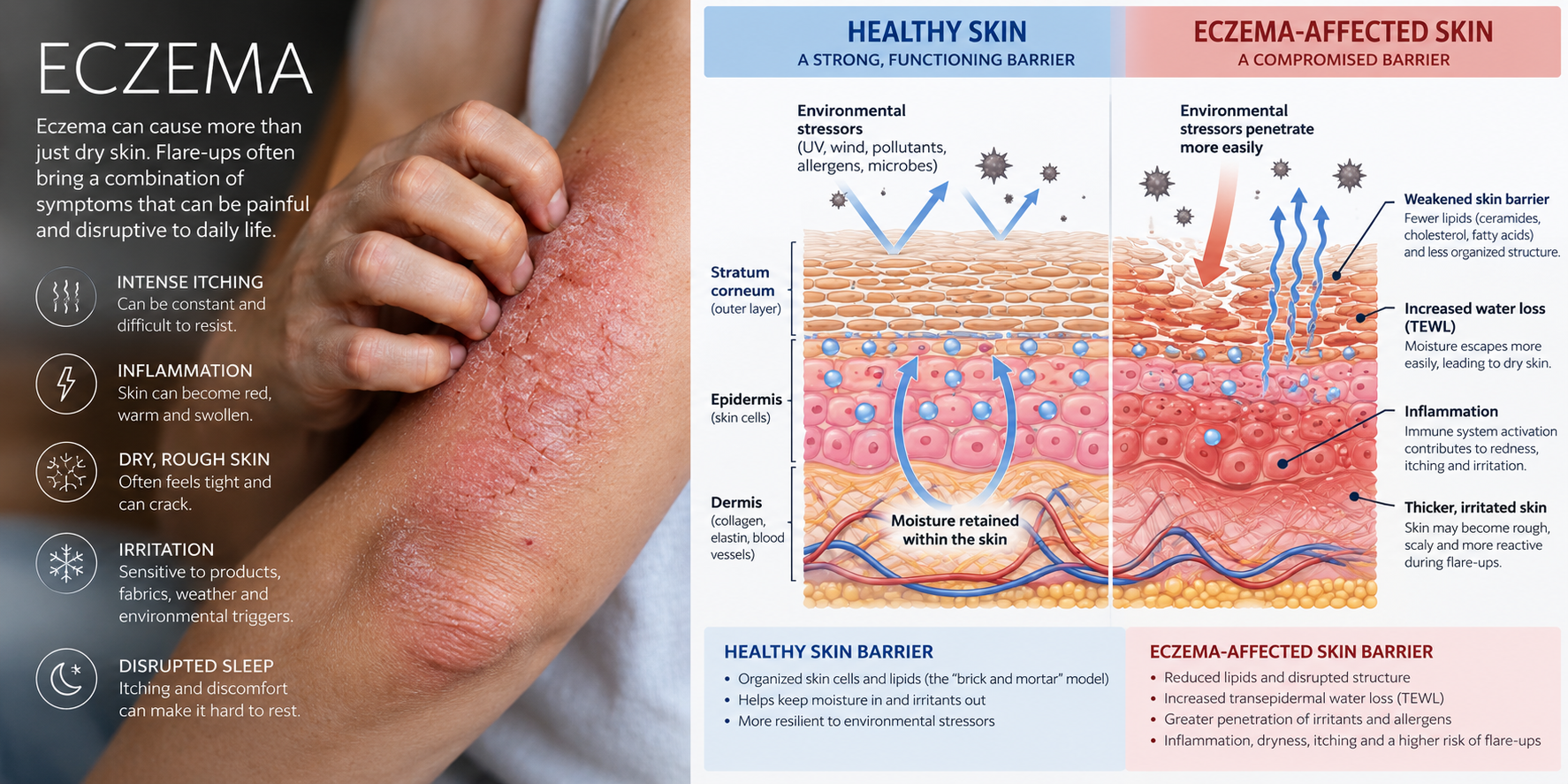
Eczema and the skin barrier: In healthy skin, the outer barrier helps retain moisture while limiting the entry of environmental irritants. In eczema-affected skin, changes to the skin barrier can increase transepidermal water loss (TEWL) and make the skin more susceptible to irritants and allergens, contributing to dryness, itching, and inflammation.
Why Moisturizers Matter
The American Academy of Dermatology recommends regular moisturization as an important part of eczema care. For atopic dermatitis, dermatologists generally recommend fragrance-free creams or ointments, particularly after bathing while the skin remains slightly damp.
Why? An occlusive or emollient-rich moisturizer can help reduce water loss and maintain hydration within the outer layers of the skin.
Think again about that brick wall. When the wall isn’t retaining water effectively, simply adding water isn’t necessarily enough. We also want to help keep that water where it belongs.
This is why the formulation and timing of moisturization matter.
The Outdoors Adds Another Dimension
For people living with eczema, individual triggers vary considerably. The American Academy of Dermatology notes that environmental factors such as dry air and sunburn can trigger flares in some people. Heat and sweating can also present challenges for some individuals.
But even without eczema, our skin continually interacts with its environment. A winter skier may experience cold temperatures, extremely dry air and wind. A sailor may encounter prolonged sun, wind, saltwater and reflected UV radiation. A cyclist or runner may experience sun, heat, sweat, wind and repeated washing. A swimmer adds chlorine or saltwater to the equation. These exposures aren’t identical, and they don’t affect everyone the same way. But they illustrate something fundamental: Our skin is not separate from our environment. It is the boundary where our bodies meet it. That is one of the central ideas behind SUI WASSER’s approach to Outdoor Skincare.
What Eczema Can Teach the Rest of Us
Eczema research has helped illuminate just how biologically important the skin barrier is.
A healthy skincare routine isn’t simply about appearance. Maintaining hydration, limiting unnecessary irritation and supporting barrier function are meaningful parts of caring for skin.
For people who spend substantial time outdoors, that suggests a simple principle:
Respect the barrier.
That can mean avoiding unnecessarily harsh cleansing, moisturizing after bathing, paying attention when skin becomes unusually dry or irritated, and considering the environmental conditions your skin has experienced during the day.
It also means recognizing that more ingredients aren’t always better.
For people with eczema in particular, dermatologists recommend caution with potential irritants. The American Academy of Dermatology recommends fragrance-free products and suggests testing new skincare products on a small area before incorporating them more broadly.
Essential oils and fragrance components can be problematic for some eczema-prone individuals, so a product being described as “natural” does not automatically make it appropriate for eczema.
That’s an important distinction for us at SUI WASSER as well.
Where SUI WASSER Fits—and Where We Don’t
SUI WASSER products are not all designed to treat eczema, and we don’t want Eczema Awareness Month to become an excuse to suggest otherwise. If you have eczema and are looking for a balm to help, we would recommend our Apres Sport Balm. Known for its calming properties, Apres Sport balm has helped many clients with their eczema
If you have eczema, particularly persistent, painful, infected or worsening eczema, working with a dermatologist or other qualified healthcare professional is the appropriate path.
What we can take from the science is something broader.
The skin barrier matters.
Hydration matters.
Lipids matter.
The environment matters.
And caring for our skin shouldn’t begin only when something goes wrong.
That’s closely connected to what we mean when we talk about Skin Longevity: caring for skin as a living organ over years and decades, particularly when we ask it to accompany us through a lifetime outdoors.
A Lifetime Outdoors
At SUI WASSER, we spend a lot of time talking about exposure.
Sun. Wind. Cold. Heat. Dry air. Altitude. Salt. Sweat. Chlorine.
But underneath all of those conversations is something even simpler:
Your skin is the part of you that meets the world first.
Eczema Awareness Month provides an opportunity to learn from people for whom maintaining that barrier can be a daily challenge—and from decades of research into why barrier function is so important.
Whether you live with eczema or simply spend a lot of your life outdoors, there is a lesson worth carrying with us:
Take care of the barrier that takes care of you.
Further Reading
National Eczema Association — Eczema Awareness Month
American Academy of Dermatology — Atopic Dermatitis: Skin Care
https://www.aad.org/public/diseases/eczema/types/atopic-dermatitis/atopic-dermatitis-coping
American Academy of Dermatology — Moisturizers and Eczema Flares
https://www.aad.org/public/diseases/eczema/insider/moisturizer-reduce-flares
PubMed — The Skin Barrier in Atopic Dermatitis
