
A “Nutrition Bath” for Aging Skin
If you’ve spent much of your life outdoors, you may have noticed something as you’ve gotten older: your skin doesn’t bounce back quite the way it used to.
A cold ski day that once left your face feeling dry for an hour may now leave it tight into the next morning. Hands exposed to wind and cold become chapped more easily. A long day on the water can leave skin feeling depleted in a way you don’t remember from twenty years ago.
That isn’t imagination. Skin changes as we age.
The barrier becomes less resilient, lipid production and composition change, water retention can decline, and antioxidant defenses and repair processes also change with age. For those of us who intend to keep skiing, sailing, running, hiking, riding, gardening, and working outdoors for decades to come, that raises an important question: Should the way we care for our skin change as our skin changes?
We think it should.
As we age, our skin doesn’t recover from environmental stress quite as efficiently as it once did. The skin barrier becomes less resilient, lipid production declines, and the antioxidant systems that help defend against oxidative stress can become less robust. After a long day outdoors—exposed to UV, wind, cold, heat, dry air, salt or sweat—older skin therefore will benefit from more support.
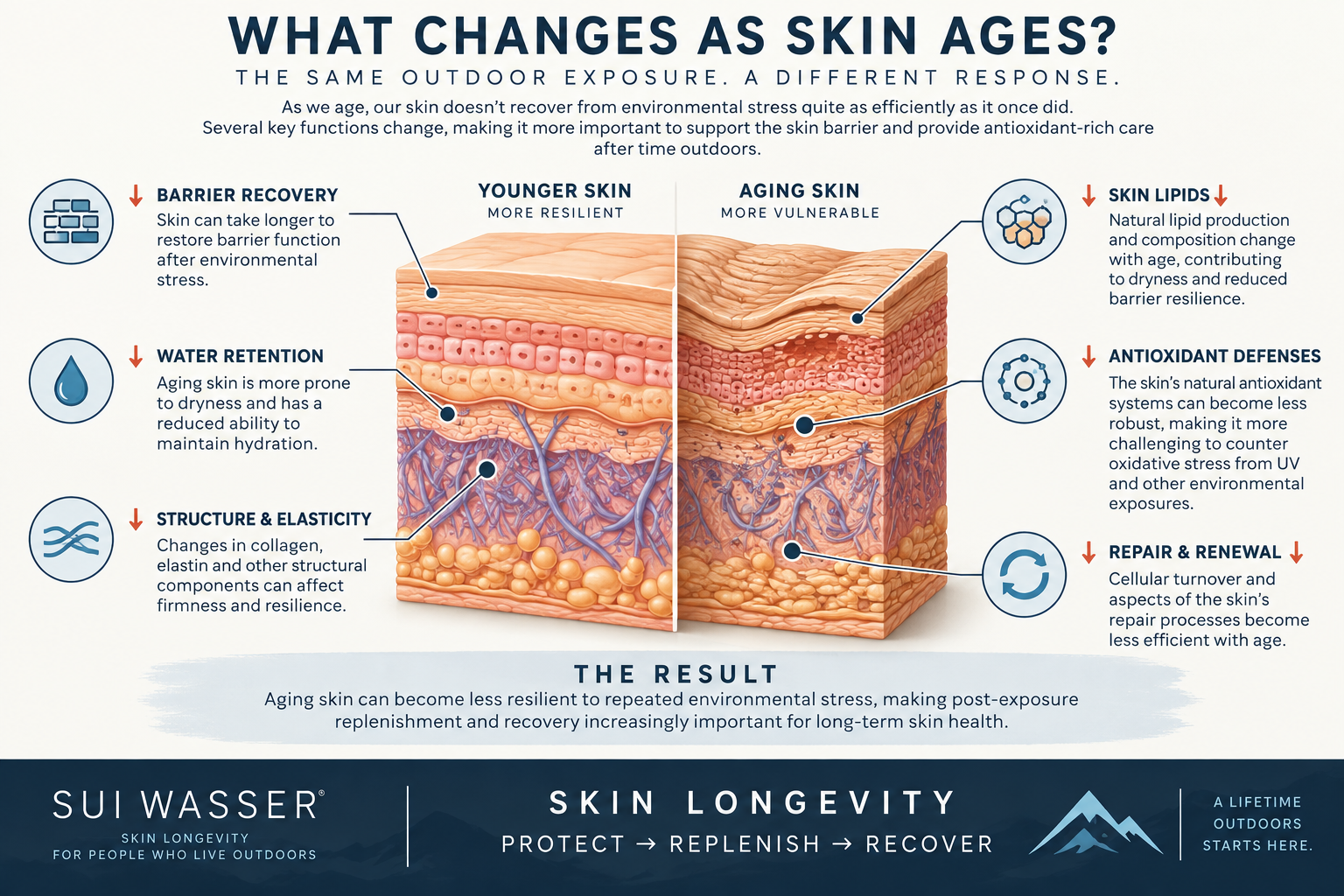
As we age, our skin doesn’t recover from environmental stress quite as efficiently as it once did. In this infographic we look at the changes our skin undergoes as we age.
We like to think of post-exposure care as giving your skin a nutrition bath: surrounding it with moisture-replenishing lipids, emollients and antioxidant-rich ingredients that help restore the barrier and support the skin as its own recovery systems go to work. It isn’t about reversing a day outdoors. It’s about giving aging skin a supportive environment in which to recover—so it can stay healthy, resilient and ready for the next adventure.
Support the barrier
A healthy barrier relies on a balanced mix of water, lipids, and well-organized skin cells. Environmental conditions can disrupt that balance. Hot showers after a cold day, aggressive cleansing after sweat and sunscreen, and dry indoor heat can add to the strain.
A straightforward recovery routine starts immediately post exposure. Don’t wait to apply an anti-oxidant rich balm. Cleansing away salt, sweat, chlorine, dirt, and sunscreen without scrubbing already stressed skin can wait till you get home. Reapply as needed. In the evening, before bed, apply an overnight recovery balm, after a gentle cleanse, while skin is still slightly damp.
The goal is not to overwhelm the skin with a complicated routine. It is to rush immediate aid to the skin to mitigate damaged caused by UV radiation. On the surface we want to help relieve, reduce, and recover what was stripped away, to relieve that tight feeling, to replenish the skin barrier, and support skin as it responds to the less visible effects of a day outdoors.
UV exposure and other environmental stressors can increase the production of reactive oxygen species (ROS)—highly reactive molecules that, when produced faster than the skin’s antioxidant defenses can neutralize them, contribute to oxidative stress. That oxidative stress can affect cellular lipids, proteins and DNA and contribute to inflammatory signaling.
Our skin has its own antioxidant defense systems, but those defenses can be challenged by repeated environmental exposure and can become less robust with age. This is one reason antioxidant-rich post-exposure balms are so interesting to us: antioxidants can help neutralize reactive species and support the skin’s natural defenses while barrier-supporting ingredients help replenish what exposure has taken away. It’s a two-part approach—help restore the barrier we can feel, while supporting the skin against oxidative stress we can’t.
Replenish what the day took away
You replenish fluids after a run because you lost them. Post-exposure skincare follows the same logic. Hours in low humidity, cold wind, salt water, or chlorinated water can leave skin feeling as if something has been pulled out of it - because, in part, it has.
For dry or weather-stressed areas, concentrated balms can be especially useful. They are practical for cheeks, lips, hands, the nose, or any area that regularly catches wind and sun. A lighter facial product may be enough after a humid summer ride, while a richer overnight application can make more sense after a cold, high-altitude ski day. The right amount depends on the conditions, your skin, and how it feels.
Support skin’s response, without overpromising
UV exposure can contribute to oxidative stress and inflammatory signaling in skin. The body has its own antioxidant defenses and repair systems that respond to these pressures. Researchers are also studying how ingredients such as antioxidants, nicotinamide, and plant polyphenols may complement traditional photoprotection by supporting aspects of the skin’s response to environmental stress.
This is promising territory, but it calls for clear thinking. Topical skincare may support healthy-looking, comfortable skin and barrier function. It is not a license to spend more time unprotected in the sun, nor should cosmetic claims be confused with medical treatment. Think of sunscreen as the helmet. Recovery care is the ice pack, the meal, and the rest afterward.
The Myth of the Single “Hero” Ingredient
Skincare marketing often revolves around a single all-star ingredient—the antioxidant, botanical extract, vitamin, or active positioned as the reason a product works.*
But skin is a biological system, and aging skin doesn’t experience just one change. Barrier lipids can decline. Moisture retention can change. Antioxidant defenses can become less robust. Environmental exposure can contribute to oxidative stress and inflammatory signaling. No single ingredient addresses all of those needs.
That’s why we prefer to think in terms of a nutrition bath rather than a hero ingredient.
A well-designed post-exposure formula can bring together different ingredients with different jobs: emollients and lipids to condition and replenish the barrier, occlusive ingredients to help reduce moisture loss, antioxidants to help counter reactive species, and soothing ingredients to support weather-stressed skin.
The value isn’t necessarily found in one superstar ingredient. It’s in the system those ingredients create together.
Just as good nutrition isn’t built around eating one “superfood,” Skin Longevity isn’t about finding one miracle ingredient. It’s about consistently giving skin a supportive environment in which its own protective and recovery systems can do their work.
*-The obvious exception is medicated skincare, where a specific active ingredient may be used to treat a specific condition. Here, we’re talking about everyday skincare and long-term skin support.
Why recovery matters when exposure is cumulative
The challenge is rarely one exceptional day. It is Tuesday’s commute, Wednesday’s practice, Saturday’s trail run, and the next season after that. Exposure adds up across years for skiers, farmers, coaches, sailors, gardeners, construction crews, and anyone who prefers a life lived outdoors.
That is why SUI WASSER thinks about skin longevity less as chasing a younger appearance and more as maintaining a resilient organ for the long haul. The goal is to help your skin stay comfortable and healthy-looking enough to keep joining you outside, whether that means a first chair at 60, a long sail at 70, or a favorite trail at 80.
Protect, replenish, recover
A useful outdoor skincare framework is simple: protect before and during exposure, replenish what the conditions take away, and recover afterward. Use broad-spectrum sunscreen as directed, wear protective clothing, and seek shade when it is available. Then clean gently, restore moisture and lipids, and give weather-stressed skin a little attention before the next day begins.
You already maintain the gear that carries you through the outdoors. Your skin has carried you through every mile, storm, run, and season too. Treating recovery as part of the routine is a practical way to respect that work.
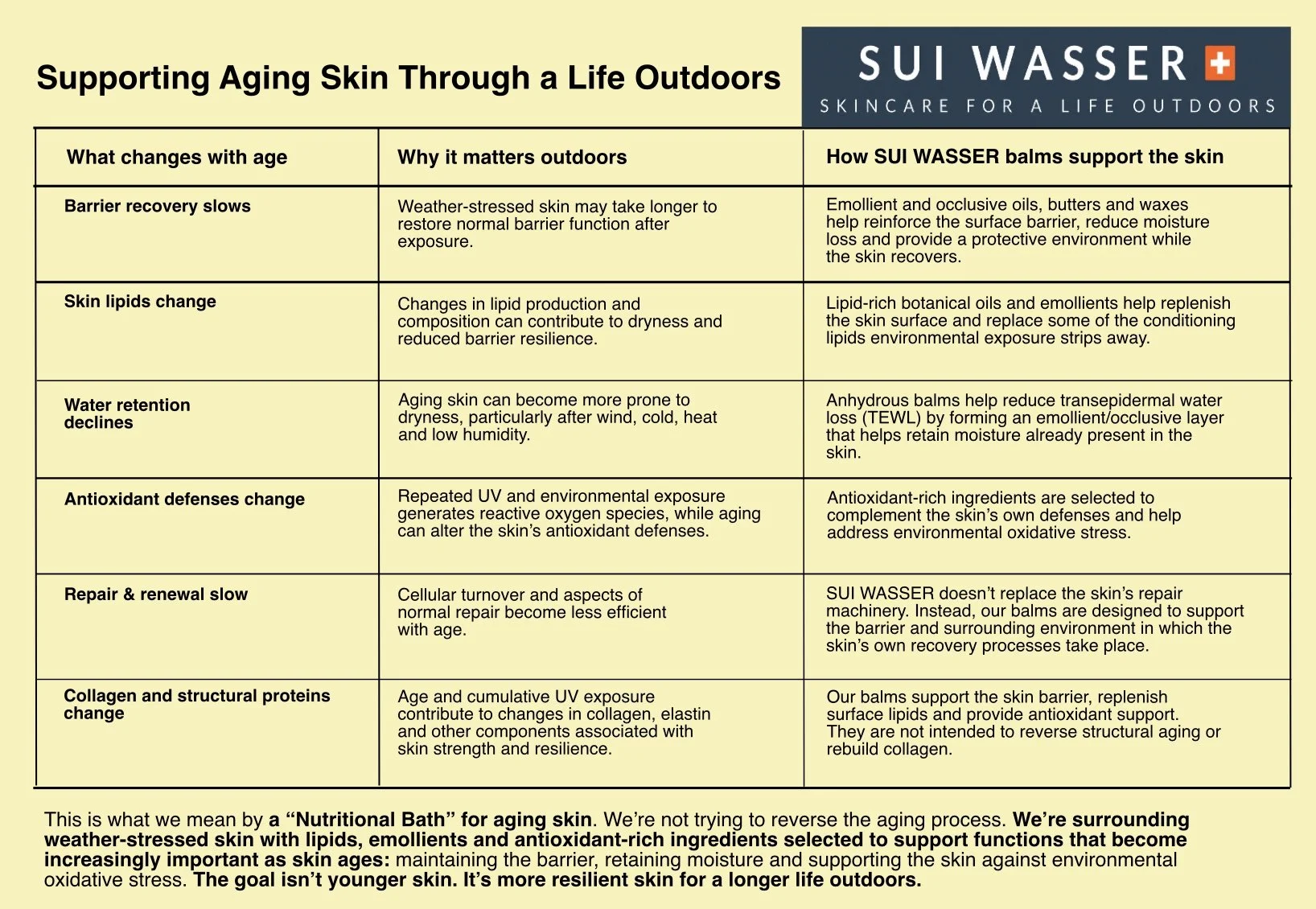
Supporting Aging Skin Through a Life Outdoors — As skin ages, changes in barrier function, hydration, lipids and antioxidant defenses can affect its resilience to environmental stress. SUI WASSER’s post-exposure approach focuses on replenishing the barrier, retaining moisture and providing antioxidant support for a lifetime outdoors.
Further Reading
SUI WASSER — Skin Barrier Lipids & Aging: What Changes as Skin Gets Older
This is probably the best internal follow-on. It goes deeper into ceramides, cholesterol, fatty acids, TEWL, and why barrier function changes with age.
Read: Skin Barrier Lipids & AgingSUI WASSER — Why Topical Antioxidants Matter More as Our Skin Ages
This naturally expands the antioxidant side of the “Nutritional Bath” concept and gets into Vitamin E, Vitamin C/THDA, CoQ10 and aging skin.
Read: Why Topical Antioxidants Matter More as Our Skin AgesSUI WASSER — New Research Puts the Skin Barrier at the Center of UV Damage
I particularly like including this one because it connects the aging/barrier discussion back to UV exposure and post-exposure recovery, while also explaining how SUI WASSER’s formulation strategy relates to the research.
Read: New Research Puts the Skin Barrier at the Center of UV DamageWu et al. — Epidermal Permeability Barrier Dysfunction Influences Acute and Chronic Skin Responses to UVA and UVB Radiation
This is the July 2026 human study we’ve discussed. The researchers experimentally impaired the skin barrier and examined subsequent UVA/UVB responses, making it directly relevant to our discussion of why barrier integrity matters.
Read the research at WileyBrown et al. — Biological Photoprotection: A Review of its Mechanisms, Evidence, and Clinical Implications
This should probably become a recurring reference throughout the Skin Longevity Library. It addresses antioxidants, oxidative damage, DNA repair, inflammation and other biological mechanisms that may complement conventional UV filtration, while also emphasizing that this remains an evolving field requiring further clinical validation.
Read the open-access paper on PubMed Central
