Skin Barrier Lipids & Aging: What Changes as Skin Gets Older
Summary: An exploration of how the skin’s lipid barrier changes with age, including the roles of ceramides, cholesterol, free fatty acids and transepidermal water loss (TEWL). The article examines how aging and environmental exposure interact and explains how emollient and occlusive skincare can support dry, weather-stressed skin as part of a broader Skin Longevity approach.A long ski day can leave your face feeling tight before you have even taken off your boots. A summer ride, a windy day on the water, or an afternoon working outside can do the same. But why does skin sometimes seem less tolerant of these stresses as we get older?
When we talk about skin aging, the conversation often centers on what we can see: fine lines, wrinkles, uneven tone, changes in texture, or loss of firmness. Some equally important changes happen at a much smaller scale.
The outermost layer of our skin—the stratum corneum—depends on an organized mixture of lipids that helps keep water in and the outside environment out. Among the most important are ceramides, cholesterol, and free fatty acids. Together, these lipids form a critical part of the skin barrier. And that barrier changes as we age.
The Skin Barrier Is More Than a Surface
The stratum corneum is often described using a “bricks and mortar” analogy. The bricks are corneocytes: flattened, mature skin cells. The mortar surrounding them is a highly organized lipid matrix composed primarily of:
Ceramides
Cholesterol
Free fatty acids
Together, these structures help regulate the movement of water through the skin while limiting the penetration of irritants and other substances from the environment. A healthy skin barrier isn’t simply about making skin feel softer. Barrier function is fundamental to maintaining healthy skin.
What Happens to Barrier Lipids With Age?
Skin does not maintain exactly the same lipid composition and recovery capacity throughout life. Research has identified age-associated changes in epidermal lipid synthesis, lipid composition, sebaceous activity, and the skin’s ability to recover following barrier disruption.
The result is something many people recognize without knowing the underlying biology: Older skin often becomes drier and can recover more slowly after environmental stress.
This doesn’t mean mature skin is inherently fragile. Climate, cleansing habits, medications, individual biology, cumulative environmental exposure, and underlying skin conditions can all affect how skin behaves. But aging can leave the skin with less margin for error.
As we age, our skincare should evolve to meet our skin’s needs. A routine that worked perfectly at 30 will no longer feel sufficient at 50 or 60—particularly after a week of skiing, cycling in dry wind, working outside, or spending a winter moving between cold outdoor air and heated indoor environments.
Skin aging, therefore, isn’t simply about seeing wrinkles forming, therefore I must add more moisturizor more frequently! It also involves and means changes in the biological systems responsible for maintaining and restoring the skin’s protective surface are changing as well.
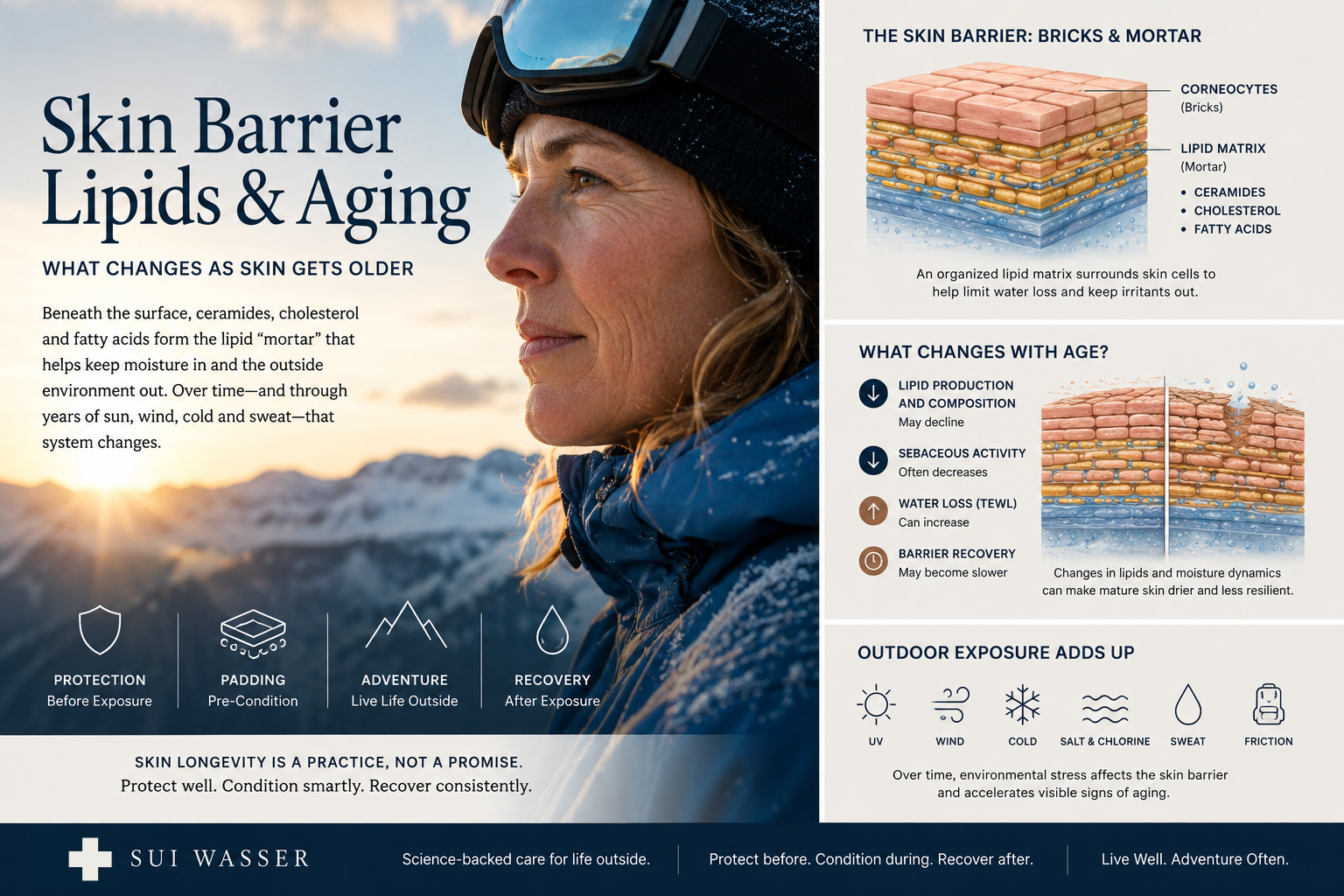
Image: As we age, our skin changes. The slide above summarizes how aging skin becomes more susceptible to moisture loss.
Ceramides: A Major Part of the Barrier
Ceramides represent a major portion of the lipid material found within the stratum corneum. Rather than being a single substance, “ceramides” describes a large family of structurally related lipids. Different ceramide classes contribute to highly organized layers between the corneocytes.
Their composition and organization matter. Changes in these lipids can influence how effectively the barrier performs its job—which is one reason ceramides have become such an important area of modern skincare research. But ceramides don’t work alone.
Cholesterol and Fatty Acids Matter Too
The skin barrier depends upon a system of lipids, not a single hero ingredient. Cholesterol contributes to the organization and physical properties of the lipid matrix, while free fatty acids have structural and physiological roles of their own.
The relationship among these different lipid classes matters. That points toward a larger principle in skincare: Healthy skin is a biological system, not an ingredient checklist. Supporting that system means thinking about the overall condition of the skin barrier rather than expecting one fashionable ingredient to solve everything.
Aging Skin Meets the Environment
Intrinsic biological aging is only part of the story. Our skin also spends decades interacting with the world around us. Sunlight is perhaps the best-known environmental stressor, but skin can also repeatedly encounter:
Low humidity
Wind
Cold
Heat
Salt water
Chlorinated water
Sweat
Friction
Repeated cleansing
Repeated wetting and drying
These exposures do not all affect skin through the same biological mechanisms. UV radiation, for example, presents a fundamentally different challenge from low humidity or friction. But over a lifetime, our skin has to respond repeatedly to all of them.
For people who spend substantial portions of their lives outdoors, this relationship between aging, environment, barrier function, and recovery becomes particularly important.
Water Loss and the Skin Barrier
Water is continuously moving from deeper layers of the skin toward the surrounding environment. This process is known as transepidermal water loss, or TEWL.
The stratum corneum helps regulate that movement. When barrier function is compromised, water can escape more readily. Skin may consequently feel dry, tight, rough, flaky, or uncomfortable.
Environmental conditions can make the challenge greater. During the winter months, cold winter air contains relatively little moisture. Heated indoor environments, during the winter, can also have very low relative humidity. Wind can increase evaporation at the skin’s surface.
A skier, outdoor worker, cyclist, runner, farmer, or anyone spending significant time outside may move repeatedly between these environments. Skin has to continually adapt.
Why Oils, Emollients and Balms Can Help
A topical balm cannot stop biological aging. It cannot replace sunscreen. And it cannot replace the skin’s own barrier. What a well-formulated balm can do, however, is help support the surface environment in which that barrier functions.
Emollient ingredients can improve the feel, softness, and flexibility of dry skin. Oils can supplement lipids at the surface. Occlusive ingredients can form a protective film that helps reduce water loss.
This can become particularly useful after exposure to conditions that leave skin feeling dry or weather-stressed.
Waterless balms approach moisturization somewhat differently from conventional lotions.
Instead of primarily delivering water, a balm supplies a concentrated mixture of lipids, emollients, skin-conditioning ingredients, and occlusive materials directly to the skin surface.
Applied after washing or while skin retains some moisture, that lipid-rich layer can help reduce subsequent moisture loss.
This is one reason balms can become particularly useful for mature, dry, and environmentally exposed skin.
Protection Comes First. Recovery Comes After.
Post-exposure skincare should never be confused with protection from UV radiation. Broad-spectrum sunscreen, protective clothing, shade, and sensible exposure remain the first line of defense against UV.
A useful analogy is sport itself: Protection is the helmet. A conditioning balm applied before sunscreen can be part of the padding underneath. Recovery is what you do afterward. The sunscreen, however, remains the protective equipment specifically designed and tested to protect against UV radiation.
Hydration, stretching, nutrition, and sleep don’t replace a helmet. Likewise, post-exposure skincare doesn’t replace sunscreen. They perform different jobs.
After outdoor exposure, a simple routine can include gentle cleansing to remove sweat, salt, chlorine, dirt, or sunscreen buildup, followed by conditioning and occlusive skincare when skin feels dry or tight. But real life doesn’t always provide a shower or warm towel at the end of the trail, slope, ride, or workday.
If you can’t clean your skin right away, you don’t necessarily need to wait. Applying a balm or moisturizer when you come indoors can provide immediate conditioning and help reduce further moisture loss. It might also mitigate inflammation and oxidative stress within your skin. So, if you have a 30+ minute drive home before you can shower, for example, applying some relief, before you start your car, makes considerably more sense than spending the drive with your skin on fire. Bottomline, don’t wait to relieve skin that feels dry, tight, or weather-stressed.
For people who live significant portions of their lives outdoors, making recovery routine rather than occasional may become increasingly valuable as skin ages.
Skin Longevity Is About More Than Looking Younger
The phrase Skin Longevity can easily be mistaken for another way of saying “anti-aging.” We think the idea is considerably broader. Skin Longevity asks a different question: How do we help skin remain healthy-looking, functional, comfortable, and resilient throughout a lifetime?
Appearance is certainly part of that conversation. But so are barrier function, moisture retention, environmental exposure, protection, recovery, and the biological changes that occur as skin ages. Rather than attempting to erase evidence of a life lived outdoors, Skin Longevity is about understanding what decades of living, working, competing, exploring, and aging ask of our skin—and taking better care of it along the way.
Understanding the lipid barrier is one piece of that larger picture. And it may be one of the most important.
Thank you for reading, In case you’re interested below are the SUI WASSER Balms that support barrier function and help prevent moisture loss post-exposure:
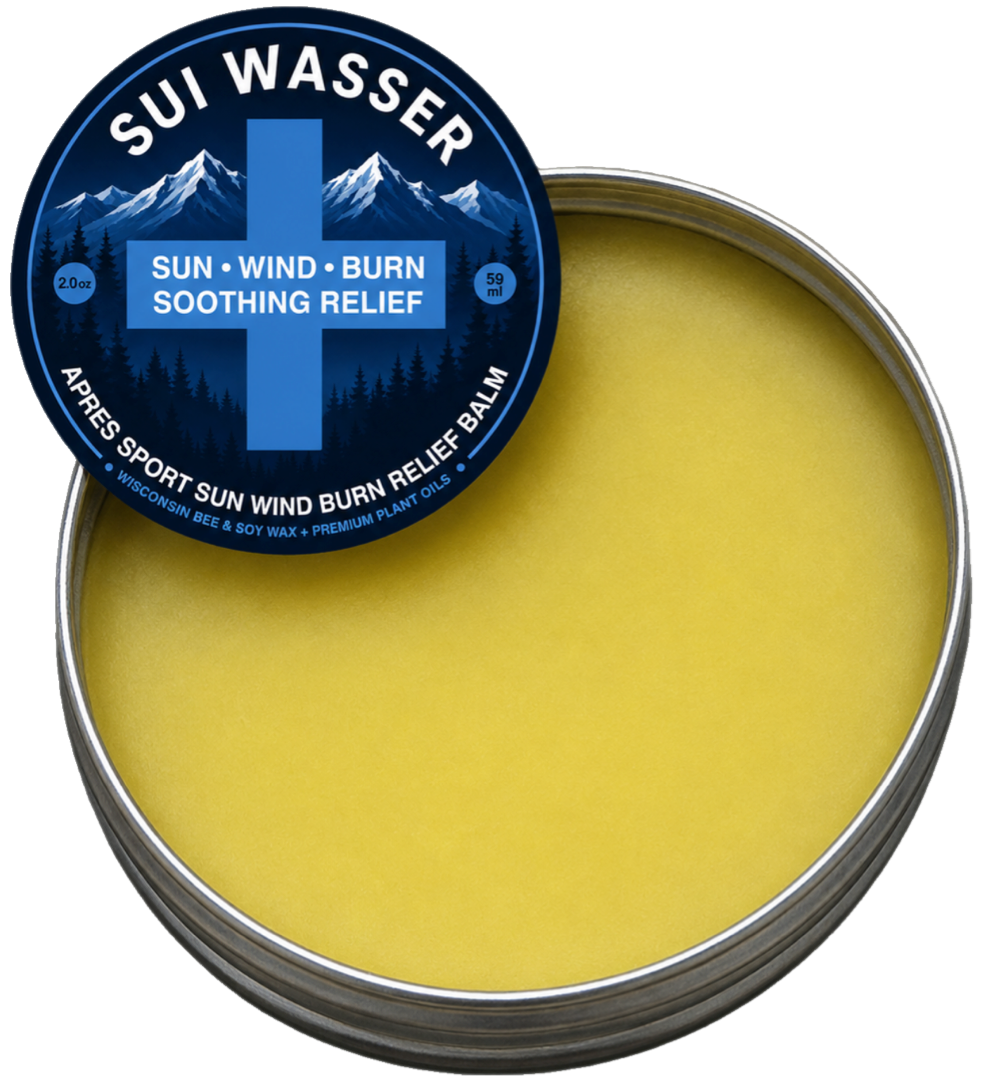
SUI WASSER’s Après-Sport Balm: designed for immediate post-exposure care.
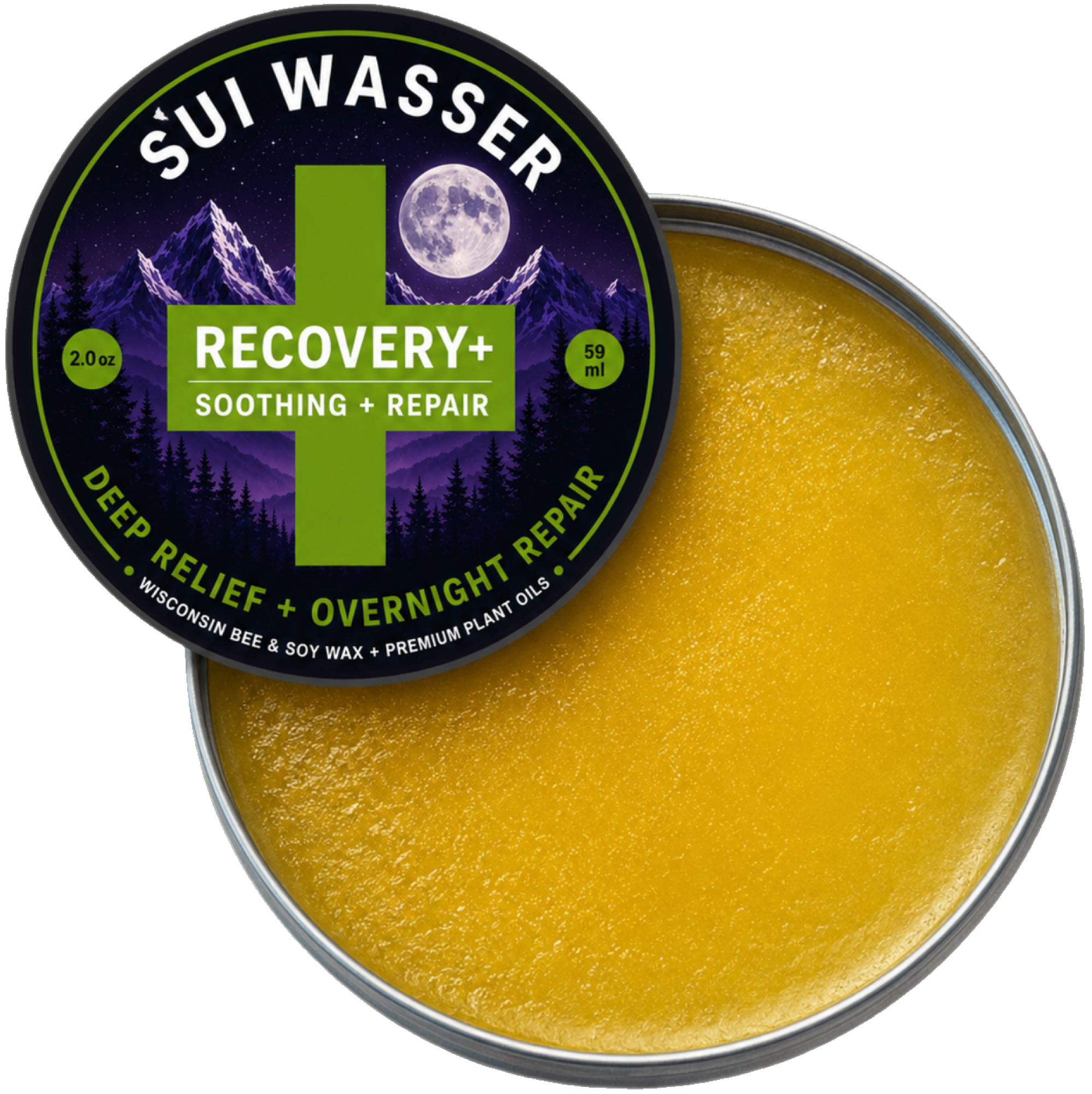
SUI WASSER’s Recovery+ Balm: Designed as an overnight balm to relieve symptoms associated with post-exposure. It may also be used post-exposure as a treatment for dry, itchy, painful, windburnt or chapped skin.
Short Definition, a Glossary of Terms
I recognize that readers have different levels of knowledge and experience, especially when it comes to skincare. And, that terms used in scientific literature can be a challenge. Therefore, when time allows, and where necessary, I am injecting a reference for readers. This is not a dictionary, but a short, summarized, definition as it relates to the article.
Skin Barrier: The skin’s outer protective system that helps retain moisture while limiting entry of irritants and other outside substances.
Stratum Corneum: The outermost layer of the epidermis, made of flattened skin cells surrounded by an organized matrix of lipids.
Corneocytes: Flattened, mature skin cells that form the “bricks” of the stratum corneum.
Skin Barrier Lipids: Lipids—primarily ceramides, cholesterol, and free fatty acids—that form the protective matrix surrounding corneocytes.
Lipid Matrix: The organized layers of lipids between corneocytes that help regulate water loss and maintain barrier function.
Ceramides: A family of lipids that make up a major portion of the stratum corneum’s lipid matrix and are important to skin barrier structure.
Cholesterol: A naturally occurring skin lipid that helps maintain the organization and physical properties of the skin barrier.
Free Fatty Acids: Fatty acids naturally present in the skin barrier that contribute to its structure, function, and surface environment.
Barrier Function: The skin’s ability to limit excessive water loss while helping protect the body from the external environment.
Emollient: An ingredient that helps soften and smooth the skin by filling spaces between surface skin cells and improving skin feel.
Epidermis: The outer layer of the skin. The stratum corneum forms its outermost portion.
Epidermal Lipid Synthesis: The biological processes through which skin produces lipids needed to build and maintain its barrier.
Sebaceous Activity: The production and release of sebum by the skin’s sebaceous glands.
Sebum: The oily substance produced by sebaceous glands that helps lubricate the skin and hair.
Intrinsic Aging: Biological changes that occur naturally with age, independent of external environmental exposure.
Environmental Exposure: Contact with outside factors such as UV radiation, wind, cold, heat, low humidity, salt water, chlorine, and friction.
UV Radiation: Ultraviolet radiation from sunlight that can interact with skin and contribute to sunburn, DNA damage, oxidative stress, and cumulative photoaging.
Transepidermal Water Loss (TEWL): The continuous movement of water through the epidermis and its evaporation from the skin surface.
Occlusive: An ingredient that forms a surface film that helps reduce evaporation and water loss from the skin.
Moisturization: Improving or maintaining the skin’s water content and reducing the sensations and appearance associated with dryness.
Skin Conditioning: Improving characteristics such as softness, smoothness, flexibility, and overall skin feel.
Post-Exposure Skincare: Skincare used after environmental exposure to cleanse, condition, moisturize, or support dry and weather-stressed skin.
Skin Longevity: An approach to skincare focused on maintaining healthy-looking, functional, comfortable, and resilient skin throughout life.
Further Reading
Publications listed below are available on PubMed:
van Smeden et al. — “The skin barrier: An extraordinary interface with an exceptional lipid organization”
A recent review and probably the best overall reference for our discussion of the stratum corneum, lipid matrix, ceramides, cholesterol and free fatty acids. It confirms that these three lipid classes are central to the highly organized lamellar structure of the skin barrier. PubMedElias & Ghadially — “The aged epidermal permeability barrier: basis for functional abnormalities”
This one is particularly important for our article because it directly connects aging with barrier biology. The authors report altered barrier homeostasis in aged epidermis, reductions in stratum-corneum lipids, abnormalities in cholesterol synthesis, and further effects associated with photoaged skin. PubMedFeingold — “The role of epidermal lipids in cutaneous permeability barrier homeostasis”
This is a foundational review. It describes the stratum-corneum extracellular lipid matrix as approximately 50% ceramides, 25% cholesterol and 15% free fatty acids by weight, and explains how epidermal lipid synthesis responds when the barrier is disrupted. PubMed
