Windburn vs. Sunburn: Can Wind-Damaged Skin Become More Vulnerable to UV?
Introduction: Windburn and sunburn are often talked about as separate problems, but the relationship between wind, skin-barrier damage, and ultraviolet exposure may be more closely connected than it first appears.
In this two-part article, Part One — “Windburn vs. Sunburn: Can Wind-Damaged Skin Become More Vulnerable to UV?” looks at how cold, dry, moving air can stress the skin barrier and examines research suggesting that compromised skin may respond more strongly to ultraviolet radiation.
Part Two — “What Could Windburn Mean for Skin Longevity?” takes the discussion further, exploring what repeated cycles of wind exposure, barrier disruption, UV stress, and recovery may mean for skin over years and decades.
Together, the two parts look beyond windburn as a temporary outdoor annoyance and consider a larger question: how might protecting and maintaining the skin barrier contribute to healthier, more resilient skin over a lifetime?
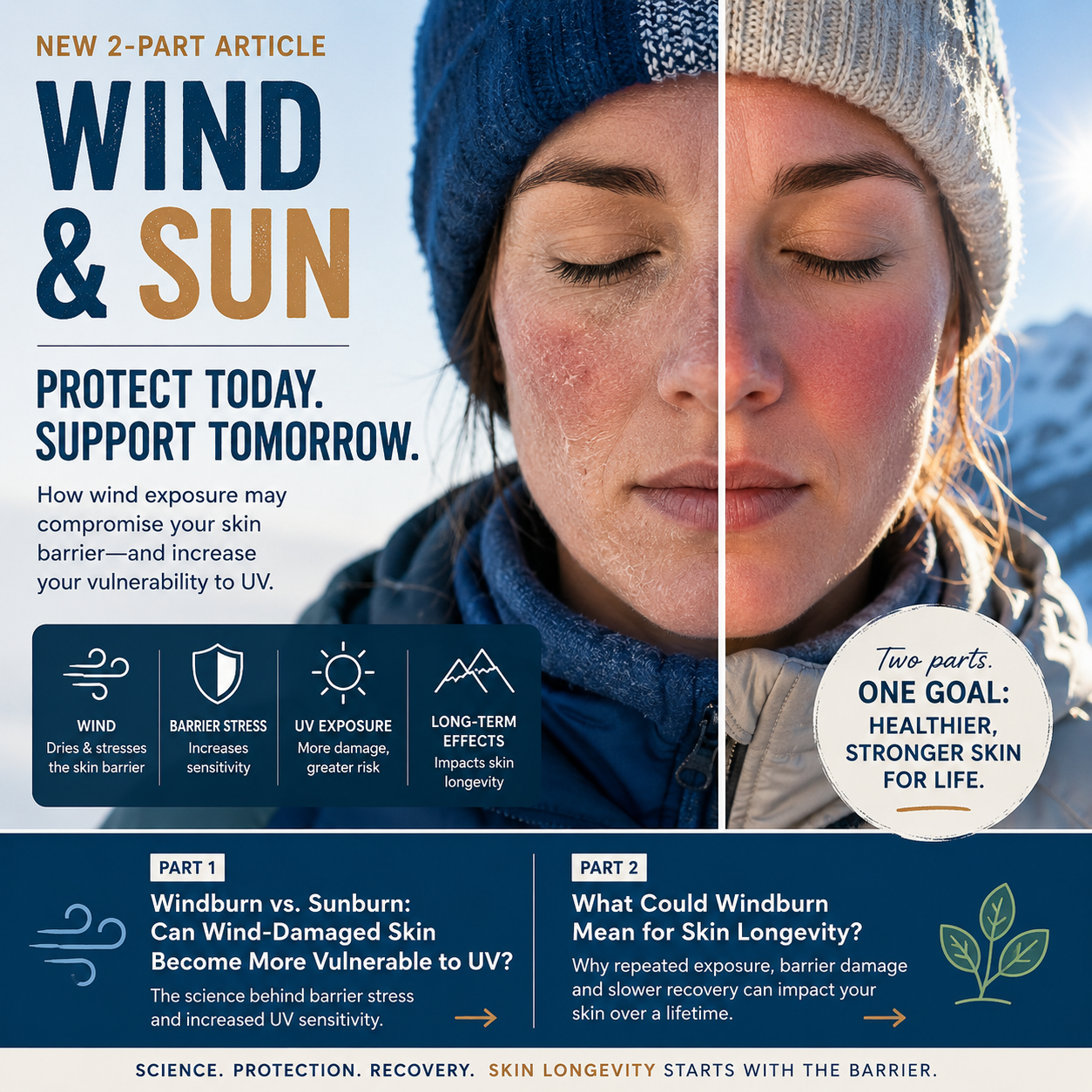
Image: SUI WASSER’s new two part article exploring the implications of Windburn & Sunburn, and their long term impact on our skin health.
A Life Lived Outdoors
Spend enough time skiing, cycling, hiking, boating, or working outdoors and you’ve probably experienced it: red, tight, tender skin after a long day in the wind. We usually call it windburn. But windburn and sunburn aren’t the same thing — and the relationship between wind, the skin barrier, and ultraviolet radiation may be more interesting than the name suggests.
Emerging research into skin-barrier function raises an important possibility: when environmental exposure compromises the skin barrier, the skin may become more sensitive to subsequent ultraviolet radiation. That makes wind exposure potentially important for reasons beyond dryness and discomfort.
Windburn and Sunburn Are Different
Sunburn has a clearly defined cause: ultraviolet radiation. UV radiation reaches the skin and triggers biological damage, including inflammation and cellular and DNA damage. Repeated UV exposure contributes to photoaging and increases the risk of skin cancer.
What we commonly call windburn is different. “Windburn” isn’t a precise medical diagnosis, and there is some disagreement about the term because sun and wind exposure frequently occur together. But cold, dry, moving air can contribute to dehydration and disruption of the skin’s outer barrier.
That can leave skin feeling:
dry
tight
rough
sensitive
irritated
red or inflamed
In controlled research designed to simulate cold wind, exposed untreated skin showed a significant reduction in hydration. Researchers also found that an emollient helped maintain hydration during the simulated exposure. (PubMed)
So while the redness someone calls “windburn” may sometimes include an actual sunburn, wind itself can place stress on the skin barrier.
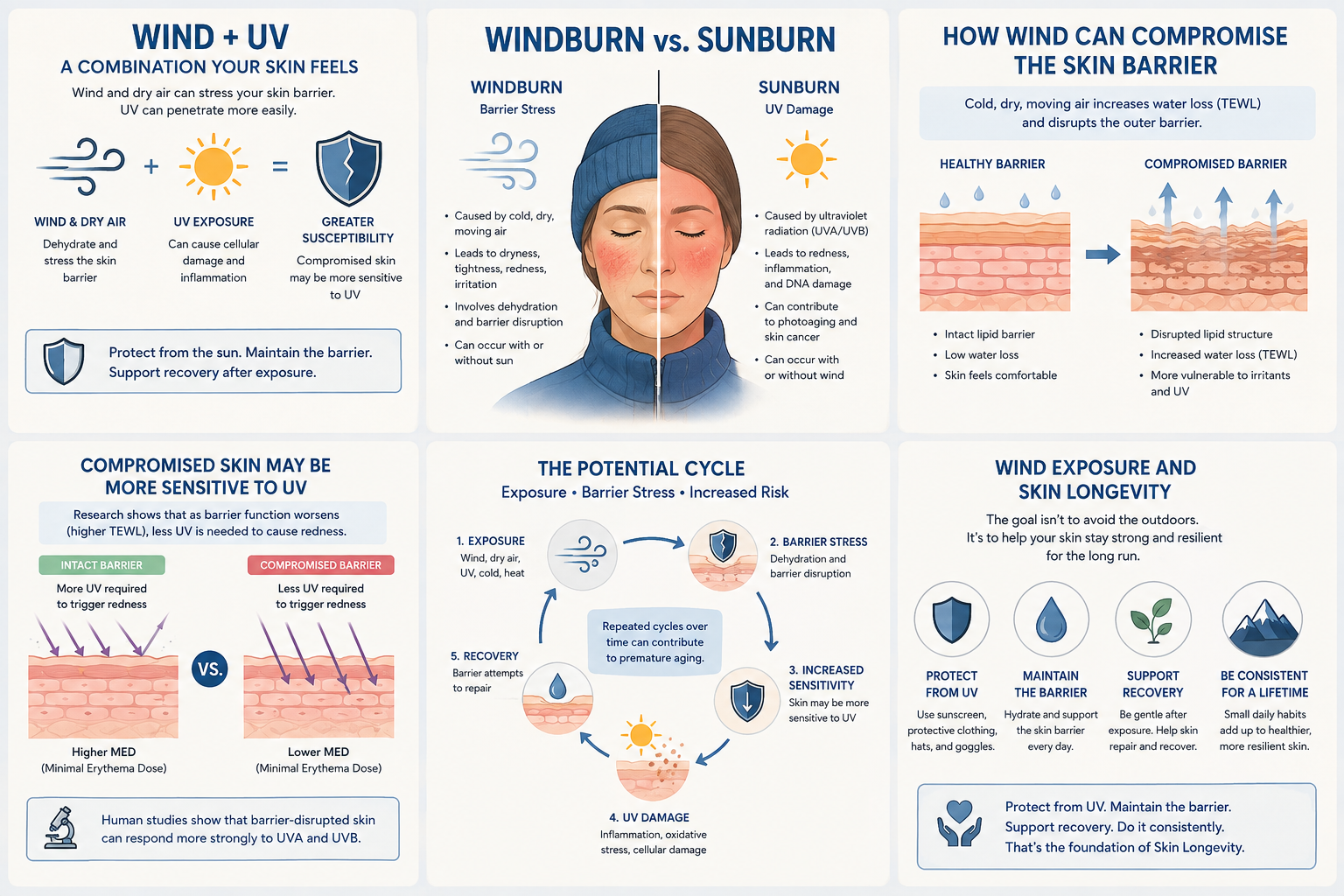
Image: Can you tell the difference between Windburn & Sunburn? Do you understand the impact mountain Wind & Sun have on exposed skin? This article & image describe the combined impact on our skin longevity.
Why the Skin Barrier Matters
The outermost portion of the epidermis — particularly the stratum corneum — isn’t simply a layer of dead skin. It is a sophisticated protective barrier. Among its jobs is helping regulate water loss from the body and protecting the living tissue underneath from environmental stressors.
When that barrier becomes compromised, transepidermal water loss (TEWL) can increase. Put simply, water escapes through the skin more readily. That is one reason skin exposed repeatedly to cold, dry and windy conditions can begin to feel increasingly dry and irritated.
But moisture retention may only be part of the story.
What Happens When Compromised Skin Meets UV?
This is where the research becomes particularly interesting. A 2022 human study investigated whether the physical condition of the skin barrier affected sensitivity to ultraviolet radiation. Researchers measured skin characteristics including hydration and TEWL and compared them with the skin’s minimal erythema dose (MED) — essentially, how much UV exposure was required to produce visible redness.
They found that as TEWL increased, indicating poorer barrier function, the amount of UV required to produce erythema decreased. When researchers deliberately disrupted the skin barrier, UV sensitivity increased. (PubMed)
Earlier human research had reached a similar conclusion. In barrier-disrupted skin, even sub-erythemal UVB exposure produced greater susceptibility to redness and increased inflammatory responses compared with normal skin. (PubMed) And in July 2026, researchers published another human study examining different degrees of epidermal barrier impairment and responses to both UVA and UVB. The results were striking.
Moderate-to-severe barrier impairment was associated with stronger persistent pigmentation responses following UVA exposure, while severely impaired skin developed more pronounced delayed redness and post-inflammatory hyperpigmentation after UVB exposure. The researchers concluded that maintaining an intact epidermal barrier should be considered part of a broader photoprotection strategy. (Wiley Online Library)
Wind + UV May Be a Particularly Important Combination
This creates an interesting chain of events for people who spend significant amounts of time outdoors. Wind and dry air can stress and dehydrate the skin barrier. Compromised skin-barrier function has been associated with increased UV sensitivity. And outdoors, these exposures frequently occur at the same time.
There is even older experimental evidence suggesting an interaction. A 1974 study found that animals exposed to UV radiation while subjected to continuous airflow experienced greater injury than animals receiving the same UV exposure without wind. Later animal research reported greater damage and slower recovery when UV exposure occurred with wind. (JAMA Network)
Those animal experiments should not be treated as proof that wind increases UV injury in humans. But when considered alongside newer human research showing that barrier-disrupted skin is more UV-sensitive, they raise a reasonable and important question: Could protecting the skin barrier be especially important for people repeatedly exposed to both wind and ultraviolet radiation?
Current evidence suggests that it may be.
Think About a Day on the Mountain
Skiing provides an unusually good example. Your face may be exposed for hours to:
cold air + low humidity + sustained wind + blowing snow + ultraviolet radiation
And those exposures aren’t necessarily independent of one another. Wind and dry air can challenge hydration and barrier integrity while UV radiation is simultaneously acting on the skin. Blowing snow and ice crystals can add further mechanical irritation to already exposed skin. In some extreme skiing and mountaineering cases, blowing mountain snow can sting and leave exposed skin raw and inflammed.
That means the traditional way of thinking about winter skin — sunscreen for the sun and moisturizer for dryness — may be too simplistic. The skin barrier itself may deserve greater attention.
Wind & Cold Can Also Hide Sunburn
There is another practical problem. Wind and cold can make it difficult to recognize what’s happening to your skin while you’re outside. A red face at the end of a cold, windy day may be attributed entirely to “windburn” when UV exposure may also have contributed. This matters because temperature tells us very little about UV exposure.
A cold day is not necessarily a low-UV day. For skiers, mountaineers and others spending extended periods outdoors, environmental conditions can therefore create overlapping stresses that aren’t always obvious while they’re occurring.
Protection and Recovery Are Different Jobs
None of this changes the first rule of UV protection: Use appropriate sun protection.
Broad-spectrum sunscreen, protective clothing, hats, goggles, face coverings and limiting unnecessary UV exposure remain the primary tools for reducing ultraviolet exposure.
A moisturizer or balm is not a substitute for sunscreen unless it has been specifically formulated and tested to provide labeled SPF protection. But the research suggests there may be another piece of the strategy: maintaining the skin barrier before exposure and supporting it after exposure.
Emollient and occlusive ingredients can help reduce water loss and improve skin hydration, while gentle post-exposure skin care can avoid adding additional stress to an already challenged barrier.
This creates a useful distinction: Sun protection helps reduce the UV reaching your skin. Barrier care helps support the skin that has to live in that environment. The two strategies complement one another, but they are not interchangeable.
The Bigger Picture: Skin Longevity
A single windy afternoon isn’t the larger issue. For many people, environmental exposure is repeated thousands of times over a lifetime. Ski instructors, coaches, lift operators, mountain guides, cyclists, runners, construction workers, farmers, landscapers, sailors and others may spend hundreds or thousands of hours exposed to combinations of sun, wind, cold, heat and dry air.
Skin doesn’t experience those environmental stressors in isolation. It experiences them together. That is why skin longevity requires thinking beyond individual events like sunburn or windburn and considering the condition of the skin barrier across a lifetime of exposure.
The emerging science around barrier function and UV sensitivity reinforces a simple idea: Protecting skin from the environment isn’t only about protecting it from the sun. It is also about helping maintain the barrier that protects us every day.
Section II. What Could Windburn Mean for Skin Longevity?
This is where windburn becomes more than a question of whether your face feels dry or irritated after a day outside. Skin longevity is ultimately about maintaining the structure, function and resilience of skin over decades of life. A single episode of windburn is unlikely to meaningfully “age” someone’s skin. But repeated environmental stress deserves more attention.
For someone who spends a lifetime skiing, cycling, hiking, farming, working construction, coaching outdoors or simply living an active outdoor life, exposure isn’t an isolated event. The skin may experience hundreds or thousands of cycles of wind, cold, dry air, sunlight and subsequent recovery.
Those stresses may also interact.
Wind and dry air can reduce skin hydration and challenge the epidermal barrier. A compromised barrier can lose water more readily and become more susceptible to irritation. Research also suggests that barrier-disrupted skin can respond more strongly to ultraviolet radiation.
UV exposure, meanwhile, is one of the best-established drivers of premature skin aging. Over time, repeated UV exposure contributes to oxidative stress, inflammation, cellular senescence and changes within the skin’s extracellular matrix, including degradation and fragmentation of collagen.
That suggests a potentially important relationship:
Wind exposure may challenge the barrier.
A compromised barrier may increase sensitivity to UV.
UV exposure can further disrupt barrier function while contributing to photoaging.
In other words, these environmental stresses shouldn’t necessarily be viewed independently. For people who spend significant amounts of time outdoors, they may form part of a repeated cycle of exposure → barrier stress → recovery → exposure again.
And Aging Changes the Equation
There is another reason this matters over a lifetime. Skin itself changes with age. Research indicates that older skin generally has reduced barrier resilience and recovers more slowly following acute barrier disruption. Structural changes, altered lipid composition and reduced regenerative capacity can make maintaining healthy barrier function increasingly important as we get older.
That creates an interesting feedback relationship. When we’re young, skin may recover relatively quickly from environmental challenges. As skin ages, recovery can become slower. Yet someone with an outdoor lifestyle may continue accumulating the same — or greater — environmental exposure.
The objective, therefore, isn’t to prevent skin from ever being exposed to the environment. For people who love being outside, that would defeat the purpose. The objective is to help skin remain functional, resilient and capable of recovering from environmental stress for as many years as possible. That’s the idea behind Skin Longevity.
Sun protection remains essential because reducing UV exposure is one of the most effective ways to reduce photoaging and UV-related skin damage.
But the emerging science suggests another complementary principle: Protect the skin from UV. Maintain the barrier. Support recovery after exposure. Then do it consistently — for a lifetime.
Further Reading
Wu P, Hua P, Yao Q, et al. (2026).Epidermal Permeability Barrier Dysfunction Influences Acute and Chronic Skin Responses to UVA and UVB Radiation. Photodermatology, Photoimmunology & Photomedicine. (Wiley Online Library)
Kim MA, Jung YC, Suh BF, Lee HN, Kim E. (2022).Skin biophysical properties including impaired skin barrier function determine ultraviolet sensitivity. Journal of Cosmetic Dermatology. (PubMed)
Lee SE, et al. (2017).Subclinical cutaneous inflammation remained after permeability barrier disruption enhances UV sensitivity by altering ER stress responses and topical pseudoceramide prevents them. Archives of Dermatological Research. (PubMed)
Ou-Yang H, et al. (2012).Methods to Assess the Protective Efficacy of Emollients against Climatic and Chemical Aggressors. Dermatology Research and Practice. (PubMed)
Thank you for reading. This is an important topic. Please feel free to share it on social media or with others.
Written by Mya Schaefer
