From the Alps to the Amazon: Two Botanicals We’re Exploring for Fall
As summer begins giving way to fall, we’re returning to one of the questions that has shaped SUI WASSER from the beginning: What can we learn from plants that people have relied upon for generations—and what happens when we examine those traditions through the lens of modern formulation and science?
Two botanicals have recently captured our attention. One is extraordinarily familiar. You may already have it in your kitchen.
The other comes from the Amazon rainforest and produces a remarkable deep-red sap that has been used traditionally for generations.
They are:
Clove (Syzygium aromaticum)
Dragon’s Blood (Croton lechleri)
And both are opening some interesting new directions for us.
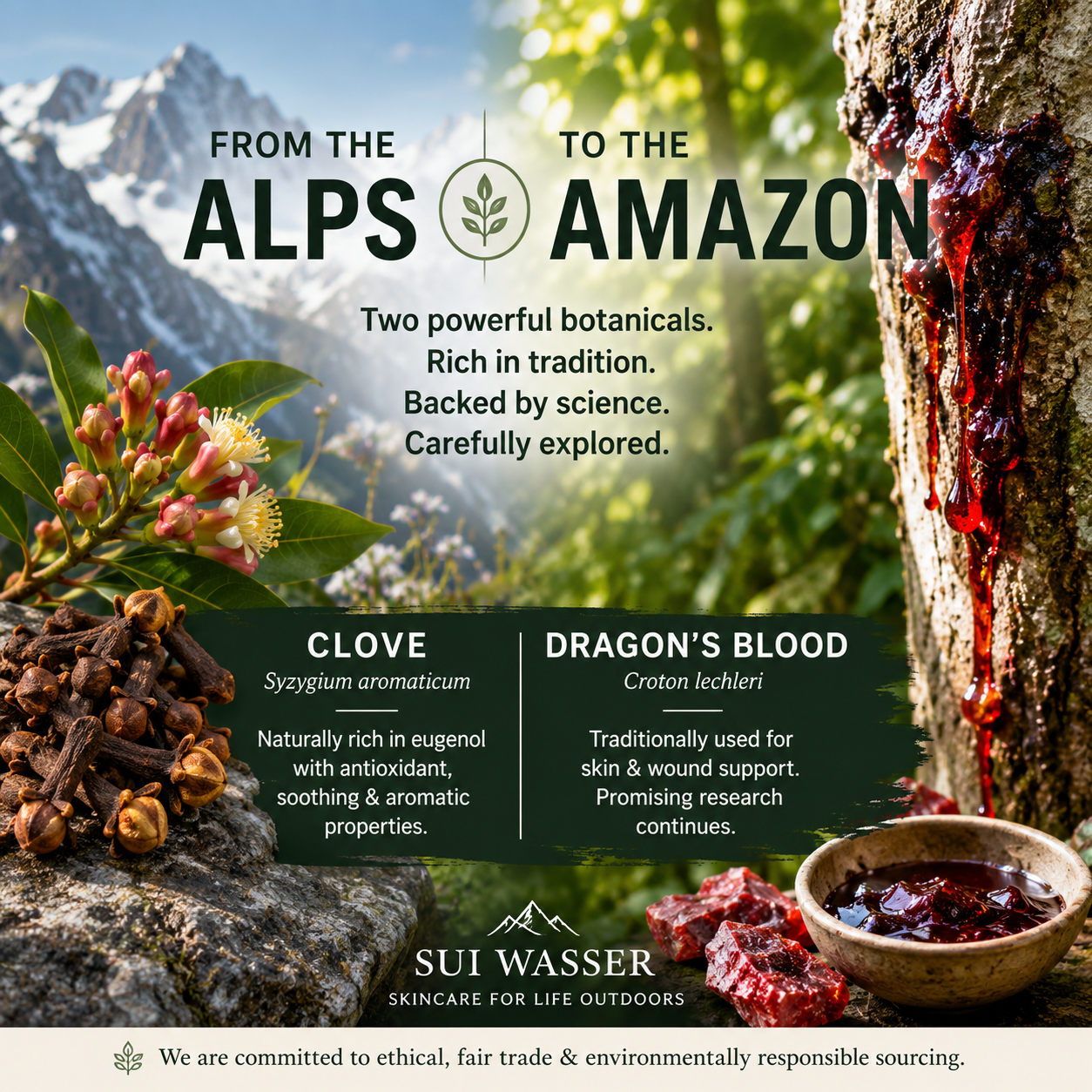
Image: From the Alps to the Amazon Rain Forest at SUI WASSER we have some powerful new ingredients we are bringing to our product offerings!
Gewürznelke: Looking Again at the Humble Clove
Cloves are the dried flower buds of Syzygium aromaticum. Most of us know them for their unmistakable warm aroma and their use as a culinary spice.
But clove also has a long history as a medicinal botanical.
Its essential oil is particularly rich in eugenol, a naturally occurring phenolic compound that has been extensively studied. Scientific literature has reported antioxidant, anti-inflammatory, analgesic, local-anesthetic and antimicrobial activities associated with eugenol and clove essential oil.
That doesn’t mean rubbing clove oil on your knee is a clinically proven treatment for arthritis. Much of the broader evidence comes from laboratory and preclinical research, and concentrated essential oils also require careful formulation.
There is, however, a genuine medicinal history here.
Clove oil’s best-established traditional medicinal application is probably dental. Eugenol has long been associated with temporary relief of tooth discomfort and has been used in dentistry. The European Medicines Agency has formally evaluated clove oil as a traditional herbal medicinal product for dental and mouth-related applications.
That history prompted another question for us:
What about the old European tradition of botanical rubs, liniments and alcohol-based herbal preparations?
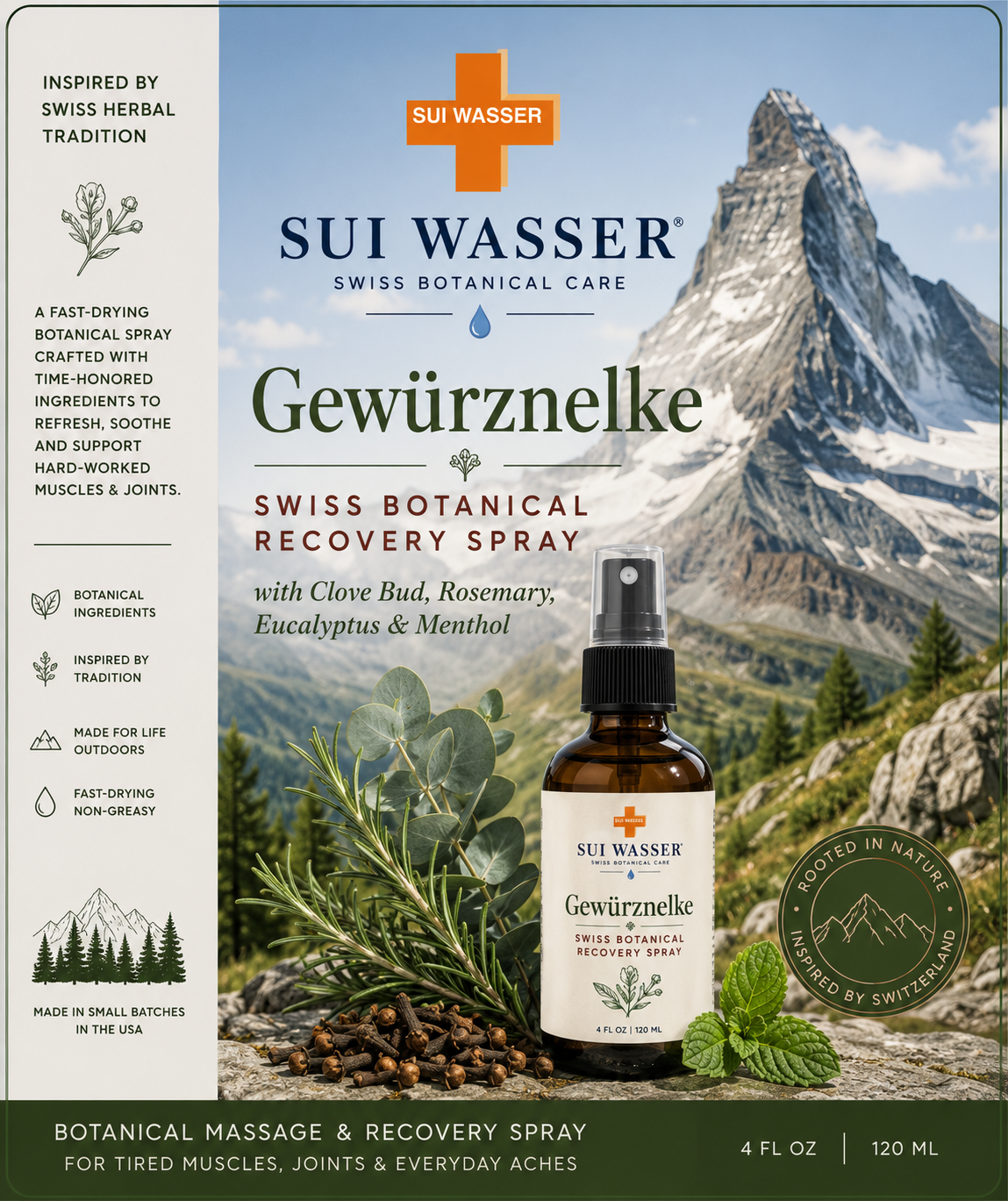
Image: Our newest product offering! We’re psyched to announce that we will have our Gewürznelke Spray available by September 5th, available online by the 4th!
A Swiss Connection
The idea came to us through family. A traditional preparation involving Gewürznelke—the German word for clove—was suggested as something worth investigating.
That sent us down a rabbit hole. Instead of simply recreating an old household remedy, we’re exploring whether the underlying idea can inspire a carefully formulated modern product.
The working project is:
SUI WASSER Gewürznelk — Swiss Botanical Recovery Spray
Our early formulation work is exploring a botanical system built around clove bud, witch hazel, rosemary, eucalyptus and menthol. The goal is a fast-drying botanical massage and recovery spray inspired by European herbal traditions, but developed using modern cosmetic-formulation practices.
We’re still experimenting. And that’s important.
Clove essential oil is potent. More isn’t necessarily better. Eugenol can also irritate or sensitize skin at inappropriate concentrations, so part of our development work is finding the lowest useful level while carefully evaluating the complete formulation.
Tradition may give us the idea — Formulation science still has to do the work.
Then We Discovered Dragon’s Blood!
The second botanical we’re investigating could hardly look more different. Cut the bark of Croton lechleri, a tree native to the Amazon region of South America, and it produces a dark red latex or sap. The resemblance to blood gave rise to names including Sangre de Drago—Dragon’s Blood.
Indigenous and traditional medicine in the Amazon region has used the sap for a variety of purposes, particularly involving wounds and skin.
IMPORTANT: As we explore Dragon’s Blood, how it is sourced matters to us as much as what it can do. We are actively seeking suppliers committed to ethical and environmentally responsible harvesting, fair economic relationships with local growers and communities, traceability, and practices that protect rather than deplete the Amazonian forests where Croton lechleri grows.
Our goal isn’t simply to find Dragon’s Blood. It is to understand where it comes from, how it is harvested, and who benefits from its growing international demand.
This isn’t merely an interesting name attached to an exotic plant. Croton lechleri has developed a surprisingly substantial scientific literature.
What’s Inside Dragon’s Blood?
Researchers have identified an unusually complex collection of plant compounds in the sap. Among the most interesting are proanthocyanidins, a family of polyphenolic compounds associated with antioxidant activity.
Researchers have also paid considerable attention to an alkaloid called taspine. An early study of Croton lechleri found that taspine increased the migration of human fibroblasts in laboratory experiments. Fibroblasts are cells involved in the construction and repair of connective tissue.
Other animal research subsequently reported effects involving wound contraction, epithelial regeneration and collagen formation. But perhaps the most intriguing evidence came from humans.
A Human Clinical Trial
In a randomized, double-blind, placebo-controlled clinical study involving 60 people, researchers compared a Dragon’s Blood cream with placebo following removal of skin tags. The Dragon’s Blood group experienced significantly faster wound healing than the placebo group.
The researchers suggested that phenolic compounds and taspine in the resin may contribute to the effect. That’s noteworthy evidence.
It is also important not to overstate it. A wound-healing study following skin-tag removal does not establish Dragon’s Blood as a treatment for every skin condition, nor does it tell us exactly how a Dragon’s Blood ingredient will perform in one of our formulations.
A 2018 dermatology review reached a similarly measured conclusion: Croton lechleri shows interesting anti-inflammatory, antioxidant and wound-healing potential, but its clinical dermatological evidence remains limited and additional research is needed.
That’s exactly the kind of ingredient we find interesting. Promising enough to investigate. Not sufficiently established to stop asking questions.
The Formulation Challenge
Dragon’s Blood presents another fascinating problem. The traditional sap is not naturally compatible with the oils and waxes that make up our waterless balms. Simply pouring Dragon’s Blood into a SUI WASSER balm isn’t an option.
So we’re currently exploring more than one pathway. We have obtained a water-based Croton lechleri extract that will allow us to begin studying the ingredient in compatible formulations, such as adding it to our RECOVERY GEL.
We’re also exploring whether Dragon’s Blood can eventually be incorporated into an oil-compatible botanical ingredient suitable for waterless skincare.
That work is still very early. But solving problems like this is part of what makes formulation interesting.
Traditional Knowledge Is a Starting Point, Not the Finish Line!
Clove and Dragon’s Blood come from very different places. One takes us toward European and Alpine herbal traditions.
The other takes us thousands of miles away to the Amazon Rain Forest. Yet the questions they raise are remarkably similar.
What did traditional users observe?
What compounds are actually present in the plant?
What does modern research support?
What remains uncertain?
And finally: Can we formulate the ingredient safely, consistently and meaningfully enough that it actually earns a place in a product? That’s the standard we’re trying to apply. We don’t want an ingredient on a label simply because its name sounds interesting. Every ingredient needs a reason to be there!
Looking Toward Fall
As fall approaches, we’re entering another period of experimentation at SUI WASSER. The first project you’ll probably hear more about is Gewürznelke, our Swiss Botanical Recovery Spray.
Dragon’s Blood is a longer-term exploration, and we’re particularly interested in understanding how this unusual Amazonian botanical might fit into future skin-soothing and recovery formulations.
Neither project is finished. That’s part of the point.
We want to share some of this work while we’re doing it—including what succeeds, what doesn’t, and what the science tells us along the way. Because sometimes innovation doesn’t begin with discovering something new.
Sometimes it begins by looking again at something people have known about for a very long time.
Cheers!
- SUI WASSER
Further Reading
Clove Essential Oil — Chemical Composition and Biological Activity
A peer-reviewed review covering the chemistry and reported biological activity of clove essential oil, including eugenol.
Dragon’s Blood (Croton lechleri) — Phytochemistry and Pharmacology
A 2025 review examining the phytochemistry and pharmacological research surrounding C. lechleri. It identifies proanthocyanidins as the predominant phytochemical group reported in the reviewed literature.
Dragon’s Blood Cream and Human Wound Healing
A randomized, double-blind, placebo-controlled study of 60 participants referenced in this article. The Dragon’s Blood cream produced significantly faster healing in the particular post-skin-tag-removal wound model studied.
Dragon’s Blood in Dermatology — Review
A useful counterbalance to some of the more enthusiastic claims surrounding Dragon’s Blood. The authors discuss promising anti-inflammatory, antioxidant and wound-healing findings while concluding that further investigation is needed to understand its dermatological potential.
