PRO TIP: Why Balms Can Become Even More Useful as Skin Ages?
Why Balms Can Become Even More Useful as Skin Ages
As we age, skin naturally tends to produce less of its own protective oils and can become drier, thinner, and less effective at holding onto moisture. That makes supporting the skin barrier increasingly important.
This is one area where a concentrated balm can be particularly useful. Rather than relying primarily on water for an immediate moisturizing sensation, a waterless balm uses oils, emollients, and waxes to condition the skin and help reduce moisture loss over time. Beeswax and soy wax add staying power, helping create a thin protective layer that remains on the skin longer—particularly valuable for mature skin repeatedly challenged by dry air, wind, cold, sun, and other environmental stresses.
And because a little concentrated balm goes a long way, you don’t necessarily need more skincare as you age. Sometimes you simply need skincare that stays with your skin longer.
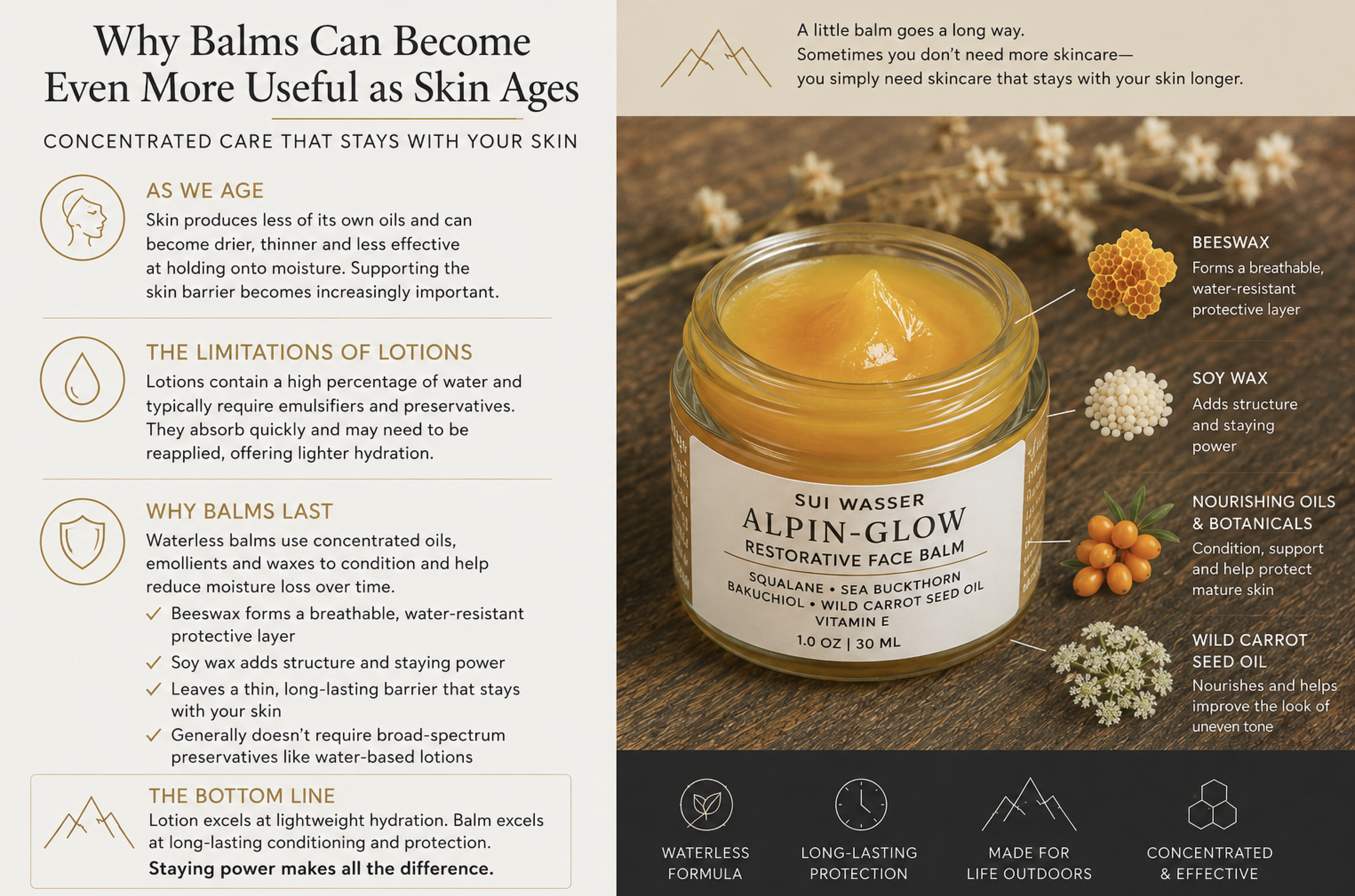
SUI WASSER’s Alpin-Glow is our flagship balm for aging skin needs. With a Retinol alternative provided by Bakuchiol Oil, Alpin-Glow provides the support your skin needs for your skin’s longevity.
Limitation of Lotions
Lotions are excellent when you want lightweight hydration and fast absorption. But when skin is repeatedly exposed to sun, wind, cold, dry air, water, and friction, a balm can provide something different: long-lasting conditioning and protection.
Most lotions contain a significant amount of water. That gives them their light texture, but it also means they typically require emulsifiers to hold oil and water together and preservatives to control microbial growth. Balms are generally water-free, allowing them to concentrate oils, waxes, emollients, and other oil-soluble ingredients into a much smaller amount of product.
Why Balms Last
Rather than disappearing quickly after application, a well-formulated balm leaves behind a thin, persistent layer of emollients and waxes. This helps soften and condition the skin while reducing moisture loss, which can be particularly useful after long days outdoors or in cold, dry environments.
Beeswax contributes structure while forming a breathable, water-resistant protective layer on the skin. Soy wax helps create a smooth, substantial balm with additional staying power. Together, they allow the oils and other ingredients in the formula to remain in contact with the skin longer than they typically would in a lightweight lotion.
Because balms contain little or no water, they also generally don’t require the same broad-spectrum antimicrobial preservative system that water-based lotions do. That doesn’t eliminate the need for careful formulation, clean manufacturing, or protection against oxidation—but it allows for a comparatively simple, concentrated formula.
The Bottom Line
Lotion excels at lightweight hydration. Balm excels when you want concentrated, long-lasting conditioning and a protective layer that stays with your skin.
For people who spend hours outside, that staying power can make balm particularly useful before, during, and after exposure to demanding environments.
Further Reading & Source Material:
National Institute on Aging — Skin Care and Aging. Probably the strongest general source. The NIA explains that skin becomes thinner with age, oil and sweat production can decline, and dry skin becomes increasingly common. It also discusses cumulative UV exposure and skin aging.
Skin Care and Aging — National Institute on AgingAmerican Academy of Dermatology — How to Pick the Right Moisturizer. This one is extremely relevant to our balm-vs-lotion argument. The AAD explains that creams contain more oil than lotions, ointments are thicker still, and thicker formulations are more effective at preserving water in dry skin. It specifically notes that skin holds less moisture with age and recommends moving toward creamier moisturizers as people get older.
How to Pick the Right Moisturizer — American Academy of DermatologyAmerican Academy of Dermatology — Skin Care in Your 60s and 70s. This gets even closer to the premise of our article. The AAD says older skin commonly becomes dry and irritated and recommends ointments rather than creams when skin is very dry because ointments do a better job of holding water in the skin.
How to Care for Your Skin in Your 60s and 70s — AADSkin Lipid Barrier: Structure, Function and Metabolism. This is the more scientific reference. The review explains the importance of lipids in the stratum corneum and how its lipid structures help protect against water loss. That provides good scientific background for why lipid-rich skincare formulations make sense from a barrier-support standpoint.
Skin Lipid Barrier: Structure, Function and Metabolism — PubMedNatural and Sun-Induced Aging of Human Skin. This is especially relevant to SUI WASSER because it connects chronological aging with photoaging. It discusses structural changes in aging skin, reduced surface lipid production, dryness, and the effects of accumulated sun exposure.
Natural and Sun-Induced Aging of Human Skin — NIH/PMC
