Why Topical Antioxidants Matter More as Our Skin Ages
Topical Vitamin E, Vitamin C, CoQ10 and the changing needs of older skin
We spend an enormous amount of time and money on our skin as we age. We spend considerably less time talking about how its biology changes. It does.
The skin we have at 50 or 60 isn’t simply an older-looking version of the skin we had at 20. Research has documented age-related changes in barrier lipids, hydration, sebum production, barrier recovery and the antioxidant systems that help skin respond to oxidative stress.
At the same time, the environment hasn’t gotten any easier on us. Ultraviolet radiation can generate reactive oxygen species and contribute to oxidative stress in the skin. And for those of us who continue skiing, cycling, hiking, gardening, working outside or simply spending a lot of time outdoors as we age, exposure to sun, wind, cold, heat and dry air doesn’t disappear just because our skin is changing.
That creates an interesting problem: We’re continuing to ask a lot from our skin at precisely the time its biology is beginning to change. This is one reason we’ve become particularly interested in topical antioxidants at SUI WASSER. Not because antioxidants are a miracle solution to aging. They’re not.
And certainly not because Vitamin E, Vitamin C, CoQ10—or any other cosmetic ingredient—can substitute for sunscreen or erase decades of accumulated sun exposure. They can’t.
The science points toward something much more interesting.
Antioxidants are part of the skin’s own defense system. And as we get older, understanding how that system works—and how topical skincare might support it—becomes increasingly relevant.
That’s where Vitamin E provides an excellent place to start.
First, What Is Oxidative Stress?
To understand why antioxidants matter, it helps to understand what they’re up against.
Our cells constantly participate in chemical reactions. As part of normal metabolism—and in response to environmental factors such as ultraviolet radiation—reactive molecules known collectively as reactive oxygen species, or ROS, can be produced.
ROS aren’t inherently abnormal. Our bodies generate them naturally, and at controlled levels they participate in normal biological processes.
Problems can arise when the production of reactive species exceeds the capacity of the body’s antioxidant defenses to keep them appropriately controlled. That imbalance is generally described as oxidative stress.
In skin, excessive oxidative stress can affect important biological molecules, including lipids, proteins and DNA. Ultraviolet radiation is particularly relevant because UV exposure can increase the formation of reactive oxygen species in skin.
Our bodies aren’t defenseless against this.
Skin has its own sophisticated antioxidant defense network. It includes antioxidant enzymes as well as compounds such as Vitamin E, Vitamin C, glutathione and other molecules that participate in controlling oxidative reactions.
Think of it less as one antioxidant standing guard and more as an interconnected defense system. And that distinction matters. Because one of the recurring mistakes in skincare marketing is the search for the one miracle ingredient. Biology rarely works that way.
Then Our Skin Gets Older
Aging skin is often discussed almost exclusively in terms of wrinkles, fine lines and appearance. Those are visible outcomes. Underneath them are biological changes that are considerably more interesting.
As skin ages, its structure and function gradually change. Research has described age-related changes involving epidermal lipids, hydration, barrier recovery, sebum production and antioxidant capacity. The outermost layer of skin—the stratum corneum—depends heavily on lipids to perform its barrier function.
Ceramides, cholesterol and fatty acids help form the lipid matrix surrounding the cells of the stratum corneum. These lipids play an important role in limiting excessive water loss and maintaining a functional barrier between our bodies and the outside world.
With age, aspects of that system can change. Research has reported differences in lipid synthesis and composition in older skin, and older skin can recover more slowly after its barrier has been disrupted.
Sebum production changes with age as well. That may sound like a cosmetic issue—less oiliness—but sebum is biologically interesting for another reason. It carries antioxidants, including Vitamin E.
The Vitamin E Connection
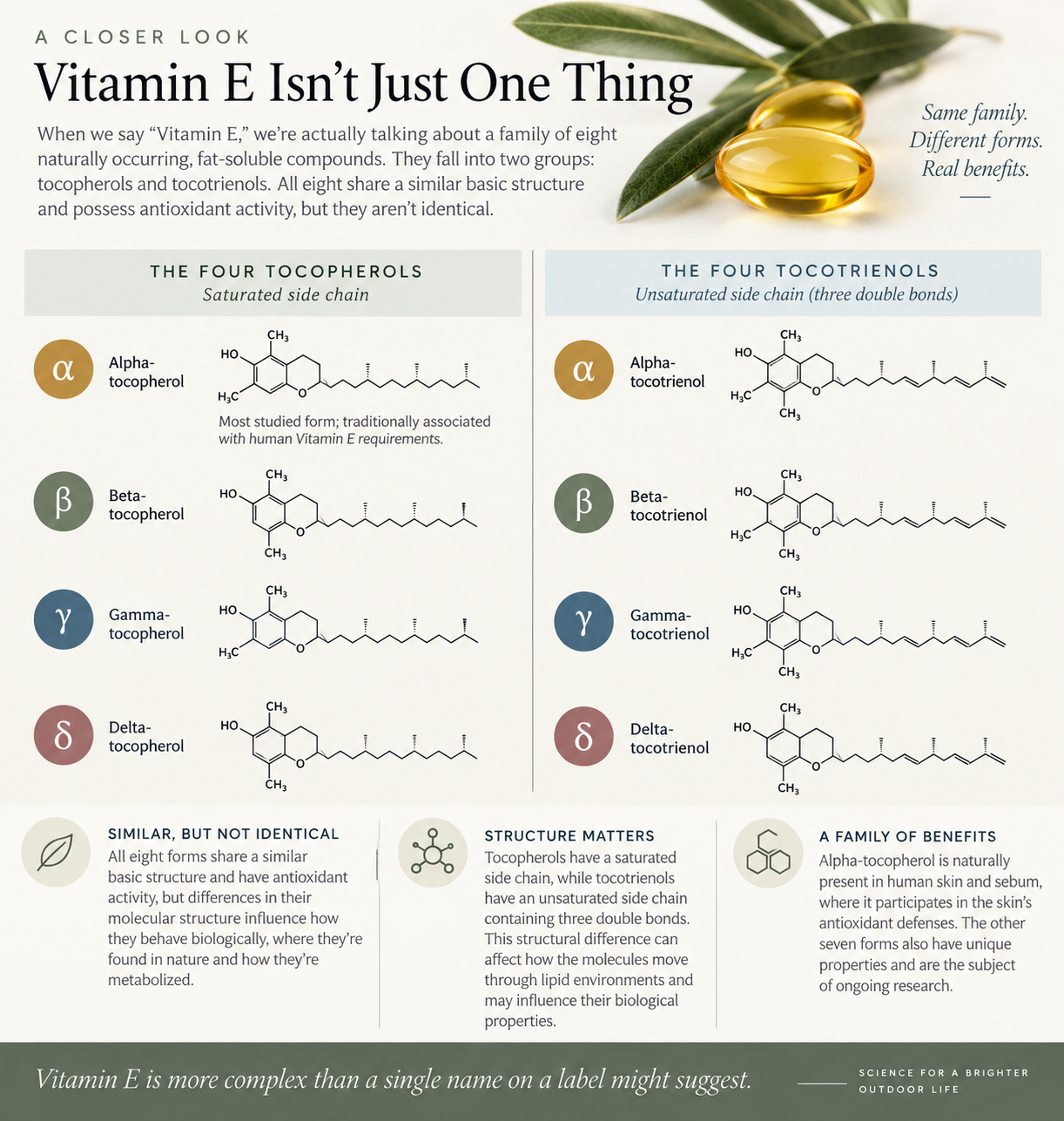
Vitamin E isn’t actually a single compound. It’s a family of eight fat-soluble compounds—four tocopherols and four tocotrienols.
Think of it like the brother who shows up to Thanksgiving with a new wife and a blended family. Each side brings four kids, and suddenly you need eight extra seats at the table. That’s Vitamin E.
The eight members are alpha-, beta-, gamma- and delta-tocopherol, along with alpha-, beta-, gamma- and delta-tocotrienol. They share the Vitamin E family name, but they aren’t identical. Their structures, biological activity and roles differ.
In human skin, alpha-tocopherol is particularly important. It is a major lipid-soluble antioxidant found in the skin and helps protect lipids in cell membranes and the skin barrier from oxidative damage.
So when we say “Vitamin E,” we’re really talking about an extended family of related antioxidants—with alpha-tocopherol occupying a particularly important seat at the table.
Vit. E Not Just
One Thing!
Because Vitamin E is lipid-soluble, it can associate with lipid-rich environments, including cellular membranes and skin surface lipids. One of its important biological functions is acting as an antioxidant that can help interrupt lipid oxidation reactions.
That makes it particularly interesting in skin. Our skin barrier is heavily dependent on lipids. Cell membranes contain lipids. Sebum contains lipids. And researchers have found that Vitamin E is naturally present in human sebum.
Even more interestingly, research has identified sebaceous secretion as an important physiological pathway through which Vitamin E reaches the upper layers of facial skin.
In simple terms: Our skin has a natural system for moving Vitamin E toward its surface. That gives us an important clue about why Vitamin E deserves attention in skincare designed for older skin.
Sebum production can decline with age, although the degree and timing vary by person, sex, hormones and other factors. At the same time, other aspects of the skin’s lipid environment and barrier function are changing.
That does not mean that everyone over 50 is deficient in Vitamin E. It also doesn’t mean that putting large amounts of Vitamin E on your face will somehow stop skin aging.But it does make topical Vitamin E scientifically interesting.
Rather than thinking about Vitamin E as an “anti-aging ingredient,” we think it is more useful to understand it as something the skin already uses as part of its own antioxidant system. And that raises a different formulation question: Can topical skincare complement some of the antioxidant support naturally present in skin?
Research suggests that topical antioxidants can play a role in skin antioxidant strategies, although the effectiveness of any individual product depends heavily on the ingredient, concentration, stability, formulation and delivery. Which leads to another important point.
Vitamin E Doesn’t Work Alone
This may be the most important part of the entire discussion. Vitamin E is useful precisely because it isn’t operating by itself. Antioxidant biology is a network.
When Vitamin E encounters certain reactive species, it can donate an electron and help interrupt oxidative chain reactions. In doing so, Vitamin E itself becomes oxidized.
That’s where another familiar antioxidant becomes particularly interesting: Vitamin C.
Vitamin C: The Partner
Vitamin C and Vitamin E can interact within antioxidant chemistry. Vitamin C can help regenerate oxidized Vitamin E back toward its antioxidant-active form. So rather than thinking: Vitamin E = antioxidant it is more accurate to think: Vitamin E participates in an antioxidant system.
That difference has influenced the way we approach formulation at SUI WASSER. If the skin itself uses multiple antioxidant systems, why would we assume that one antioxidant is all a topical formulation should contain?
Vitamin C is one of the best-known antioxidants in skincare, but its biology extends considerably beyond that simple label. Human skin naturally contains Vitamin C. It participates in antioxidant defense and is also involved in biological processes associated with collagen synthesis.
Vitamin C and Vitamin E are especially interesting together because one is primarily water-soluble while the other is lipid-soluble. That gives them different environments in which to operate.
Traditional Vitamin C, however, presents formulation challenges. L-ascorbic acid can be unstable and is water-soluble, making it difficult to incorporate into certain formulations—particularly anhydrous balms.
For that reason, cosmetic science has developed a number of Vitamin C derivatives with different characteristics. At SUI WASSER, we use Tetrahexyldecyl Ascorbate (THDA) in select formulations.
THDA is an oil-soluble Vitamin C derivative, making it particularly compatible with the lipid-rich, water-free formulations we produce.
That doesn’t make THDA identical to pure L-ascorbic acid, and we don’t treat the two as interchangeable. Different Vitamin C forms have different evidence bases and formulation characteristics. But it illustrates something important about skincare formulation:
Choosing an antioxidant is only the beginning. You also have to figure out how to formulate with it.
CoQ10: Another Part of the Network
Then there’s Coenzyme Q10, or CoQ10. CoQ10 is naturally present in the human body and plays an important role in cellular energy metabolism. It also participates in antioxidant defense, particularly within lipid environments.
Like Vitamin E, CoQ10 is lipid-soluble. That makes it particularly interesting in anhydrous skincare formulations built around oils, emollients and waxes.
Research into topical CoQ10 has investigated its ability to penetrate into skin and its potential role in supporting antioxidant capacity. As with other topical antioxidants, that does not make CoQ10 a magic anti-aging ingredient.
Again, a SUI WASSER, we’re interested in building the system.
Vitamin E.
Vitamin C derivatives.
CoQ10.
Different molecules. Different chemistry. Different roles. The goal isn’t to cram as many fashionable antioxidants as possible onto an ingredient label. It’s to formulate ingredients that make sense together.
Antioxidants Are Only Part of the Story
This is where we think the conversation around aging skincare sometimes becomes too narrow. Oxidative stress matters. But older skin isn’t dealing with only oxidative stress. Remember those other age-related changes? Barrier lipids. Moisture retention. Sebum. Barrier recovery. Dryness. Skin feel and flexibility.
An antioxidant alone doesn’t address all of those things. So a formulation designed for older skin may also benefit from ingredients that perform entirely different jobs. That’s where emollients and lipid-compatible ingredients such as squalane, jojoba, meadowfoam and other carefully selected oils become relevant.
And it’s where waxes such as beeswax can help create the protective, water-loss-reducing characteristics of a balm. These ingredients aren’t there because every ingredient needs an exotic antioxidant story.
Sometimes an ingredient’s job is simply to make skin feel softer.
Sometimes its job is to improve spread.
Sometimes it’s there to help reduce moisture loss.
Sometimes it’s there to create a more durable layer on weather-exposed skin.
And sometimes it’s there to help carry another ingredient.
Good formulation is about giving different ingredients different jobs.
Why Topical?
There’s another obvious question: If antioxidants are important, why not simply eat them? You should.
A healthy diet provides nutrients the body needs throughout its tissues, including nutrients involved in maintaining healthy skin. But oral nutrition and topical skincare aren’t interchangeable. The body tightly controls where nutrients go after digestion and absorption. Skin competes with every other organ and tissue for nutrients delivered through circulation.
Topical application takes a different route: ingredients are placed directly onto the skin. That doesn’t mean every antioxidant applied topically will penetrate effectively—or that more is automatically better. Far from it. Molecular size, solubility, concentration, stability, formulation and the condition of the skin all influence what happens after an ingredient is applied. But it helps explain why topical antioxidant research has become such an interesting part of dermatologic and cosmetic science.
Diet supports skin from within. Properly formulated topical skincare approaches the problem from the outside. We don’t see those strategies as competitors.
Outdoor Skin Adds Another Variable
Now add an outdoor lifestyle to aging skin. This is where SUI WASSER’s interest becomes particularly specific.
Someone who spends most of the day indoors and someone who spends decades skiing, cycling, farming, hiking, gardening, coaching or working outside are exposing their skin to very different environments. UV radiation is the obvious factor. But outdoor skin also encounters wind, cold, heat, low humidity, sweat, salt, chlorine and friction in different combinations.
Sunscreen remains essential whenever appropriate. Protective clothing remains essential. Managing exposure remains essential. Antioxidants do not replace any of them. Instead, we’re interested in what happens when good protection is combined with thoughtful skincare—particularly as the skin underneath all of that protection changes with age. That’s the intersection we call Skin Longevity.
Skin Longevity Isn’t About Turning Back the Clock
We deliberately use the term Skin Longevity rather than “anti-aging.” Aging isn’t a disease. And our objective isn’t to convince someone who’s 55 that their skin should look 25.
Our question is different: How do we support the skin we have today so we can continue doing the things we want to do tomorrow?
For someone who loves being outside, that matters. We want to keep skiing. Keep riding. Keep hiking. Keep gardening. Keep working outside. Keep going into the mountains. And we’d like our skincare routine to acknowledge two realities simultaneously: Our environment can be demanding on our skin. And, accept our skin changes as we age.
Topical antioxidants are one part of responding to that reality. Vitamin E is one. Vitamin C is another. CoQ10 adds another piece. Lipids, emollients and barrier-supportive ingredients address different needs entirely.
No single ingredient does everything. No balm can erase decades of sun exposure, and if they say their balm can, then look somewhere else. And nothing we formulate replaces sunscreen, protective clothing or responsible exposure. But understanding how skin changes—and formulating accordingly—gives us a much more intelligent starting point than simply chasing the latest “miracle” ingredient.
That’s the approach we’re taking at SUI WASSER.
Not anti-aging. Skin Longevity.
