
SUI WASSER was born outdoors, not in a laboratory.
Our approach to skincare comes from decades spent skiing, cycling, racing, coaching, climbing, mountaineering and working outside—learning firsthand what repeated exposure to sun, wind, cold, altitude, heat and dry air can do to skin. Those experiences taught us something fairly simple: protecting your skin before exposure is only part of taking care of it.
What happens afterward matters, too. And when you repeat that cycle—day after day, season after season, year after year—taking care of your skin becomes less about solving an occasional problem and more about supporting the skin you’re going to depend on for the rest of your life.
That’s the idea behind Skin Longevity. Protect before exposure. Care for your skin afterward. Support it for the long term. Because Skin Longevity isn’t about changing the life you live. It’s about taking better care of the skin you’re going to live it in.
Life Outdoors Was Our Motivation—and Our Laboratory
Long before there was SUI WASSER, there were thousands of days outside.
Cold mornings on ski hills. Long days coaching on snow. Bike rides in intense summer heat. Endurance mountain bike races through Vermont mud—a.k.a. cow poo! Backcountry skiing on bluebird days. Climbing and mountaineering in Huntington Ravine. Decades of wind, altitude, sweat, sun, cold and extremely dry winter air.
Over time, you begin to notice things changing.
You notice how your skin feels after twelve hours outside in January. You notice what happens after several consecutive days in the sun and wind. You notice that products perfectly comfortable on normal skin can sting or feel unpleasant when your skin is already stressed from exposure.
And eventually you begin asking a different question: Why does so much outdoor skincare focus on what we put on our skin before we go outside, while comparatively little attention is given to how we care for it when we come back in?
Sunscreen, protective clothing, shade and responsible exposure remain essential. But our experience convinced us that outdoor skincare shouldn’t end when the activity does. For people who spend a substantial portion of their lives outside, post-exposure care and long-term maintenance shouldn’t be a nice-to-have.
They should be central to the strategy.
Think about it: if we know repeated environmental exposure can take a toll on our skin, why aren’t we developing skincare specifically around that reality? You can certainly find individual products that help with one need or another. But where’s the support system? What’s the long-term strategy for someone who knows they’re going back outside tomorrow—and intends to keep doing it for decades?
That’s the question we became determined to answer. And ultimately, that’s what led us to SUI WASSER.
Born Outdoors. Built in a Workshop.
SUI WASSER didn’t begin with a cosmetics wholesaler company developing a product for us. It started much more simply.
We had problems we wanted to solve, ingredients we wanted to understand, and an old wood shop that could be converted into a place to start experimenting. That workshop became SUI WASSER’s proving ground. Our approach has remained remarkably similar to the way you approach making almost anything in a workshop:
Identify the problem → Understand it →Build something → Test it → Learn from it → Change it → Make it again → Repeat.
We melt waxes. We blend oils. We change ratios. We experiment with ingredients. We pour small batches. We evaluate texture, absorption and skin feel. Sometimes we like the result. Sometimes we don’t. Then we make another version. There isn’t much mystery to the process. It’s a lot of work—It’s hands-on product development.
And in a strange way, a converted wood shop feels like exactly the right place for SUI WASSER to have started.
Outdoor experience → Workshop experimentation → Small-batch production → SUI WASSER
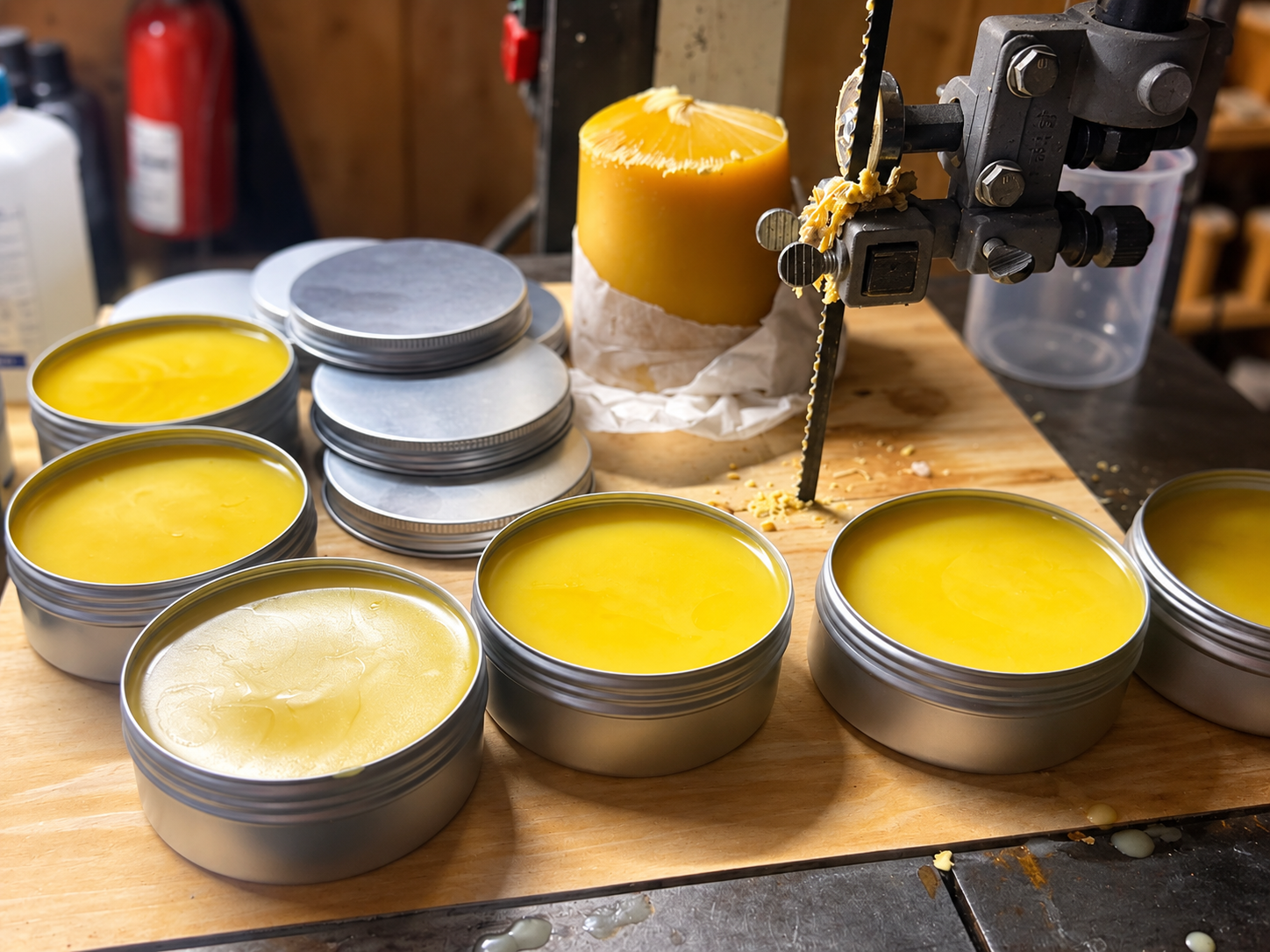
Please pardon our dust! Small-batch SUI WASSER balm cooling in our converted wood shop. The same space once used to build beds, chairs, tables, and lamps has become the workshop where we formulate, test and produce our skincare.
Old Knowledge Meets Modern Formulation
Some of the materials we work with aren’t particularly new. Quite the opposite. Beeswax. Botanical oils. Arnica. Rosemary. Jojoba. Sea buckthorn. Humans have turned to plants, oils, waxes and botanical preparations to care for their skin and bodies for generations. We think there’s value in that accumulated knowledge.
But we’re not interested in pretending that everything old is automatically better—or that “natural” is synonymous with effective, gentle or appropriate for every person’s skin. Modern cosmetic science gives us materials and formulation knowledge that earlier generations simply didn’t have. So our approach is to bring the two together.
Traditional waxes, botanical oils and plant-derived ingredients can be combined with modern emollients, antioxidants and formulation techniques to improve texture, stability, application and overall skin feel.
The objective isn’t to make skincare the old way. It’s to learn from the old ways and improve upon them with what we know today.
Why Balm?
Our preference for balms grew naturally out of that philosophy. Many conventional skincare products are largely water-based and loaded with petroleum fillers. There are good and bad reasons for that. One, there are many excellent medical-grade additives. Two, lotion and cream bases are incredibly cheap.
But we became interested in another approach: concentrated, anhydrous formulations, built primarily from oils, waxes, emollients and other oil-compatible ingredients gives you long-lasting performance. Waxes and oils don’t evaporate—they get absorbed.
Without water occupying much of the formula, a balm gives us a very different canvas to work with.
It also creates the rich, substantial skin feel we wanted after long periods outside—something you can apply deliberately, massage into the skin and leave behind. Balms are as close as you can get to an all over bandaide. As an emollient and occlusive layer are applied they immediately being to reduce moisture loss and supports the skin barrier.
That long-lasting performance is an important part of the SUI WASSER’s value proposition and corner stone to our system. Not because everyone should replace every moisturizer with a balm, but because as we age our skin needs more support, longer lasting protection and deeper hydration.
Skincare for People Who Live Outside
Ultimately, that’s what connects everything we make. SUI WASSER isn’t really about skiing. It isn’t about cycling, climbing, farming, construction, gardening or mountain biking either. It’s about the common denominator connecting all of them: time outside.
A ski coach standing on snow for six hours and a farmer working through an Iowa summer may live very different lives, but their skin encounters many of the same environmental stresses. Sun. Wind. Cold. Heat. Dry air. Sweat. Friction. Repeated exposure. And importantly, those exposures don’t happen once. They accumulate across seasons and years. That’s why we’ve increasingly come to think about outdoor skincare as a system:
Outdoor Lifestyle → Repeated Environmental Exposure → Skin Stress → Post-Exposure Care → Long-Term Skin Health → Skin Longevity
That is the problem SUI WASSER is being built to address.
We’re Still Building It
Perhaps the most important part of the workshop mentality is recognizing that a product is rarely finished simply because you’ve made something that works well. There is always something to learn. A different ingredient to investigate. A texture that could be improved. A formulation that could be simplified. Feedback from someone using a product in conditions we hadn’t anticipated.
SUI WASSER is still a young company, and we don’t want to hide that. We make our products in small batches. We listen to the people using them. We continue experimenting. And when we think we can make something better, we go back into the workshop and try. That’s part of what Built From Experience means to us.
Experience isn’t something that happened before SUI WASSER—It’s how we’re building SUI WASSER.
Protect Before. Care After. Support for the Long Term.
We aren’t interested in telling people who love being outdoors to spend less of their lives outside. Quite the opposite. We want to help build a better approach to skincare for the people who intend to keep skiing, riding, climbing, hiking, working, gardening, exploring and getting dirty for as long as they’re able.
Protect your skin before exposure. Care for it afterward. Support it between adventures. And think about its health not just tomorrow, but ten, twenty and thirty years from now. Because Skin Longevity isn’t about changing the life you live. It’s about taking better care of the skin you’re going to live it in.
