
What Happened When I Used Trail Recovery+ on My Feet for an Entire Summer
There are certain parts of our bodies we tend to ignore until they start giving us problems. For me, my feet were one of them.
I’ve spent most of my life in outdoor sports. Years of alpine ski racing were followed by decades of coaching and extreme outdoor sports. During the winter, my feet can be locked inside ski boots six days a week—sometimes for eight, ten, or even fourteen hours at a time.
Then ski season ends and those same feet go straight into cycling, running, climbing, or water shoes. They’ve taken a beating.
And until recently, caring for the skin on my feet, toes, ankles and lower legs simply wasn’t something I thought much about.
Do you have a SUI WASSER story to share? Please share it with us. Use our Contact Us page or email us at: mya@suiwasser.com
The Starting Point
The original photographs below were taken in January, in the middle of ski season, after approximately five hours of coaching alpine skiing in temperatures around -10°F.
My feet were characteristic of what I’d come to consider normal for winter: extremely dry skin, rough cuticles, peeling and flaking around the toes, and generally weathered-looking skin.
Some of that undoubtedly comes from decades of use. Some comes from winter. Some comes from spending countless hours with my feet confined inside ski boots.
Whatever the combination, they weren’t exactly something to write home about.
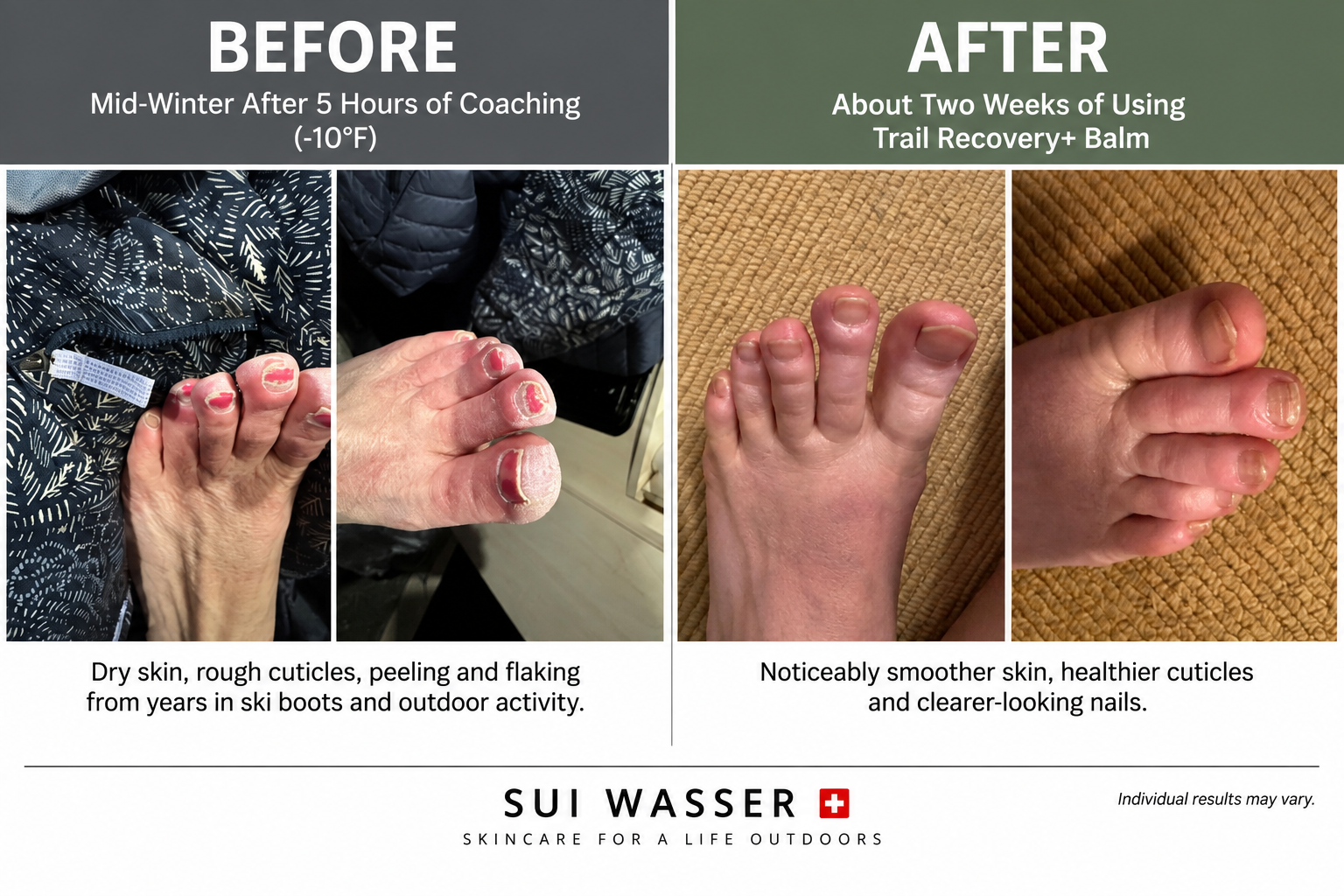
SUI WASSER Trail Recovery+ Balm before-and-after case study showing dry, weather-stressed feet and toes before and after regular balm use.
Then I Started Using Trail Recovery+
When I originally developed Trail Recovery+, I wasn’t thinking about making a foot-care product. Trail Recovery+ grew out of our Recovery+ balm and was formulated as a multi-purpose post-activity massage balm featuring Arnica, Eucalyptus and Rosemary, alongside the oils, waxes and skin-conditioning ingredients used throughout the SUI WASSER balm system.
I initially began applying it regularly to my lower legs and ankles. Then I started using it on my feet. My routine wasn’t particularly complicated. I generally applied Trail Recovery+ before bed several nights per week, massaging a small amount into my feet, around my toes, cuticles and ankles.
Within a couple of weeks, I began noticing a difference in how the skin looked and felt.
So I kept using it.
Several Months Later
The photographs, (to the right,) above show my feet after consistent use. The most obvious difference to me isn’t actually the toenails. It’s the skin. The skin surrounding my toes appears considerably less dry and rough. The cuticles look better conditioned. The skin across the toes and forefoot appears smoother and healthier. That’s precisely the kind of change I’d expect a concentrated waterless balm to support.
Balms provide emollient oils and an occlusive layer that can help soften dry skin and reduce moisture loss—something particularly useful for skin repeatedly subjected to cold, dry air, footwear, friction and long periods outdoors.
What About the Toenails?
There’s an interesting change there too—but this is where we need to be careful.
Several of my toenails appear noticeably clearer and smoother in the later photographs. I cannot say Trail Recovery+ caused that change. Toenails grow slowly, and their appearance can change for numerous reasons, including repeated trauma from footwear, nail polish and polish removal, environmental conditions, fungal organisms, and simply damaged nail gradually growing out.
Trail Recovery+ also isn’t an antifungal medication, and I don’t want to represent it as one. What I can document is what you see in these photographs: while using Trail Recovery+ consistently, both the surrounding skin and the overall appearance of several nails improved.
And that’s interesting enough on its own.
Why Trail Recovery+ May Be Particularly Well Suited to Feet
Feet present an unusual skincare environment. They’re subjected to pressure, friction, sweat, footwear and, for many outdoor athletes and workers, repeated cycles of wet/dry, hot/cold and prolonged confinement. Trail Recovery+ combines the basic benefits of a concentrated waterless balm with botanicals selected for post-activity massage and skin conditioning. For me, that has made it an unexpectedly useful addition to my routine.
How I’ve Been Using It
My current routine is simple:
Apply a small amount of Trail Recovery+ to the feet, toes and ankles before bed approximately three or more nights per week.
Massage it into particularly dry areas, around the toes and cuticles.
Reapply during the day when skin feels especially dry or depleted.
During ski season, I may also apply a light amount before putting on my boots.
A little goes a surprisingly long way.
The Bigger Lesson
This experiment also reinforced something I’ve increasingly come to believe while developing SUI WASSER: We tend to think about skincare primarily in terms of our faces. But if you spend your life outdoors, the rest of your body is accumulating exposure too. Hands. Feet. Ankles. Lower legs. Knees. Elbows. They experience cold, heat, dry air, friction, repetitive activity and environmental exposure year after year. They’re worth taking care of.
My feet certainly aren’t going to win any modeling contracts. But after a lifetime of ski racing, ski coaching, cycling and running, I’m pretty happy with the direction they’re heading. And I’m going to keep using Trail Recovery+ on them.
— Mya Schaefer, Founder, SUI WASSER
These photographs document my personal experience using Trail Recovery+. Individual experiences will vary. Trail Recovery+ is a cosmetic skincare and massage balm and is not intended to diagnose, treat, cure or prevent fungal infections or other medical conditions.
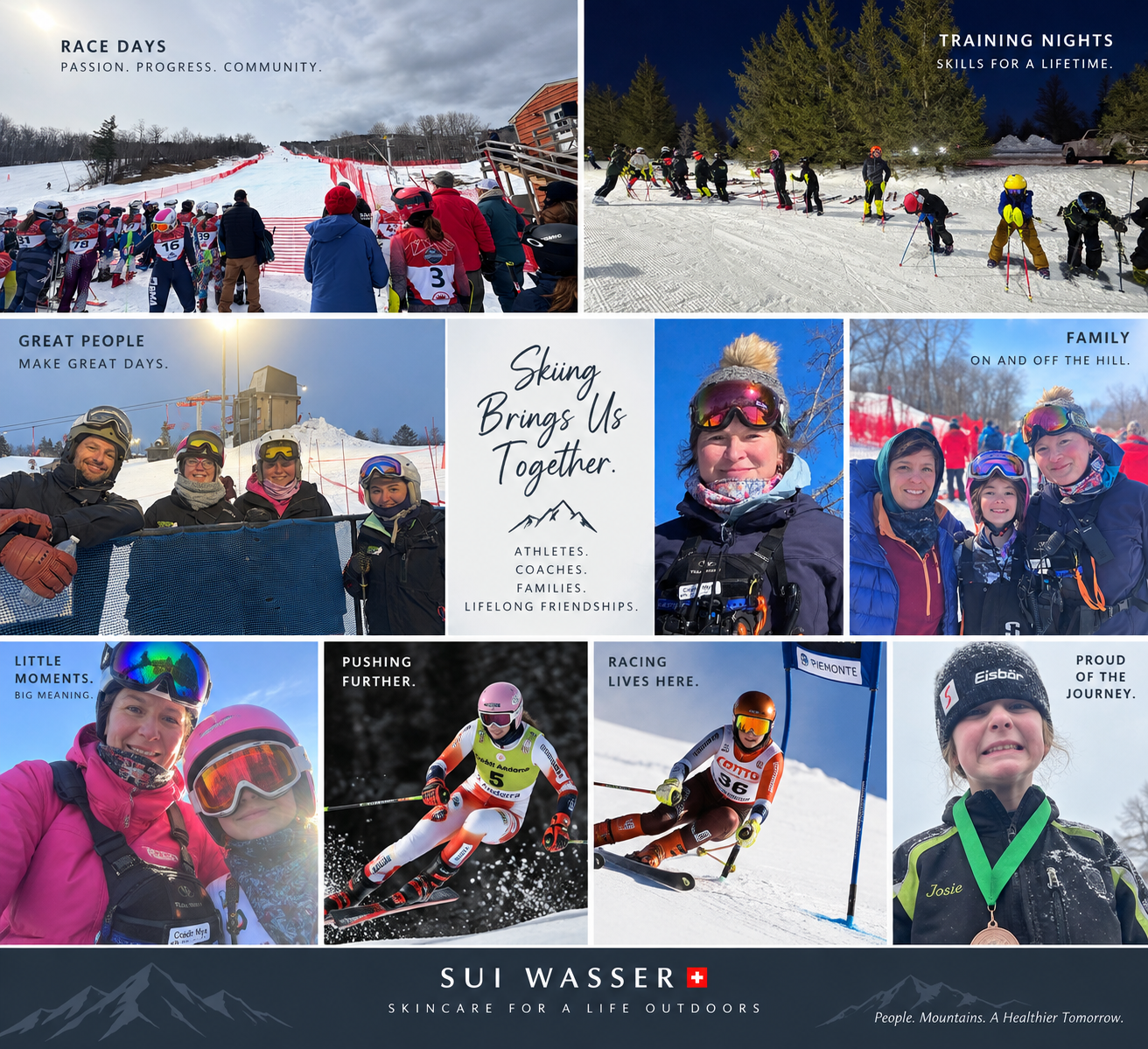
Alpine Ski Racing—much more than a sport—builds community.
