Why fatty-acid diversity matters for Skin Longevity—and why one celebrated ingredient rarely tells the whole story.
The skincare industry loves a hero ingredient. Vitamin C. Collagen. Retinol. The list goes on. Every year, another miracle molecule. Another botanical breakthrough. Another expensive jar promising to change everything. And another marketing campaign convincing you that your skin is missing something.
Meanwhile, plenty of those miracle ingredients are swimming in water-heavy formulas, surrounded by emulsifiers, thickeners, and other ingredients chosen as much for manufacturing costs, texture, and shelf life as for what they actually deliver to your skin.
Because what’s good for a manufacturer’s bottom line isn’t necessarily what’s best for your skin. We’re not saying water is bad. We’re saying water isn’t the miracle they’re selling you. Here’s what the beauty industry doesn’t spend nearly enough time talking about:
YOUR SKIN DOESN’T RUN ON HYPE. IT RUNS ON BIOLOGY.
And a critical part of that biology is lipids. Not one miracle oil. Not one fashionable molecule. A complex, carefully organized system of fatty acids, ceramides, cholesterol, and other compounds working together to maintain your skin’s protective barrier. Because skin that spends a lifetime exposed to sun, wind, cold, heat, dry air, sweat, and environmental stress needs more than another marketing sensation.
It needs a healthy lipid environment.
That means understanding the fats and oils that help maintain the skin barrier, reduce moisture loss, and support the conditions necessary for healthy skin. It also means understanding what your skin actually allows in—and what it keeps out. The 500 Dalton Rule reminds us that molecular size matters: many larger molecules struggle to penetrate intact skin, regardless of how impressive they sound on an ingredient label.
Because what you put on your skin and what actually gets into your skin are two very different things. At SUI WASSER, we believe that conversation should begin with fatty acids.
YOUR SKIN DOESN’T NEED ANOTHER MIRACLE INGREDIENT. IT NEEDS BETTER LIPIDS.
Your Skin Is Built to Depend on Lipids
The outermost layer of your skin, called the stratum corneum, is often described as a brick-and-mortar structure. The bricks are flattened skin cells called corneocytes. The mortar is a highly organized mixture of lipids, primarily ceramides, cholesterol, and free fatty acids.
Together, they form a protective barrier that helps regulate water loss and limits the penetration of external substances. This isn’t simply a cosmetic feature. It’s fundamental skin biology.
When the barrier becomes compromised, skin can lose moisture more readily and become increasingly susceptible to dryness, irritation, and environmental discomfort.
For people who spend significant time outdoors, maintaining that barrier is particularly important. Cold temperatures, low humidity, wind, repeated washing, and other environmental conditions can challenge the skin’s ability to maintain comfortable hydration.
Your skin doesn’t just need moisture. It needs the lipid architecture that helps keep moisture where it belongs.
Your Skin Changes With Age. Your Skincare Should, Too.
Your skin at 40, 50, or 60 isn’t the same skin you had at 20 or 25. So why would you treat it the same way? As we age, our skin undergoes changes that go far beyond wrinkles, fine lines, and the occasional gray hair.
The skin’s ability to produce and organize lipids can change. Sebum production often declines, particularly with hormonal changes. Epidermal renewal may slow, and the skin’s ability to recover from barrier disruption can become less efficient. The result?
Skin that can become drier, more fragile, and less forgiving of environmental punishment. And for those of us who have spent decades outdoors, there’s another factor: cumulative exposure.
Years of sun, wind, cold, dry air, and other environmental stresses can influence how our skin looks, feels, and functions. Ultraviolet radiation, in particular, contributes to photoaging through changes involving collagen, elastin, pigmentation, and cellular signaling.
But here’s where things get interesting.
Skin Longevity Begins With a Stronger Lipid Barrier
Your skin’s protective barrier is an extraordinary biological structure. Its effectiveness depends on the precise organization of three principal lipid classes: ceramides, cholesterol, and free fatty acids.
Together, these lipids form highly organized layers between the cells of the stratum corneum, creating a permeability barrier that regulates water loss and helps protect the skin from environmental stress.
IMPORTANT: The quality, composition, and organization of these lipids directly influence how effectively your skin maintains its protective function.
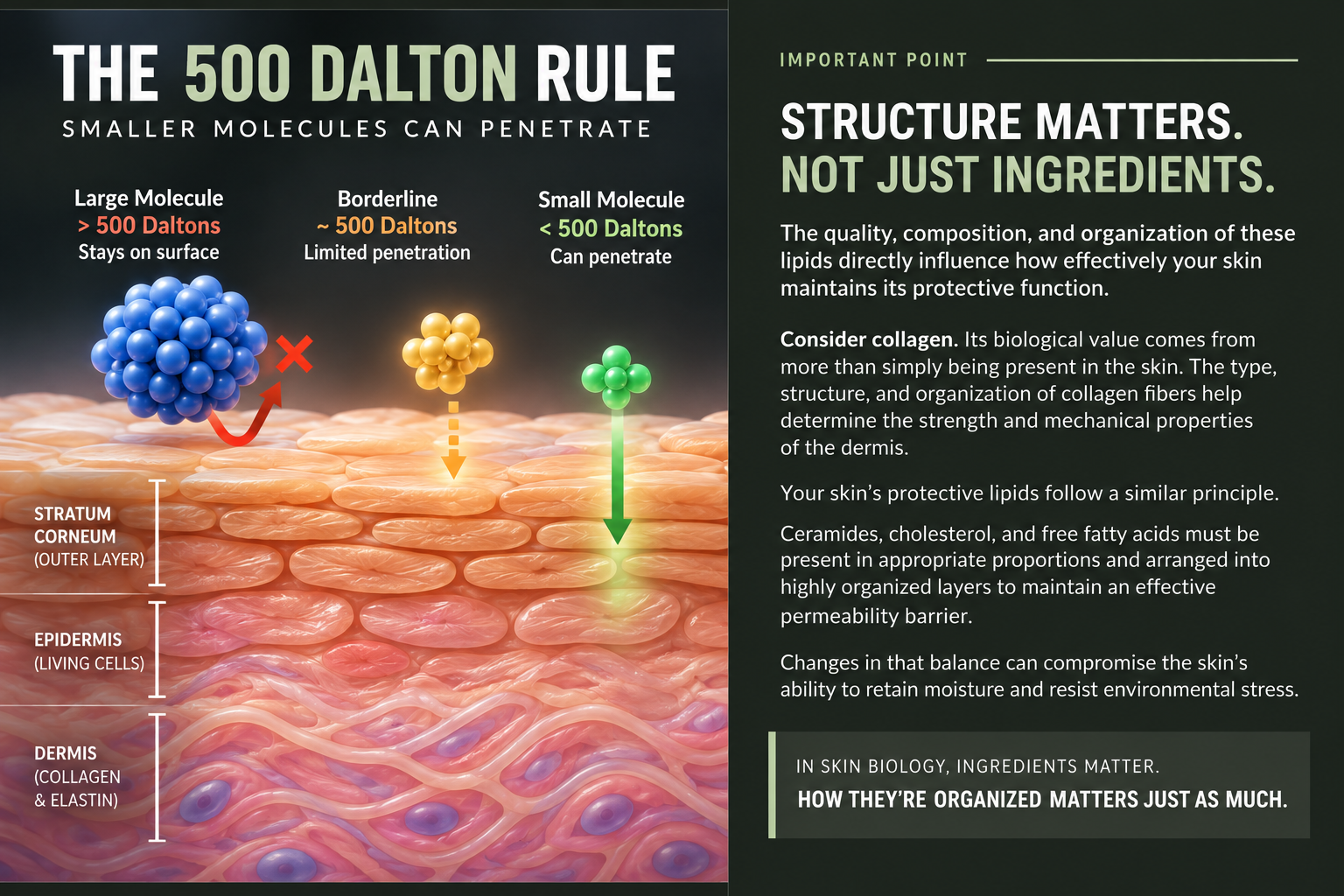
THE 500 DALTON RULE | WHY MOLECULAR SIZE MATTERS
This scientific illustration demonstrates how molecular size influences the ability of skincare ingredients to penetrate the skin’s protective barrier. Molecules larger than approximately 500 Daltons generally have difficulty crossing the intact stratum corneum, while smaller molecules have greater potential to penetrate.
The illustration also highlights the importance of skin structure, from the lipid-rich outer barrier to the collagen-supported dermis.
The takeaway: Effective skincare depends on more than ingredient selection. Molecular size, formulation chemistry, and the organization of the skin’s protective lipids all influence how ingredients interact with the skin.
The 500 Dalton Rule is a useful guideline, not an absolute cutoff. Smaller molecules are not guaranteed to penetrate, and larger molecules can still provide valuable surface-level moisturizing and protective benefits.
As skin ages, changes in epidermal lipid metabolism and barrier recovery can compromise its ability to respond to environmental challenges. Although baseline barrier function may remain relatively intact, recovery following disruption often becomes slower.
For people who spend their lives outdoors, that biological reality carries additional consequences.
Cold temperatures, low humidity, wind, and repeated exposure to the elements place additional demands on the skin’s protective barrier. Environmental conditions can accelerate moisture loss, contribute to surface dryness, and increase the need for effective barrier support.
The Science of Lipid-Rich Skincare
Effective moisturizing involves three complementary mechanisms: attracting water, softening and conditioning the skin, and reducing excessive water loss.
Humectants help attract and retain water. Emollients improve skin softness and flexibility. Occlusive ingredients create a protective layer that helps reduce evaporation from the skin’s surface.
Lipid-rich balms can be particularly effective at delivering sustained emollient and occlusive support because their oils and waxes remain on the skin rather than evaporating like the water component of a conventional lotion.
Botanical oils introduce another dimension: fatty-acid diversity.
Different plant oils contain distinct proportions of linoleic acid, oleic acid, alpha-linolenic acid, and other fatty acids, alongside varying concentrations of phytosterols, tocopherols, and additional lipid-soluble constituents.
These differences influence how an oil behaves within a formulation, how it interacts with the skin’s surface, and its potential contribution to conditioning and barrier support.
Linoleic acid is especially relevant because it participates in epidermal lipid metabolism and is required for the formation of certain specialized ceramides essential to normal barrier function.
Other fatty acids contribute different properties, including emollience and changes in the way oils spread and interact with the skin.
Ingredient diversity creates formulation opportunities that a single botanical oil cannot provide on its own.
The objective is to combine complementary lipid ingredients into a formulation that delivers effective conditioning, lasting moisture retention, and practical protection against environmental dryness.
For skin that has experienced decades of outdoor exposure, this approach makes lipid management an important component of a broader Skin Longevity routine.
Aging Is Inevitable. Neglecting Your Skin Isn’t.
Skin aging is a continuous biological process shaped by genetics, time, and accumulated environmental exposure.
Ultraviolet radiation, oxidative stress, changing lipid metabolism, and declining recovery capacity all influence how skin looks, feels, and functions over a lifetime.
The condition of aging skin is influenced by how consistently we protect and care for it.
Thoughtful skincare can help maintain hydration, reduce dryness, support barrier function, and improve skin comfort. Consistent sun protection remains essential for reducing avoidable UV damage, while post-exposure care addresses the moisture and conditioning needs of skin challenged by the elements.
That’s the foundation of SUI WASSER’s approach: PROTECT. REPLENISH. RECOVER.
Protect skin against unnecessary environmental exposure. Replenish moisture and provide complementary lipid-rich conditioning. Recover comfort and maintain a consistent skincare routine after time spent outdoors. Skin Longevity is a commitment to caring for the skin that carries you through every season, every adventure, and every decade of your life.
Because the goal is to keep living outdoors—and keep your skin ready for what’s next.
Not All Fatty Acids Are Created Equal
Fatty acids are fundamental components of many botanical oils and naturally occurring skin lipids. But they aren’t interchangeable. Their molecular structures influence their physical properties, biological roles, and behavior within skincare formulations.
Understanding these differences helps explain why combining carefully selected oils can make more sense than relying on one fashionable ingredient.
Linoleic Acid: The Barrier Connection
Linoleic acid is an essential omega-6 polyunsaturated fatty acid found in many botanical oils. It’s especially interesting because of its role in normal epidermal barrier biology.
Linoleic acid is incorporated into specialized skin lipids called acylceramides, which are important for the organization and integrity of the skin’s permeability barrier.
Botanical oils such as sunflower, rosehip, oat, and pumpkin seed oil can provide linoleic acid, although concentrations vary considerably by source and processing.
That doesn’t mean every linoleic-acid-rich oil automatically repairs damaged skin. It means linoleic acid has a well-established biological role worth understanding when selecting ingredients for barrier-focused skincare.
Oleic Acid: Conditioning With a Different Personality
Oleic acid is a monounsaturated omega-9 fatty acid found in numerous botanical oils. Unlike linoleic acid, it isn’t considered an essential fatty acid because the human body can synthesize it. Oleic-acid-rich oils can contribute desirable emollient properties, helping products spread and leaving skin feeling softer and more conditioned.
But here’s where ingredient marketing often gets ahead of the science. Free oleic acid, particularly at elevated concentrations, can disrupt the organization of skin-barrier lipids and increase skin permeability.
That doesn’t make every oleic-acid-rich botanical oil undesirable. Fatty acids contained within intact triglycerides behave differently from isolated free fatty acids, and finished formulations have their own characteristics.
The lesson is simple: an ingredient’s value depends on its form, concentration, and the company it keeps.
Alpha-Linolenic Acid: Another Dimension of Lipid Diversity
Alpha-linolenic acid, or ALA, is an essential omega-3 polyunsaturated fatty acid. It’s present in certain botanical seed oils, including rosehip oil. Omega-3 fatty acids participate in important biological pathways, including those involved in cellular membranes and inflammatory signaling.
However, research involving dietary omega-3 fatty acids shouldn’t automatically be interpreted as evidence that applying an omega-3-rich cosmetic oil produces the same effects.
For topical skincare, formulation stability, delivery, concentration, and the evidence supporting the finished product all matter. Nevertheless, ALA contributes another dimension to the fatty-acid profiles available from botanical oils.
Palmitic Acid: Structure Matters, Too
Palmitic acid is a saturated fatty acid found in human tissues and numerous plant-derived oils. It differs structurally from the unsaturated fatty acids discussed above.
In cosmetic formulations, palmitic-acid-containing ingredients can contribute to texture, consistency, and emollient characteristics. Its presence also helps illustrate an important principle: botanical oils aren’t composed exclusively of omega-3, omega-6, or omega-9 fatty acids. They contain mixtures of saturated and unsaturated fatty acids, each contributing different properties.
Then There’s Punicic Acid
Pomegranate seed oil introduces another interesting molecule: punicic acid. Often classified as an omega-5 fatty acid, punicic acid is a conjugated polyunsaturated fatty acid found in unusually high concentrations in pomegranate seed oil.
Its chemical structure differs from that of conventional linoleic and alpha-linolenic acids. That distinction has attracted scientific interest, including research into its biological activity. But research interest isn’t the same as demonstrated clinical benefit from a finished cosmetic product.
For SUI WASSER, pomegranate seed oil is interesting because it contributes a distinctive fatty-acid profile to a broader formulation strategy. Different oils. Different chemistry. Different reasons for being there.
Fatty Acids Aren’t the Whole Story
Here’s something that often gets lost in discussions about botanical skincare. An oil isn’t just a container of fatty acids. Depending on its botanical source, extraction method, and refinement, it may also contain smaller quantities of other compounds.
These can include:
Phytosterols: Plant-derived sterol compounds that contribute to the chemical diversity of botanical oils.
Tocopherols and tocotrienols: Members of the vitamin E family with different antioxidant properties.
Carotenoids: Naturally occurring pigments found in certain botanical ingredients, including sea buckthorn berry oil.
Phenolic compounds: A diverse group of plant-derived molecules, some of which exhibit antioxidant activity under appropriate conditions.
These compounds don’t all behave the same way. Nor are they necessarily present in concentrations sufficient to produce measurable effects when incorporated into a finished balm. But their presence helps explain why two botanical oils with similar major fatty-acid profiles can still differ in color, stability, texture, and chemical composition.
It’s also why ingredient selection deserves more thought than simply choosing whichever oil is trending.
The Case for Ingredient Diversity
At SUI WASSER, we don’t believe that piling ingredients into a formula automatically makes it better. More isn’t always more. Every additional ingredient introduces considerations involving concentration, stability, compatibility, sourcing, cost, and potential sensitivity. But thoughtfully selected diversity can serve a purpose.
Consider some of the oils used in our formulation work.
Meadowfoam Seed Oil brings an unusual long-chain fatty-acid profile and excellent oxidative stability.
Jojoba Oil is technically a liquid wax ester rather than a conventional triglyceride oil, contributing a different lipid structure and desirable emollient properties.
Rosehip Oil introduces a profile rich in polyunsaturated fatty acids, including linoleic and alpha-linolenic acids.
Pomegranate Seed Oil contributes punicic acid and a distinctive lipid composition.
Oat Oil offers fatty acids alongside other lipid constituents, including phytosterols.
Sea Buckthorn Berry Oil contributes fatty acids and naturally occurring carotenoids responsible for its characteristic color.
Each ingredient has a different chemical identity. Each presents different formulation opportunities and limitations. And none should be expected to accomplish everything on its own. Our objective isn’t to collect exotic oils. It’s to formulate with intention.
Why We Build Balms Instead of Chasing Another Lotion
The lipid conversation also helps explain SUI WASSER’s interest in waterless balms. A conventional lotion typically contains water, oils, emulsifiers, and a preservation system. A waterless balm takes a different approach. It combines oils, waxes, and other compatible ingredients into a concentrated, predominantly lipid-based product. Because there’s no substantial water phase to evaporate after application, the product can leave a persistent emollient film on the skin.
Depending on the formula, that film can help reduce moisture loss and protect against the drying effects of environmental conditions. Anhydrous formulations also generally present lower microbial-growth risks than comparable water-containing emulsions, although good manufacturing practices and appropriate stability and safety evaluations remain essential. None of this means that every balm outperforms every lotion.
Performance depends on the complete formulation, how it’s used, and what the skin needs. But for people repeatedly exposed to cold, wind, and dry air, a well-designed balm can be an especially practical skincare format.
Skin Longevity Isn’t About Finding One Perfect Oil
Skin is a living, constantly changing organ. Its barrier is influenced by age, genetics, environmental exposure, cleansing habits, hydration, and numerous biological processes. No single botanical oil can address all of those factors. And no cosmetic balm can replace sunscreen, eliminate UV-induced DNA damage, or reverse every consequence of environmental exposure. That’s not the promise we’re making.
Our approach to Skin Longevity is about supporting healthy skin over time through a consistent routine built around protection, replenishment, and post-exposure care. We believe ingredient selection should reflect the complexity of the skin itself. That means four things:
Understanding fatty acids.
Understanding the skin barrier.
Understanding antioxidant chemistry.
Recognizing the difference between promising ingredient research and demonstrated finished-product performance.
Because the objective isn’t to chase the next miracle. It’s to give skin a thoughtfully designed combination of lipids and skin-conditioning ingredients that makes sense for a lifetime outdoors.
PROTECT → REPLENISH → RECOVER
SUI WASSER develops waterless, lipid-rich skincare for people who live life outdoors. Our formulations bring together complementary botanical oils, waxes, and carefully selected skin-conditioning ingredients to support daily skincare before and after environmental exposure.
Our Promise… LESS MIRACLE MARKETING. MORE FORMULATION SCIENCE. THAT’S SKIN LONGEVITY.

IMAGE: THE ANTI-AGING MARKETING MACHINE
A beautiful 28-year-old face selling the dream of ageless skin. (Madeline Cline, brand ambassador for Revlon.)
There’s just one problem.
Looking young when you’re young isn’t a skincare breakthrough.
It’s biology.
And biology deserves better than miracle marketing.
FURTHER READING
& SCIENTIFIC REFERENCES
Skin Longevity isn't built on miracle ingredients or marketing promises. It's informed by decades of research into skin-barrier biology, lipid composition, environmental exposure, and the changes our skin experiences throughout life.
For readers who want to explore the science behind this article, the following publications provide a deeper understanding of why lipids matter—and why the composition of a skincare formulation deserves more attention than any single celebrated ingredient.
01 / UNDERSTANDING THE SKIN'S LIPID BARRIER
The Skin Barrier: An Extraordinary Interface With an Exceptional Lipid Organization
A comprehensive scientific review examining the complex organization of lipids within the stratum corneum. The authors explain how ceramides, cholesterol, and free fatty acids form highly organized structures that help regulate skin permeability and prevent excessive water loss.
Healthy barrier function depends on lipid composition and organization, not simply the presence of moisture.
Role of Lipids in the Formation and Maintenance of the Cutaneous Permeability Barrier
An examination of the biological processes responsible for creating and maintaining the skin's permeability barrier, including the roles of ceramides, cholesterol, and fatty acids.
Provides the biological foundation for understanding why the skin barrier is a structured lipid system rather than simply a layer of oil.
Skin Lipid Barrier: Structure, Function and Metabolism
A detailed review of lipid metabolism in the epidermis, including the formation of specialized ceramides and the organization of lipid layers that protect against water loss and environmental penetration.
Explains how skin cells produce and organize barrier lipids and why disturbances in those processes can compromise normal skin function.
02 / FATTY ACIDS & BOTANICAL OILS
The Role of Linoleic Acid in Skin and Hair Health: A Review
An examination of linoleic acid's biological functions, including its involvement in specialized epidermal ceramides and maintenance of the skin barrier.
Supports our discussion of omega-6 fatty acids and explains why linoleic acid deserves particular attention in barrier-focused skincare research.
Anti-Inflammatory and Skin Barrier Repair Effects of Topical Application of Some Plant Oils
Published in the International Journal of Molecular Sciences, this review examines various botanical oils, their fatty-acid compositions, antioxidant constituents, and the scientific evidence concerning their effects on skin.
Particularly relevant to SUI WASSER's formulation philosophy. Botanical oils differ considerably in chemical composition, and those differences can influence their suitability for topical applications.
The Heterogeneity and Complexity of Skin Surface Lipids in Human Skin Health and Disease
A review exploring the remarkable diversity of lipids found on the skin's surface, including epidermal barrier lipids and sebum-derived lipids.
Reinforces the distinction between the skin's naturally organized lipid barrier and the broader mixture of oils, waxes, and other lipids present at its surface.
03 / AGING SKIN & BARRIER RECOVERY
The Aged Epidermal Permeability Barrier: Structural, Functional, and Lipid Biochemical Abnormalities in Humans and a Senescent Murine Model
Published in the Journal of Clinical Investigation, this research investigated age-associated changes in epidermal barrier structure, lipid composition, and recovery.
Provides direct scientific support for our discussion of how aging can affect barrier resilience and recovery.
The Aged Epidermal Permeability Barrier: Basis for Functional Abnormalities
A review of age-related changes in epidermal barrier function, including altered lipid synthesis, barrier recovery, and the effects of photoaging.
Helps explain why skincare requirements may change as we age and why maintaining barrier function becomes particularly important over a lifetime of environmental exposure.
04 / UNDERSTANDING SKIN PENETRATION
The 500 Dalton Rule for the Skin Penetration of Chemical Compounds and Drugs
Published in Experimental Dermatology, this influential paper introduced the widely discussed 500 Dalton guideline for molecular penetration through intact skin.
Applying an ingredient to the skin does not guarantee that it penetrates deeply or produces a particular biological effect.
The 500 Dalton guideline is not an absolute rule. Penetration also depends on molecular chemistry, formulation, skin condition, and delivery mechanisms. Many useful skincare ingredients work at the surface or within the outermost skin layers without requiring deep penetration.
READ THE ORIGINAL PUBLICATION →