Why Two Botanical Balms Can Feel Completely Different on Your Skin
A real-world comparison between SUI WASSER ALPIN-GLOW and Frøya Organics (a.k.a. Froya Organics) opens a larger conversation about formulation science, ingredient diversity, skin nutrition, and what our skin actually experiences.
THREE GOLDEN BALMS. ONE INTERESTING OBSERVATION.
Recently, I had the opportunity speak with a a client about their experience between Froya Organics balms she’d been using vs. SUI WASSER’s balms. She ended up sending me a photograph that caught our attention.
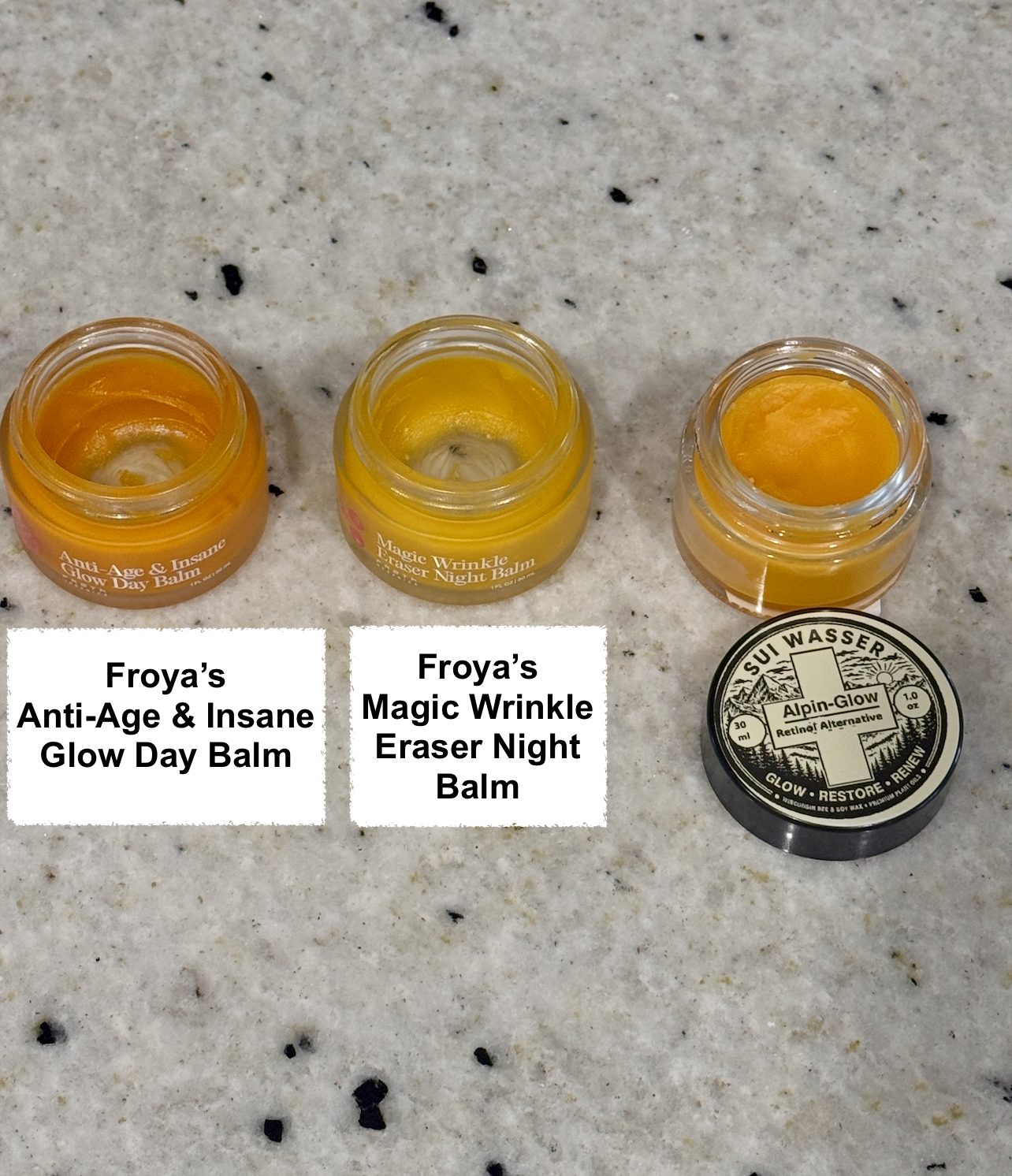
Sitting side by side were three facial balms: Frøya Organics’ Anti-Age & Insane Glow Day Balm, its Magic Wrinkle Eraser Night Balm, and our own SUI WASSER ALPIN-GLOW.
All three shared something visually striking: a rich golden appearance. At first glance, they might appear to belong to the same family of skincare products. Each is positioned around botanical skincare and the appearance of aging skin.
But our customer noticed something interesting when actually using them. “The Alpine-Glow feels better on my skin than the Froya balm!! And I think it’s already minimizing my wrinkles.”
The customer later elaborated: “They have a daytime (darker balm) and night. They are more tacky on the skin and yours is smooth and feels light.”
We found these observations particularly interesting. Not because they establish that one product is universally better than another. They don’t. This is one customer’s personal experience, not a controlled clinical comparison.
What interests us is the distinction between products that appear similar but behave differently when applied. How can three golden botanical balms create such different experiences on the skin? The answer begins with formulation science.
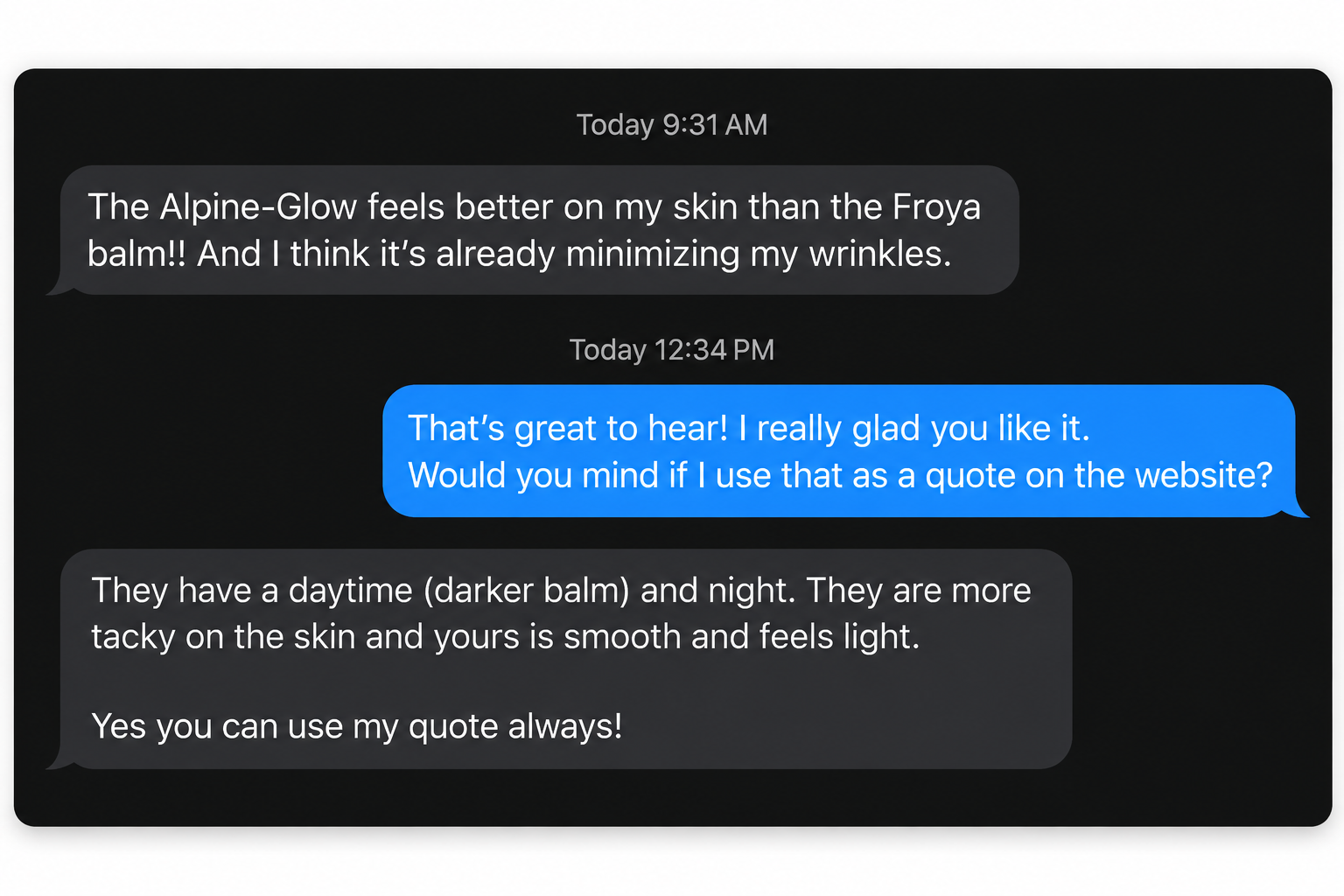
Image above: We document every quote we use. Julie from Arkansas, thank you for your feedback. You enspire us to keep going, to develop better products, and to share what we’re creating with others.
1 | YOUR SKIN DOESN’T EXPERIENCE AN INGREDIENT LIST
It experiences a formulation. This is a principle we’ve explored extensively at SUI WASSER, and it sits at the center of our approach to developing skincare products.
Consumers are frequently encouraged to evaluate products by identifying individual ingredients. Does it contain vitamin C? Does it contain bakuchiol? What about sea buckthorn, jojoba, or antioxidants?
These are reasonable questions, but they only tell part of the story. A finished skincare product is not simply a collection of independent ingredients. It is a carefully constructed physical and chemical system.
Every oil, wax, ester, antioxidant, and botanical component contributes to the behavior of that system. The proportions matter. The relationships between ingredients matter. The physical structure matters. And the way those ingredients interact with the skin matters.
Two products can contain several of the same botanical ingredients yet feel remarkably different. They may spread differently, leave different surface films, exhibit different degrees of tackiness, or create different sensations of softness and comfort. The presence of an ingredient tells us what went into a product. It doesn’t necessarily tell us how that product will perform.
That distinction deserves considerably more attention in skincare.
2 | WHY DO SOME BALMS FEEL HEAVY WHILE OTHERS FEEL LIGHT?
Our customer’s observation about tackiness provides a useful starting point. To understand why balms feel different, we need to look beyond their botanical ingredients and examine their physical structure.
Waxes: More Than Just Thickeners
Waxes help determine a balm’s consistency, melting behavior, structural stability, and the character of the film it leaves behind. Different waxes have different melting characteristics, crystalline structures, and interactions with oils. Their concentrations can substantially influence how a balm behaves.
A formulation with a relatively high proportion of structuring waxes may feel firmer or leave a more persistent surface film. But wax concentration alone does not determine tackiness. The types of oils, esters, and other ingredients surrounding those waxes also influence the result.
And importantly, a persistent surface film isn’t necessarily undesirable. For someone exposed to cold temperatures, dry air, and wind, a substantial protective layer may be precisely what they want. The objective isn’t always to make a balm feel lighter. It’s to create the right formulation for the intended application.
Oils: Not All Lipids Behave the Same Way
Botanical oils vary considerably in their fatty-acid composition, viscosity, oxidation stability, and sensory characteristics. Some spread readily across the skin. Others produce a richer, more substantial sensation.
Some contribute to a lingering surface film, while others can help create a lighter application experience. These differences aren’t necessarily indicators of nutritional value or biological effectiveness. They are formulation characteristics.
And they can be deliberately balanced.
Emollient Esters and Squalane
This is an area where ALPIN-GLOW’s formulation becomes particularly interesting. Alongside its botanical oils, ALPIN-GLOW incorporates ingredients selected partly for their emollient and sensory characteristics. Squalane, for example, is valued for its skin-conditioning properties and relatively lightweight feel.
Certain emollient esters can improve spreading behavior and reduce the perception of greasiness. When appropriately combined with botanical oils and structuring waxes, these ingredients can help produce a balm that feels rich without necessarily feeling heavy.
That balance is intentional. At SUI WASSER, we want ALPIN-GLOW to provide a satisfying application experience while delivering a diverse collection of skin-conditioning ingredients.
A sophisticated balm should be judged not simply by what it contains, but by how successfully its components work together.
3 | THE GOLDEN COLOR: WHAT DOES IT ACTUALLY TELL US?
The photograph also raises another interesting question. Why do these balms share such similar golden and orange colors? Certain botanical ingredients naturally contain pigments, including carotenoids. Sea buckthorn oil, for example, can contribute a vivid orange appearance because of its carotenoid content. Other botanical oils and extracts may contribute yellow, amber, or reddish tones.
In ALPIN-GLOW, the combination of sea buckthorn and other botanical ingredients contributes to the finished balm’s distinctive golden appearance. However, color is not a reliable measurement of antioxidant concentration or skincare effectiveness. Two similarly colored products may contain very different ingredient combinations.
Likewise, a darker product isn’t necessarily more concentrated, more nourishing, or more effective. The visible color tells us something about the finished formulation’s appearance. It tells us much less about its biological performance. The most important characteristics of skincare are not always visible in the jar.
4 | ALPIN-GLOW: FORMULATING FOR MORE THAN ONE PURPOSE
When we developed ALPIN-GLOW, we weren’t interested in creating a product built around a single fashionable ingredient. We wanted to explore a broader question: What would a facial balm look like if we considered several interconnected aspects of skin biology simultaneously?
That question influenced our ingredient selection. ALPIN-GLOW combines botanical oils, lightweight emollients, antioxidant ingredients, and components selected for their potential to support the appearance and condition of skin. Consider some of the formulation’s functional groups.
Skin-Conditioning Lipids
Jojoba, meadowfoam, sunflower, rosehip, and other botanical oils contribute different lipid profiles and formulation characteristics. These ingredients help condition the skin and influence the balm’s application properties. Their fatty-acid compositions vary, creating opportunities to balance sensory performance, stability, and skin-conditioning functions.
Antioxidant Ingredients
ALPIN-GLOW incorporates ingredients such as CoQ10, vitamin E, and tetrahexyldecyl ascorbate, an oil-soluble vitamin C derivative. These ingredients have different chemical properties and potential roles within a skincare formulation. Some may also contribute to protecting the formulation itself against oxidation. However, the presence of antioxidants in a product does not automatically establish that the finished formulation prevents UV-induced damage or reverses existing cellular injury. Those are separate questions requiring appropriate evidence.
Botanical Components
Sea buckthorn, wild carrot, pomegranate, and other botanical ingredients contribute to ALPIN-GLOW’s broader formulation profile. These materials contain different combinations of lipids and naturally occurring compounds. Their value depends on factors such as composition, concentration, stability, and how they behave within the complete formulation.
Bakuchiol and Skin Appearance
Bakuchiol is another component of ALPIN-GLOW. It has attracted scientific interest because some clinical research suggests it may improve certain visible signs of photoaging with sustained use. But it should not be confused with retinol. The two compounds are chemically different, and the available evidence does not establish that every bakuchiol formulation performs equivalently to a retinoid treatment. For us, bakuchiol represents one component of a larger formulation strategy. Not the entire strategy.
5 | WHY MIGHT WRINKLES LOOK LESS NOTICEABLE?
Our customer’s observation that ALPIN-GLOW seemed to be minimizing wrinkles raises an important biological question. What can skincare realistically accomplish, and how quickly? The answer depends partly on what we’re observing.
Immediate Changes in Skin Appearance
The outermost layer of skin, the stratum corneum, plays an essential role in maintaining hydration and barrier function. When this layer becomes dehydrated, the skin’s surface may appear rougher, and fine lines can become more noticeable. Applying an appropriate moisturizer can alter the appearance of the skin relatively quickly. Emollients help smooth the skin’s surface. Occlusive ingredients can reduce water loss. Improved hydration can temporarily make fine dehydration lines less apparent. These effects can produce a visible cosmetic improvement without requiring structural changes deep within the skin.
Longer-Term Changes
Changes involving collagen, elastin, pigmentation, and other aspects of photoaged skin are considerably more complex. Some topical ingredients have been studied for their potential to improve the appearance of photoaging over weeks or months. But these outcomes depend on the ingredient, its concentration, the complete formulation, frequency of application, and individual skin characteristics.
A customer’s observation of smoother-looking skin is valuable feedback. It tells us something about their experience, but it doesn’t establish that collagen production has increased or that wrinkles have been structurally reversed.
Understanding the difference between immediate cosmetic improvements and longer-term biological changes helps consumers develop realistic expectations.
And realistic expectations are fundamental to meaningful skincare—and to our greater objective: Skin Longevity.
Of course, we’re delighted when someone tells us their wrinkles appear less noticeable. We’ve observed similar changes in the appearance of our own skin, and those moments are genuinely rewarding!
But our ambitions extend well beyond the appearance of fine lines and wrinkles.
We are developing products that help people care for their skin throughout their lives. Products that support the skin’s protective barrier, replenish moisture and skin-conditioning lipids, improve comfort, and help skin feel its best through the demands of everyday life and environmental exposure.
Because ultimately, Skin Longevity isn’t about making your skin look younger. It’s about helping you care for the skin you live in—today, tomorrow, and for all the years ahead. And if that journey happens to leave you looking a little smoother, feeling more comfortable, and smiling a little more? We think that’s a pretty wonderful outcome, too. ☺️
6 | SKIN NUTRITION: A MORE COMPLETE CONVERSATION
We frequently hear skincare discussed in terms of individual problems.
Dryness.
Fine lines.
Uneven texture.
Sensitivity.
Environmental damage.
These concerns are real, but the skin does not function as a collection of isolated problems. It is a complex biological organ. Its protective capabilities depend on interconnected processes involving barrier maintenance, lipid organization, hydration, cellular signaling, and responses to environmental stress.
These processes also change throughout life. Age, environmental exposure, genetics, health, and daily habits all influence how skin behaves. At SUI WASSER, we’ve begun using the term Skin Nutrition to describe a broader formulation philosophy.
Not nutrition in the dietary sense. And not the suggestion that applying botanical oils can replace the nutrients delivered through the body’s circulation. Rather, we’re referring to the thoughtful topical use of skin-conditioning lipids, antioxidants, and other ingredients that may support specific aspects of skin condition, comfort, and appearance.
This approach requires more than simply adding as many ingredients as possible. Ingredient diversity is not inherently beneficial. Every additional ingredient introduces questions about concentration, compatibility, stability, safety, and its contribution to the finished product.
The goal is not maximum complexity. The goal is purposeful diversity. A formulation should contain ingredients because they serve identifiable functions, not because their names look impressive on a label.
7 | WHAT CAN WE LEARN FROM THE FRØYA COMPARISON?
Returning to the photograph, we can now appreciate why the customer’s observations are interesting.
Three balms. Similar golden appearances. Different reported application experiences. Our customer preferred the feel of ALPIN-GLOW, describing it as smoother and lighter than the two Frøya products.
That’s meaningful feedback about personal preference and sensory performance. But it doesn’t establish that Frøya’s products are poorly formulated or biologically inferior. A tackier or more persistent surface film might be desirable for certain applications. Different consumers have different preferences.
And without controlled testing and detailed formulation information, we cannot determine precisely which ingredients account for the reported differences. What the comparison demonstrates is something more fundamental.
Products that look similar can behave differently because the complete formulation matters.
The oils matter.
The waxes matter.
The emollients matter.
Their proportions and interactions matter.
And the characteristics of the finished product matter.
This is why comparing ingredient lists alone provides an incomplete picture of skincare quality.
8 | THE PROBLEM WITH MIRACLE INGREDIENTS
The skincare industry has become exceptionally skilled at building stories around individual ingredients. A botanical extract becomes the centerpiece of a product. An antioxidant becomes the headline. A vitamin becomes the promise. And consumers are encouraged to believe that the presence of that ingredient explains the product’s effectiveness.
Sometimes an ingredient has substantial scientific evidence supporting a particular benefit. Sometimes the evidence is preliminary. And sometimes marketing language extends well beyond what the research actually demonstrates. But even when an ingredient is supported by good research, the formulation still matters. An ingredient studied at one concentration in a particular delivery system cannot automatically be expected to perform identically in every product containing it.
Stability matters. Concentration matters. The surrounding ingredients matter. And the finished product must be appropriate for its intended use.
This is one reason we believe skincare deserves a more complete scientific conversation. The question shouldn’t simply be, “Does this product contain a beneficial ingredient?” It should be, “Has this product been thoughtfully formulated to deliver the benefits being promised?”
Those are very different questions.
9 | FROM COSMETIC PROMISES TO SKIN LONGEVITY
There is another distinction worth exploring.
Much of the skincare industry approaches aging as something to defeat.
Erase the wrinkles.
Reverse the years.
Restore youth.
It’s a powerful marketing narrative.
But aging is not a disease, and skin longevity is not about pretending that biological aging can be eliminated.
Our skin changes throughout life.
Its barrier characteristics evolve.
Its responses to environmental stress change.
And its capacity to maintain hydration and recover from certain forms of disruption may decline.
We believe those changes deserve understanding rather than fear.
That philosophy is central to SUI WASSER.
We develop products for people who spend their lives outdoors.
People exposed to wind, cold, dry air, sunlight, and the physical demands of active living.
People whose skin has experienced decades of environmental exposure.
And people who simply want to care for their skin without being told that aging is something shameful.
Our approach is organized around three principles:
PROTECT
Help defend the skin’s moisture barrier against the challenges of environmental exposure.
Appropriate protective skincare can help reduce moisture loss and improve comfort, particularly in cold or dry conditions.
It does not replace sunscreen or other established methods of UV protection.
REPLENISH
Provide thoughtfully selected lipids, emollients, and skin-conditioning ingredients that help maintain softness, flexibility, and a comfortable skin surface.
RECOVER
Support the conditions associated with normal skin-barrier maintenance following environmental stress.
Topical moisturizers can help improve comfort and reduce water loss, but they should not be represented as treatments that reverse UV-induced DNA damage.
These distinctions matter.
Because Skin Longevity should be grounded in biology, not promises that exceed the available evidence.
10 | THE DIFFERENCE IS IN THE FORMULATION
Our customer’s photograph began as a simple product comparison. Three golden balms sitting on a countertop. But the accompanying feedback raised a much larger question.
What makes one skincare formulation feel different from another? The answer cannot be found in color alone. It cannot be determined simply by counting ingredients. And it cannot be reduced to the presence of one celebrated botanical extract.
The finished formulation is the product. Its structure, stability, sensory characteristics, and interactions with the skin all contribute to the experience.
At SUI WASSER, we believe thoughtful formulation deserves as much attention as the individual ingredients that make it possible. We also believe consumers deserve a clearer understanding of what skincare can accomplish, what remains uncertain, and why products that appear similar may behave very differently.
That is the conversation we’re interested in advancing. Not because we believe every skincare product needs more ingredients. Not because we believe one formulation will be ideal for everyone. But because the biology of skin is complex, and the products we apply to it deserve the same thoughtful consideration.
Your skin doesn’t experience an ingredient list—It experiences a formulation—And that difference matters!
SUI WASSER | SKIN LONGEVITY
PROTECT → REPLENISH → RECOVER
Built for a lifetime outdoors.
Editorial note: The customer observations described in this article reflect an individual experience and should not be interpreted as clinical evidence of comparative product performance. Product formulations and ingredient lists may change. Discussion of ingredient functions is educational and does not establish that a particular finished product produces clinical outcomes. Individual results vary.
FURTHER READING
& SCIENTIFIC REFERENCES
Two skincare products can share similar ingredients, colors, and marketing promises while producing remarkably different experiences on the skin.
Understanding these differences requires looking beyond individual ingredients to examine formulation chemistry, emollient behavior, skin-barrier physiology, moisturization, and the scientific evidence behind cosmetic performance.
The following publications provide scientific context for the principles explored in this article. Together, they illustrate why ingredient selection, concentration, physical structure, and the properties of the finished formulation all matter.
The way a balm feels on the skin depends on more than the presence of botanical oils or waxes. Viscosity, spreading behavior, ingredient chemistry, and surface-film characteristics can influence perceived smoothness, tackiness, and comfort.
Predicting Tactile Sensory Attributes of Personal Care Emulsions Based on Instrumental Characterizations: A Review
This scientific review examines relationships between the physical properties of cosmetic formulations and the sensory characteristics experienced during application.
The authors discuss how ingredient composition, rheology, and instrumental measurements can help explain characteristics such as spreadability, texture, and perceived skin feel.
Two products containing similar ingredient categories can behave differently because their complete formulations have different physical properties.
This provides a scientific framework for understanding why a customer might describe one balm as tackier and another as smoother or lighter.
The review focuses on cosmetic emulsions; its findings should not be assumed to establish identical behavior in waterless balms.
Moisturizing formulations work through several complementary mechanisms. Understanding the differences between emollients, occlusives, and humectants helps explain why products can provide different sensory experiences while addressing similar skincare needs.
The Role of Moisturizers in Addressing Various Kinds of Dermatitis: A Review
This review examines the mechanisms through which moisturizers support skin hydration, barrier function, and comfort.
The authors describe the distinct roles of emollients, occlusives, and humectants, along with their relevance to skin conditions involving dryness and barrier disruption.
A product's moisturizing performance depends partly on how its ingredients influence the skin's surface and moisture balance.
A richer or more persistent surface film is not automatically better or worse than a lighter-feeling formulation.
Different formulations may be appropriate for different skin conditions, environments, and personal preferences.
Revitalizing the Skin: Exploring the Role of Barrier Repair Moisturizers
This review explores the role of moisturizers in supporting the skin barrier, including the contributions of physiological lipids, emollients, occlusives, and humectants.
It discusses how different ingredient classes contribute to moisturization and the maintenance of skin-barrier function.
Moisturization is not one isolated mechanism. Different ingredients contribute different functions within the finished product.
This supports the importance of considering formulation balance rather than evaluating a moisturizer solely by its most recognizable ingredient.
Healthy skin depends on a complex protective barrier composed of specialized lipids, proteins, and moisture-regulating structures. The composition and organization of these components influence hydration and protection.
The Skin Barrier and Moisturization: Function, Disruption, and Mechanisms of Repair
This review examines the interconnected physical, chemical, microbiological, and immunological components of the skin barrier.
It also discusses how moisturizers can support different aspects of barrier maintenance and recovery.
The skin barrier is not simply a layer of oil covering the body.
It is a complex biological system whose functions depend on multiple interacting components.
Appropriate moisturization can support certain aspects of barrier function, but topical products do not replace the skin's natural biological processes.
Improvements in the appearance of fine lines may involve different mechanisms depending on the ingredient, formulation, and duration of use.
Immediate improvements in surface smoothness should be distinguished from longer-term changes associated with photoaging.
Prospective, Randomized, Double-Blind Assessment of Topical Bakuchiol and Retinol for Facial Photoageing
This randomized clinical study compared topical bakuchiol and retinol over a 12-week treatment period.
Forty-four participants were assigned to use either a 0.5% bakuchiol formulation twice daily or a 0.5% retinol formulation once daily.
Both groups demonstrated improvements in measured wrinkle surface area and hyperpigmentation, without a statistically significant difference between treatments in those outcomes.
Participants using retinol reported more skin scaling and stinging.
This study provides clinical evidence that bakuchiol may improve certain visible signs of photoaging when used consistently in an appropriately formulated topical product.
However, the findings concern specific formulations and application schedules.
They do not establish that every bakuchiol-containing product produces equivalent results, nor do they demonstrate that immediate changes in wrinkle appearance represent structural skin rejuvenation.
Laboratory findings and ingredient research provide important information, but the experience of using a finished skincare product involves additional considerations.
Emollients and Moisturisers
This dermatology resource explains the functional differences between emollients, occlusives, and humectants.
It also describes why different moisturizing product formats may be preferred for different skin conditions and application needs.
A heavier product is not necessarily more effective, and a lighter product is not necessarily less protective.
Product selection depends on the intended application, individual skin characteristics, tolerability, and the desired balance between comfort and moisture retention.
A NOTE ABOUT INGREDIENT RESEARCH
The scientific publications referenced above examine cosmetic formulation properties, moisturization, skin-barrier physiology, and selected topical ingredients.
These findings establish important scientific principles, but they do not constitute clinical testing of SUI WASSER ALPIN-GLOW or the Frøya Organics products discussed in this article.
The performance of a finished formulation depends on ingredient selection, concentration, compatibility, stability, delivery characteristics, and individual skin responses.
ABOUT CUSTOMER EXPERIENCES
The customer observations discussed in this article represent one individual's experience with the products.
Descriptions such as smoother, lighter, tackier, or more comfortable reflect personal sensory observations.
These experiences should not be interpreted as controlled evidence of comparative effectiveness or clinical superiority.
ABOUT SKIN AGING & COSMETIC CLAIMS
Moisturization can improve skin softness, surface smoothness, and the appearance of fine dehydration lines.
These effects should be distinguished from structural changes involving collagen, elastin, or other components associated with biological skin aging.
Clinical findings involving individual ingredients do not automatically establish equivalent results in other formulations.
ABOUT SKIN NUTRITION
SUI WASSER uses the term Skin Nutrition to describe a topical formulation philosophy involving complementary skin-conditioning lipids, emollients, antioxidants, and other supportive ingredients.
Skin Nutrition is not equivalent to dietary nutrition, and topical skincare cannot replace the nutrients delivered through normal biological processes.
ABOUT ENVIRONMENTAL PROTECTION
Moisturization and skin-barrier support are distinct from ultraviolet protection.
SUI WASSER products are not substitutes for sunscreen, protective clothing, or other established methods of reducing ultraviolet exposure.
