What Is Bakuchiol—and Why Are We Putting It in Alpin-Glow?
Spend enough time looking at skincare for mature or sun-exposed skin and eventually you’ll encounter retinol. Retinol and other retinoids have become some of the best-known ingredients for improving the appearance of photoaged skin.
But there’s another ingredient attracting considerable attention: bakuchiol.
Bakuchiol is a plant-derived compound that is chemically different from retinol. It isn’t vitamin A and it isn’t technically a retinoid. Yet research suggests that bakuchiol can produce some retinol-like effects in skin—which is why it has become particularly interesting to us as we develop Alpin-Glow.
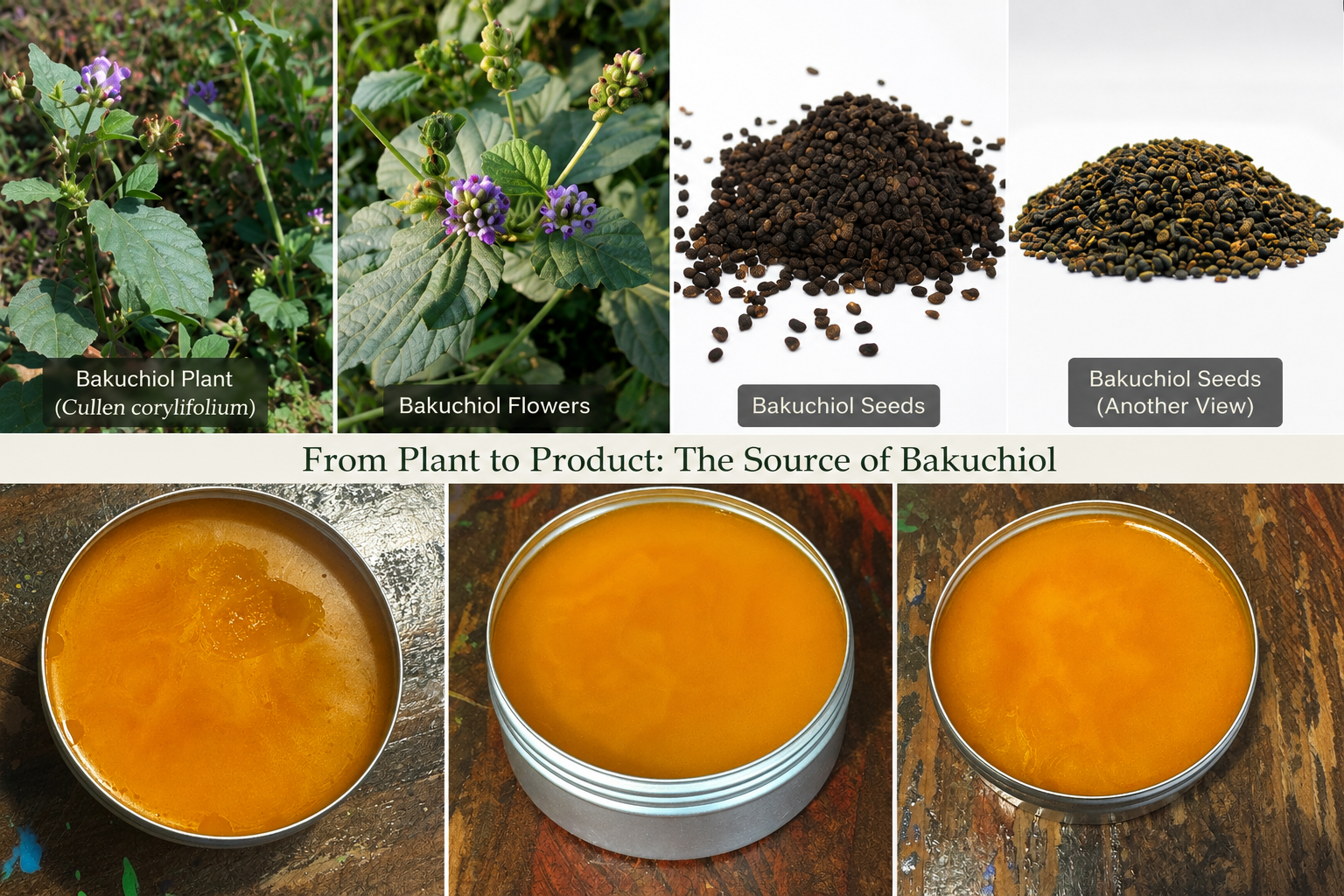
From plant to product: Bakuchiol is a plant-derived skincare ingredient associated with the babchi plant (Cullen corylifolium). This collage shows the purple-flowering plant and its dark seeds alongside small-batch Alpin-Glow balm, illustrating the botanical origins behind one of Alpin-Glow’s key ingredients.
Bakuchiol vs. Retinol: What Did the Research Find?
One particularly interesting clinical study directly compared bakuchiol and retinol.
Researchers conducted a randomized, double-blind 12-week study involving 44 participants. One group applied a cream containing 0.5% bakuchiol twice daily, while another applied 0.5% retinol once daily.
At the end of the study, both groups showed significant improvements in wrinkle surface area and hyperpigmentation, with researchers finding no statistically significant difference between the two treatments for those outcomes.
There was, however, an interesting difference in tolerability: participants using retinol reported more skin scaling and stinging.
That finding caught our attention.
Why This Matters to Us
SUI WASSER was created around a simple idea: skin that lives outdoors faces a very different environment.
Sun is part of that equation, but so are wind, cold, extremely dry air, heat, sweat, friction and repeated exposure day after day.
Alpin-Glow is our attempt to look beyond simply moisturizing that skin.
That’s why bakuchiol caught our attention.
Rather than choosing ingredients simply because they’re fashionable in skincare, we’re interested in ingredients for which there is scientific evidence worth investigating—particularly when that research relates to the visible effects associated with photoaged skin.
What About After a Day in the Sun?
This is where the distinction between retinol and bakuchiol becomes particularly relevant to Alpin-Glow.
Retinol belongs to the retinoid family. While retinoids have a long history in skincare, they can also cause dryness, scaling, redness and irritation. Dermatologists commonly recommend applying topical retinoids in the evening and emphasize careful daytime sun protection because retinoids can make skin more sensitive to the sun.
That can present an interesting problem for someone whose lifestyle already exposes their skin to the elements for hours at a time.
Think about a skier, ski coach, cyclist, runner, gardener or outdoor worker coming inside after spending an entire day exposed to sun, wind, cold or dry air. Their skin may already feel dry, tight and weather-beaten.
Adding an ingredient known for potentially causing additional dryness and irritation isn’t necessarily what we were looking for in Alpin-Glow.
Bakuchiol offered an intriguing alternative.
Bakuchiol is not a retinoid and is chemically distinct from retinol. Yet research suggests it can produce some similar effects associated with the appearance of photoaged skin. In the head-to-head clinical study described above, the bakuchiol group experienced less scaling and stinging than the retinol group.
That combination—research into photoaging together with potentially better tolerability—is particularly interesting when you’re developing skincare for people who spend a significant portion of their lives outdoors.
There’s an Important Distinction: Sun Exposure Is Not Sunburn
None of this means bakuchiol—or Alpin-Glow—is a treatment for sunburn.
If your skin is actually sunburned—red, hot, painful, blistering or significantly inflamed—it needs to be treated as an acute injury. Dermatologists recommend measures such as getting out of the sun, cooling the skin and applying an appropriate gentle moisturizer. More serious burns may require medical attention.
That’s different from coming home with skin that simply feels dry, tight or depleted after a long day outdoors.
For us, that distinction is important.
Alpin-Glow isn’t sunscreen, and it isn’t a treatment for sunburn. It’s skincare we’re developing for skin that lives outdoors.
Sunscreen and protective clothing belong at the beginning of the day. Alpin-Glow fits into a different part of the conversation: caring for your skin after the day’s exposure and, with consistent use, supporting the appearance and condition of mature, environmentally exposed skin.
Concentration Matters
There’s another important lesson in the bakuchiol research: the amount of an ingredient in a product matters.
The clinical trial described above studied a formulation containing 0.5% actual bakuchiol. That doesn’t mean every product containing bakuchiol has been demonstrated to produce the same results.
It also doesn’t mean putting more bakuchiol into a formulation automatically makes it better.
Different concentrations, carrier oils, formulations, application frequencies and combinations of ingredients can all affect the finished product. And while the scientific literature surrounding bakuchiol is promising, the body of human clinical evidence remains considerably smaller than that available for established retinoids.
That’s an important distinction—and one we believe consumers deserve to understand.
Where Alpin-Glow Fits In
Alpin-Glow isn’t simply a bakuchiol product.
We’re developing it as a concentrated blend of emollients, antioxidants and plant-derived ingredients for mature and environmentally exposed skin, including bakuchiol, tetrahexyldecyl ascorbate (THDA), CoQ10, vitamin E, meadowfoam seed oil, sea buckthorn berry oil and wild carrot seed oil.
Each ingredient has a different job within the formula.
And Alpin-Glow itself is still evolving.
We’re producing small batches, testing texture and skin feel, listening to feedback from the people using it, and continuing to examine the research behind the ingredients we’re putting into it.
That’s part of the philosophy behind SUI WASSER:
Don’t just ask what an ingredient is supposed to do. Ask what the evidence actually says.
References & Further Reading
Dhaliwal S, et al. Prospective, randomized, double-blind assessment of topical bakuchiol and retinol for facial photoageing. British Journal of Dermatology. 2019;180(2):289–296.
Puyana C, Chandan N, Tsoukas M. Applications of bakuchiol in dermatology: Systematic review of the literature. Journal of Cosmetic Dermatology. 2022;21(12):6636–6643.
Fanning JE, McGee SA, Ibrahim OI. Human Clinical Trials Using Topical Bakuchiol Formulations for the Treatment of Skin Disorders: A Systematic Review. Journal of Drugs in Dermatology. 2024;23(4):239–243.
American Academy of Dermatology. Retinoid or retinol? and How to treat sunburn.
