Excerpt: What’s actually inside SUI WASSER—and why? We take a closer look at the oils, lipids, antioxidants and botanicals we keep coming back to, from jojoba and meadowfoam to sea buckthorn, CoQ10, bakuchiol, arnica and eucalyptus. More importantly, we explain what each ingredient contributes, its limitations, and why it fits our approach to skincare.
About: Welcome to SUI WASSER—a Skin Longevity system built from the ground up for people who perform, work, or spend extraordinary amounts of time outdoors. Designed around the long-term needs of skin repeatedly exposed to sun, wind, cold, heat, and dry air—because you shouldn’t have to compromise on skincare when your skin needs it most. In this article, I discuss the core ingredients I’ve picked and why I’ve picked them.
Introduction
If you look across SUI WASSER formulations, you’ll notice many of the same ingredients appearing again and again.
That’s intentional.
Rather than chasing long ingredient lists or adding botanicals simply because they sound good on a label, I’m developing a core collection of oils, lipids, antioxidants and botanical ingredients that serve specific purposes within our balms and skincare system.
Some contribute to the structure and feel of a balm. Some help reinforce the skin’s lipid-rich surface. Others provide antioxidants or compounds of interest for soothing and post-exposure skincare. And every ingredient has limitations. Natural doesn’t automatically mean gentle, effective or appropriate at every concentration.
Built for Skin That Lives Outdoors
There’s another filter I apply when evaluating ingredients: How well does this ingredient fit the needs of skin that’s routinely exposed to sun, wind, cold, heat and dry air?
Outdoor skin can already be dry, stressed, sensitive or uncomfortable after a long day of exposure. That’s not necessarily the time we want to introduce unnecessarily harsh, aggressive or irritating ingredients. Instead, I look for oils, lipids, antioxidants and botanicals that can help replenish emollient lipids, reduce moisture loss, soothe the feel of stressed skin and support the skin’s natural barrier, while providing antioxidant support where appropriate.
This is also why ingredient compatibility matters so much to us. An ingredient can have impressive skincare credentials and still be a poor fit for the SUI WASSER system if it requires a formulation we don’t want, introduces unnecessary irritation, or doesn’t make sense for skin that’s already been through hours of environmental exposure.
Our objective isn’t to treat or reverse UV damage—and none of these ingredients replaces sunscreen or other sun-protective measures. My objective is to build skincare specifically around what outdoor skin needs before, during and especially after exposure.
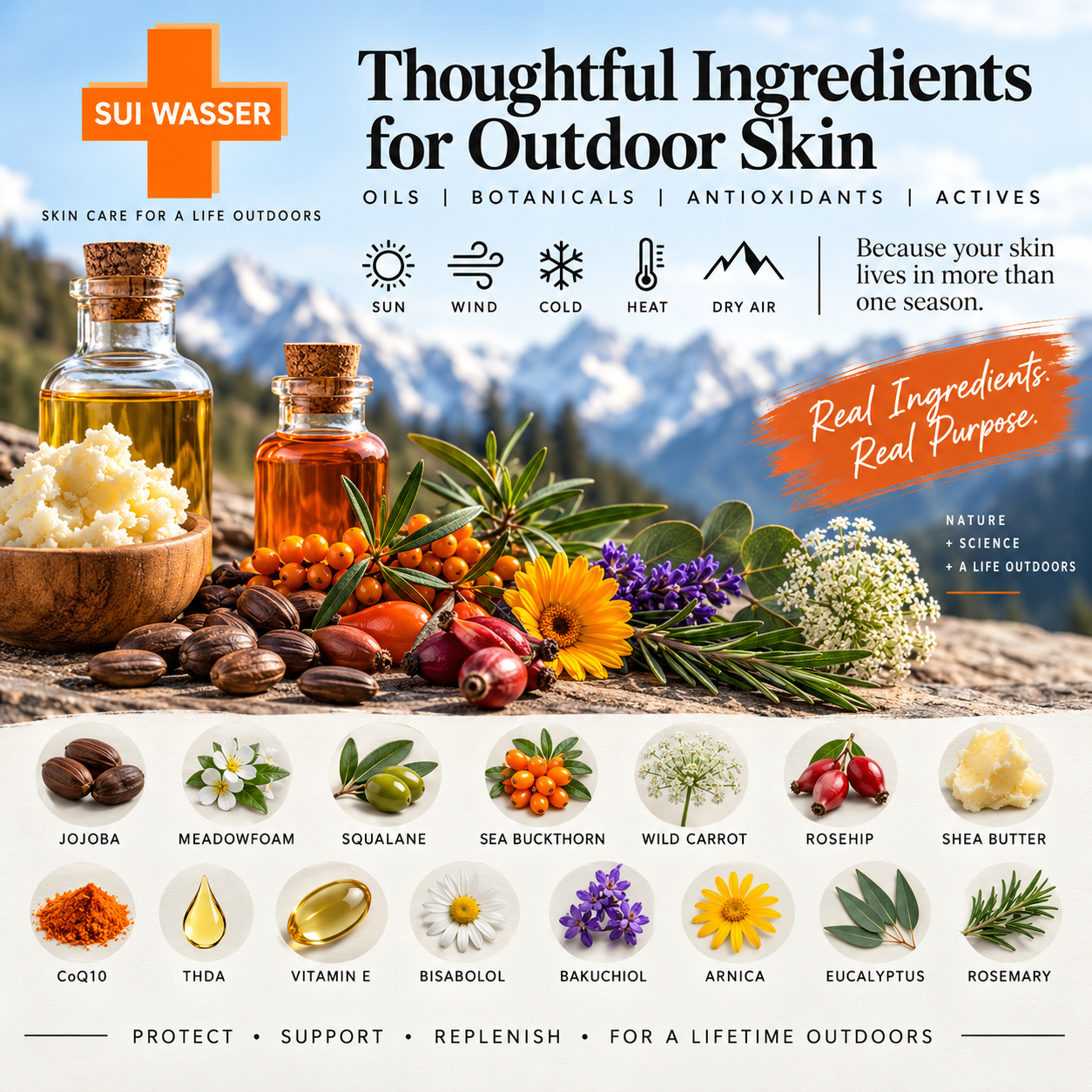
Here are some of the ingredients I keep coming back to—and why.
Jojoba: The “Oil” That Isn’t Really an Oil
Jojoba is one of the foundation ingredients in many SUI WASSER balms.
Interestingly, jojoba oil isn’t technically a conventional vegetable oil. It consists primarily of long-chain liquid wax esters, giving it unusual stability and a distinctly different skin feel from many triglyceride oils.
That combination makes jojoba particularly useful in an anhydrous balm. It provides emollience and lubrication without necessarily producing the heavy, greasy character associated with some richer oils. Its oxidative stability is another major advantage when I’m building products intended to sit in a ski bag, backpack, bathroom or work truck.
Why I like it: stability, excellent skin feel and wax-ester chemistry.
Caution: Jojoba is generally considered well tolerated, but as with virtually any cosmetic ingredient, individual sensitivity is possible.
Meadowfoam Seed Oil: Remarkably Stable by Nature
Meadowfoam is another ingredient that earns its place through chemistry rather than marketing. Its fatty-acid composition is unusual, containing high proportions of very-long-chain fatty acids. This contributes to its exceptional oxidative stability. That’s especially valuable in formulations containing more oxidation-prone botanical oils. Meadowfoam can help us build a richer botanical oil system without relying exclusively on less-stable oils. It also produces a smooth, substantive skin feel that works particularly well in balms.
Why I like it: exceptional oxidative stability, long-lasting emollience and excellent sensory characteristics.
Caution: Meadowfoam doesn’t magically prevent the oxidation of every other ingredient in a formula. Good raw-material handling, antioxidants, packaging and storage still matter.
Squalane: Inspired by the Skin’s Own Lipids
Squalane is one of our favorite ingredients for improving the feel of a balm. It’s the stable, hydrogenated form of squalene, a lipid that naturally occurs in human sebum. Cosmetic squalane is commonly derived from plant sources such as sugarcane or olives. It is lightweight, highly spreadable and can soften a formulation without making it feel excessively oily. For SUI WASSER, that’s particularly valuable. I want a balm to remain on the skin, but I don’t necessarily want it to feel like it’s sitting there.
Why I like it: lightweight emollience, spreadability and its relationship to naturally occurring skin lipids.
Caution: “Skin-identical” shouldn’t be interpreted to mean biologically identical to the skin’s entire lipid barrier. Squalane is one component within a much more complicated system.
Sea Buckthorn Berry Oil: The Brilliant Orange Oil
You can usually recognize Sea Buckthorn Berry Oil before reading the ingredient list. It’s intensely orange-red. That color comes largely from its naturally occurring carotenoids. Sea buckthorn berry oil also contains tocopherols and a distinctive fatty-acid profile, including palmitoleic acid. For us, that’s what makes it interesting: it’s an unusually concentrated botanical oil that brings several classes of naturally occurring lipid-soluble compounds into a formulation. It doesn’t take much to make its presence known.
Why I like it: carotenoids, tocopherols, distinctive fatty acids and antioxidant-rich botanical chemistry.
Caution: Its intense pigmentation can stain clothing and dramatically change a balm’s color. More isn’t necessarily better.
Wild Carrot Seed Oil / Queen Anne’s Lace
Wild carrot—Daucus carota—is another botanical we’ve incorporated into our oil systems. Carrot-derived ingredients can contain carotenoids and other lipid-soluble plant compounds, depending heavily upon how the particular ingredient was produced. And that’s an important distinction. Wild carrot infused/fixed-oil preparations and carrot seed essential oil are not interchangeable ingredients. Essential oils are concentrated volatile materials with very different chemistry and safety considerations.
Why I like it: an interesting botanical complement to our carotenoid-rich oil system.
Caution: Always identify exactly which carrot-derived ingredient is being used. “Carrot oil,” “carrot seed oil,” essential oil and infused oil can mean very different things.
Rosehip Seed Oil: A Beautiful Oil With a Trade-Off
Rosehip Seed Oil is particularly rich in unsaturated fatty acids, commonly including linoleic and alpha-linolenic acids. Those fatty acids make rosehip interesting for skincare—but they also illustrate an important formulation principle: Some of the most interesting botanical oils are also among the more oxidation-sensitive.
That’s one reason I don’t evaluate oils independently. I consider how they work as part of a complete oil system alongside more stable ingredients such as jojoba, meadowfoam and antioxidants such as Vitamin E.
Why I like it: an interesting essential-fatty-acid profile and excellent sensory potential.
Caution: comparatively oxidation-sensitive. Fresh raw material, appropriate storage and formulation strategy matter.
Shea Butter: Structure, Cushion & Staying Power
Shea Butter occupies an interesting middle ground between skincare ingredient and formulation tool. Its triglycerides and unsaponifiable fraction contribute emollience, while its physical consistency gives a balm body, cushion and persistence. We’ve found firsthand that changing the relationship between waxes, liquid oils and butters can dramatically alter how a balm behaves. Shea isn’t simply something I add because “shea butter is moisturizing.” It’s part of the physical architecture of the product.
Why I like it: richness, cushion, emollience and the ability to change the character of a balm.
Caution: Shea can crystallize or become grainy when its heating and cooling history isn’t controlled. Processing matters.
The Antioxidants & Specialized Actives
CoQ10: A Lipid-Soluble Antioxidant
Coenzyme Q10 occurs naturally in the body and participates in cellular energy processes. It also functions as an antioxidant. Its lipid solubility makes it particularly interesting to us because SUI WASSER primarily works with oil-rich, water-free balm systems. Rather than forcing a water-soluble ingredient into an incompatible formulation, CoQ10 naturally fits the type of products I’m building.
Why I like it: antioxidant chemistry and compatibility with anhydrous formulations.
Caution: CoQ10 is potent enough to visibly color a formulation, and claims about reversing aging or repairing skin can quickly exceed what the evidence—or cosmetic regulations—supports.
THDA: Why I Use an Oil-Soluble Vitamin C Derivative
Tetrahexyldecyl Ascorbate—THDA—is an oil-soluble derivative of Vitamin C. That’s important because conventional L-ascorbic acid is water soluble and notoriously challenging to stabilize. THDA allows us to incorporate a Vitamin C derivative directly into an oil-based system without introducing a water phase simply for the sake of adding Vitamin C.
Why I like it: oil solubility, formulation compatibility and antioxidant/skin-conditioning potential.
Caution: THDA isn’t chemically identical to L-ascorbic acid. Claims made for conventional Vitamin C shouldn’t automatically be transferred to every Vitamin C derivative.
Vitamin E: Helping the Skin—and the Formula
Vitamin E, particularly tocopherol, is another lipid-soluble antioxidant. It has value as a skin-conditioning ingredient, but it also plays an important formulation role by helping slow oxidation within an oil system. That makes Vitamin E particularly logical in formulas containing delicate botanical oils.
Why I like it: antioxidant activity, oil compatibility and formulation support.
Caution: Vitamin E isn’t a complete preservative system and doesn’t make an oil indefinitely stable. At higher concentrations it can also affect feel and occasionally cause sensitivity.
Bisabolol: More Than a Chamomile Story
Bisabolol is a naturally occurring constituent associated particularly with chamomile, although cosmetic bisabolol can come from other sources or be manufactured.
It’s used extensively in skincare for its soothing properties and is especially interesting when designing products for skin that may already feel dry or uncomfortable after environmental exposure.
Why I like it: concentrated soothing functionality without requiring large quantities of botanical material.
Caution: Botanical origin doesn’t eliminate the possibility of sensitivity, and source and purity matter.
Bakuchiol: Not Simply “Natural Retinol”
Bakuchiol is frequently marketed as a natural alternative to retinol. That’s useful shorthand—but chemically, the two are quite different. Bakuchiol is a plant-derived compound that has attracted substantial skincare interest because research suggests some overlapping cosmetic effects with retinoids while potentially offering better tolerability for some users. For outdoor skincare, that distinction interests us because irritated, wind-exposed or sun-stressed skin may not tolerate aggressive skincare particularly well.
Why I like it: an oil-compatible active with interesting evidence surrounding skin appearance and signs of photoaging.
Caution: Bakuchiol isn’t retinol, shouldn’t be described as though it works identically, and can still cause irritation in some people.
The Recovery Botanicals
Arnica: A Long History of Topical Use
Arnica has an extensive history of topical use in products intended for bruised, sore or overworked areas. That’s one reason it appears in our recovery-oriented formulations. Rather than treating that history as proof of every claim made about Arnica, I’m interested in the plant’s chemistry and the body of research surrounding topical preparations.
Why I like it: long-established topical use and its relevance to recovery-oriented formulations.
Caution: Arnica should generally not be applied to broken skin, and some people develop contact dermatitis or other reactions. Concentration and extract type matter.
Eucalyptus: Cooling, Aromatic and Functional
Eucalyptus provides much more than fragrance. Eucalyptus essential oil contains high concentrations of 1,8-cineole (eucalyptol), depending upon species and grade. That gives it its characteristic aroma and contributes to the cooling, refreshing sensory character people associate with many topical recovery products. I use it where that sensory effect makes sense—not simply to make every product smell botanical.
Why I like it: distinctive sensory profile and established use in topical formulations.
Caution: Essential oils are concentrated ingredients. Eucalyptus can irritate sensitive skin, shouldn’t be swallowed, and requires careful concentration control.
Rosemary: An Interesting Botanical With Multiple Roles
Rosemary is another plant with a long history in topical preparations. But “rosemary” can describe very different cosmetic ingredients: rosemary essential oil, extracts and antioxidant preparations aren’t chemically equivalent. Rosemary contains a number of interesting compounds, including carnosic acid, carnosol and rosmarinic acid, although their concentrations depend strongly on the particular extract. In recovery-oriented products, rosemary also complements ingredients such as Arnica and Eucalyptus extremely well from a sensory standpoint.
Why I like it: interesting antioxidant botanical chemistry, traditional topical use and compatibility with recovery formulations.
Caution: Rosemary essential oil and rosemary antioxidant extract should not be treated as interchangeable. Essential-oil concentration and skin sensitivity must be considered.
Why Use So Many Different Oils?
This may be the most important point. I’m not trying to find one “miracle oil.” Different lipids bring different characteristics. Jojoba gives us wax esters and stability. Meadowfoam contributes remarkable oxidative resistance. Squalane provides lightweight slip. Rosehip contributes highly unsaturated fatty acids. Sea Buckthorn brings carotenoids and distinctive fatty acids. Shea contributes richness and physical structure. Then ingredients such as CoQ10, THDA, Vitamin E, Bisabolol and Bakuchiol allow us to layer additional functionality into that lipid foundation.
Arnica, Eucalyptus and Rosemary take us in another direction—toward products intended for the broader post-activity and recovery side of the SUI WASSER system.
That’s the formulation philosophy I’m developing:
Don’t add an ingredient because its name looks good on the label. Give every ingredient a reason to be there.
For people who spend a significant portion of their lives outdoors, I believe skincare should be approached as a system: protect before exposure, support skin afterward, replenish what the environment takes away, and care for it consistently over a lifetime.
